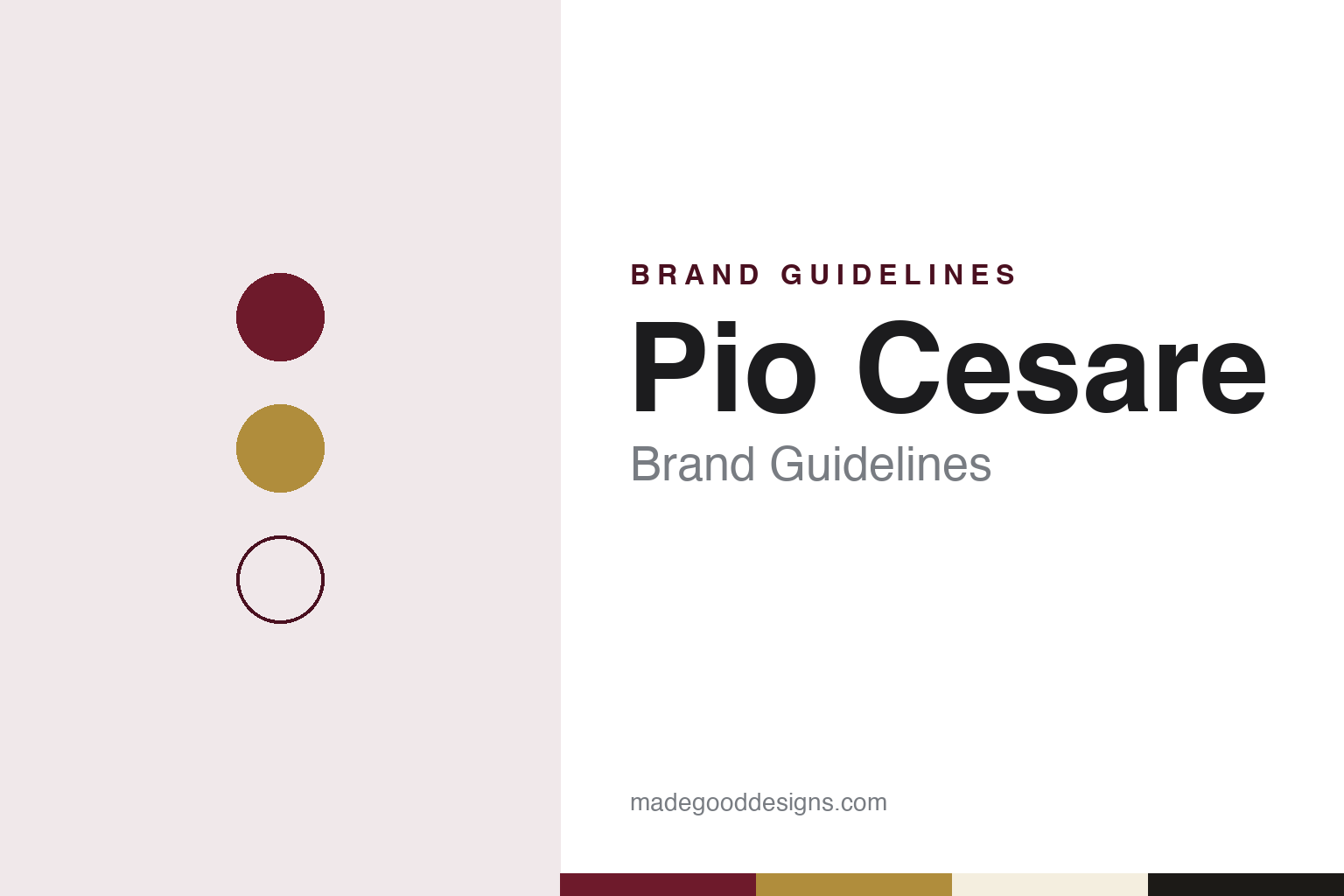
Pio Cesare Brand Guidelines
A Barolo house inside Alba’s old town, since 1881.
Aa
Two constants: a Barolo garnet, crest gold and label cream palette and a classical book serif register. Abstract homage — not a Pio Cesare product or mark; no label, crest or bottle is reproduced.
Five generations in Alba
From a merchant’s cellar to an estate winery.
Pio Cesare is a family wine house in Alba, the town at the centre of Piedmont’s Langhe hills, and it dates its beginnings to 1881. The founder was Cesare Pio; the house name sets his two names the other way round. Wine Spectator reported in April 2021 that Cesare Pio founded the winery that year in an old Alba cellar. The company describes him as a successful entrepreneur who began by making a small, select quantity of wine from the hills of Barolo and Barbaresco for his family, friends and customers, and says that in the early 20th century he travelled around Europe to promote his wines and his region. A copy of his passport, which the company says was number 55 and one of the first issued in Italy, is on display at the cellar.
The house has passed down the family through marriage as well as by birth. The company says Cesare’s son Giuseppe Pio took over at the turn of the century and invested in the cellar and in sales. In 1940, it says, Giuseppe Pio’s only daughter, Rosy Pio, married Giuseppe Boffa, an engineer from Alba who gave up his profession to work full-time at the winery. Their youngest son was named Pio, after his great-grandfather’s surname, and as Pio Boffa he became the fourth generation to lead the house.
Pio Boffa shaped the modern winery. Wine Spectator reported that after high school he worked in the cellars of the Robert Mondavi Winery in Napa, began studying business administration in the 1970s, and soon returned home to learn the trade from his father. Over four decades, the magazine wrote, he turned Pio Cesare from a négociant, which bought in grapes, into an estate winery working only its own vineyards in Barolo and Barbaresco, and since 2014 it has made only estate wines. Gambero Rosso reported in April 2021 that his early work abroad began with delivering samples to sommeliers in the United States. In a tribute published by the Académie du Vin Library in January 2022, the Barbaresco producer Angelo Gaja called him a tireless ambassador for Barolo and Barbaresco around the world, and wrote that he insisted on a blended Barolo that did not suffer from the selection made for single-vineyard wines.
Pio Boffa died in April 2021, Wine Spectator, Decanter and Gambero Rosso reported, a few days before the house marked its 140th anniversary. The fifth generation now runs it: his daughter Federica Boffa and his nephew Cesare Benvenuto, who the Italian wine news site WineNews reported in April 2021 had worked at the company since 2000. The company says they lead it with the support of their cousin Augusto.
Colour
The arms of Alba, and a name customers gave the wine.
The label is the most constant part of the brand. WineNews reported in April 2021 that the Pio Cesare labels were designed by the founder and carry the coat of arms of Alba. The company says it is the only producer authorised to use the town’s crest on its wine labels.
The wines’ names also came partly from the people who drank them. From the 2021 releases, WineNews reported, the labels began to carry the names Barolo “Pio” and Barbaresco “Pio”, the names customers had used for the two wines since the 1960s. The company lists the two wines among its classics.
Single-vineyard wines came later and sit alongside them. Wine Spectator reported that Giuseppe Boffa bought the family’s first vineyards in the Ornato cru at Serralunga d’Alba and the Il Bricco cru in the Barbaresco zone, and that Pio Boffa released the first Ornato Barolo with the 1985 vintage and the first Il Bricco Barbaresco with the 1990 vintage. The magazine added that he persuaded his father to let him replant part of Il Bricco with Chardonnay, which became the Langhe white Piodilei. The company’s current range also lists a Barolo from the Mosconi vineyard, a Timorasso called Derthona from the Colli Tortonesi, and a Vermouth di Torino and Barolo Chinato under the heading “Revival.”
Anniversaries have been marked on the bottle itself. For the 140th anniversary in 2021, WineNews reported, the labels and capsules carried the dates 1881–2021; a Barolo from the family’s Serralunga d’Alba vineyards was released in 1,881 numbered bottles, and a Barolo Riserva 2000 came in 500 numbered bottles with a label reproducing the key to the family’s cellar library.
Typography
Design and documentation.
The seven brands in this group are all Italian wine houses and labels: Gaja, Sassicaia, Ornellaia, Tignanello, Allegrini, Zenato and Pio Cesare. Wine houses and labels in general sit at many different points in the trade, from family houses that still carry a founder’s name to labels that belong to a larger wine group or estate, and a single name can be sold everywhere from a wine shop to a restaurant list.
A wine brand’s identity is usually carried less by a single bottle than by a label, a name and the place it promises, because the company behind the name may have changed hands, bought new vineyards or grown far beyond the place where it started. That makes the questions behind each name worth asking plainly: who started it, who owns it now, and where its wine is actually made and bottled.
Each guide separates what independent sources record from what the company says about itself — its founding story, its owners over time, where its wine is made and how its labels have changed — and marks plainly what rests only on the company’s own word.
Aa
A classical book serif for a label that carries a town’s coat of arms. (Specimen set in Cormorant Garamond, a serif STAND-IN; NOT the Pio Cesare logo.)
Pio Cesare
Where the wine is made, and who owns it.
The company says it is one of the few wineries still working in the heart of Alba. The cellar is in the historic centre of Alba, and WineNews reported in 2021 that its foundations rest on the town’s ancient Roman walls. The company says the cellar is built on the walls of the Roman town of Alba Pompeia, runs through four underground levels, has been renovated and expanded several times within the old town, and is where all its wines are produced.
Since 2014, Wine Spectator reported, the wines have come only from the family’s own vineyards. WineNews reported in 2021 that the family had bought about 75 hectares gradually from the 1970s, in Barolo and Barbaresco communes including Serralunga d’Alba, Grinzane Cavour, La Morra, Novello, Monforte d’Alba, Treiso and San Rocco Seno d’Elvio, with Ornato, La Briccolina, La Serra and Lirano among its Serralunga holdings. The company now gives a figure of about 80 hectares, with newer holdings in the Alta Langa and the Colli Tortonesi.
Ownership has stayed in the family since 1881. The company’s legal name is Pio Cesare Società Semplice Agricola, based in Alba, and in 2021 Wine Spectator and WineNews both described the handover to Federica Boffa and Cesare Benvenuto as the move to the fifth generation. The official website is piocesare.it.
For a design guide, Pio Cesare shows how a founder’s label, a town’s coat of arms and a cellar inside the old town walls can carry a family wine house through five generations without changing its name or its home. Compare Gaja, the Barbaresco house whose head paid tribute to Pio Boffa, and Antinori, the Florentine wine family. For this guide we use Barolo garnet, crest gold and label cream with a serif, an unofficial interpretation; no product or logo is reproduced.
Explore & save
Keep Pio Cesare’s identity on hand — save it to a board in the Made Good inspiration library.
Pio Cesare identity set
Pin the Pio Cesare Barolo garnet, crest gold and label cream palette and the classical book serif register to your own board.