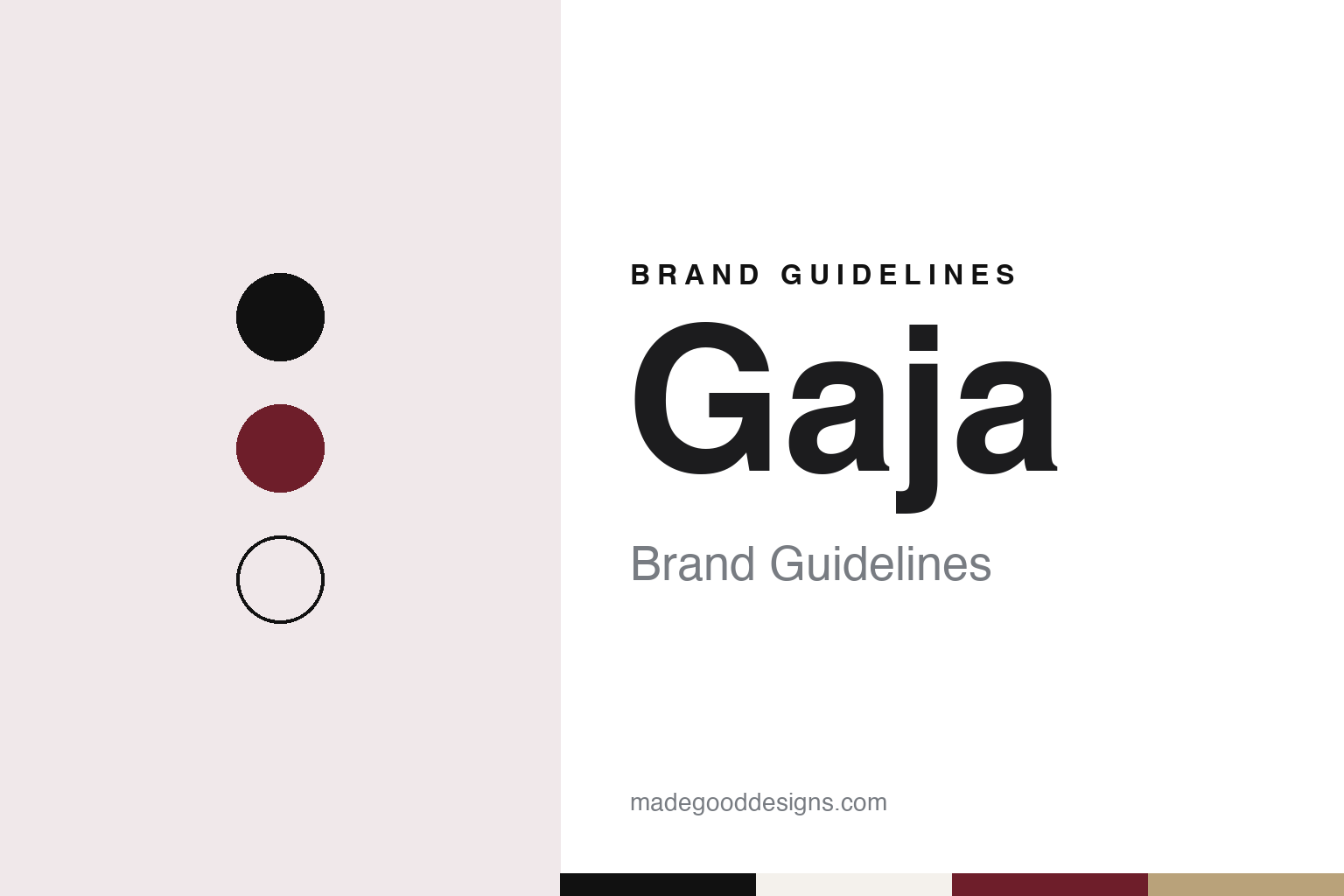
Gaja Brand Guidelines
The Barbaresco family house founded in 1859.
Aa
Two constants: a black, white and garnet palette and a heavy grotesque sans register. Abstract homage — not a Gaja product or mark; no bottle, label or logo is reproduced.
Barbaresco, 1859
A tavern family on a Langhe hilltop.
Gaja is a family wine house in Barbaresco, the village in the Langhe hills of Piedmont, in north-west Italy. English Wikipedia dates it to 1859, when Giovanni Gaja founded the business; the family, it says, had arrived from Spain in the 17th century and opened a tavern in Barbaresco, serving its own wine with the food. By the end of the 19th century, the same source says, Gaja wine was being bottled and supplied to the Italian army in Abyssinia. In 2009 the house marked 150 years with an exhibition at the Castello di Barbaresco, the castle it owns opposite the winery, the Indian Wine Academy reported.
The family name went on the bottle early. English Wikipedia says that in 1937 Giovanni Gaja, the founder’s grandson, first put the name Gaja in big red letters on his labels; the Indian Wine Academy report credits the practice to Angelo Gaja’s grandfather, also called Angelo, with his father Giovanni continuing it, so the sources differ on which generation began it. English Wikipedia also credits Clotilde Rey, the mother of that Giovanni, with insisting on high quality and on positioning the wine at the top of the market, and says Giovanni made a series of important vineyard purchases after the Second World War.
Angelo Gaja, the founder’s great-grandson, joined the company in 1961, having studied winemaking at Alba and at Montpellier in France and economics at the University of Turin, English Wikipedia says. In the same year, according to the Indian Wine Academy, he decided that the house would make wine only from grapes grown on the family’s own estate — a decision the report called a defining moment for the brand. English Wikipedia adds that, thanks to his family’s purchases, he was already a major vineyard owner in Barbaresco when he started.
Colour
Single vineyards, barriques and Cabernet.
Under Angelo Gaja the house changed how its Barbaresco was made and presented. English Wikipedia lists single-vineyard bottlings from Sorì San Lorenzo (1967), Sorì Tildìn (1970) and Costa Russi (1978), and says the oenologist Guido Rivella has worked with the house since 1970. It credits Gaja with introducing French barriques, temperature-controlled fermentation equipment and malolactic fermentation to Piedmont, and notes that his father opposed both the new barrels and the decision to plant French grape varieties. Sorì Tildìn takes its name from Tildìn, a nickname of Clotilde Rey, the same source says.
Those French varieties went into Gaja land. In 1978 the Darmagi vineyard in Barbaresco, a prime Nebbiolo site, was planted with Cabernet Sauvignon; in 1979 the Gaia & Rey vineyard at Treiso was planted with Chardonnay, its wine named after Angelo’s eldest daughter, Gaia, and his grandmother, Clotilde Rey; Sauvignon Blanc followed in 1983. In 1977 Angelo set up Gaja Distribuzione, which imports wines from elsewhere in the world into Italy, English Wikipedia says.
The house went back to Barolo in 1988, buying vineyard land after years in which it had stopped making the wine, and its Barolo Sperss was first released in 1992; in 1995 it added the Gromis property at La Morra, English Wikipedia says.
The best-known episode concerns the wording on the label. From the 1996 vintage the single-vineyard Barbarescos were labelled under the broader Langhe designation, which allowed other grapes — in Gaja’s case Barbera — up to 15 percent; Wine Spectator reported in July 2016 that Angelo Gaja had taken that decision in 2000 and that it shocked the industry. In the same report Gaia Gaja announced that, from the 2013 vintage, Costa Russi, Sorì Tildìn and Sorì San Lorenzo would again be labelled Barbaresco and made from 100 percent Nebbiolo. “Now is time for us to make our own choices,” the family said. English Wikipedia says Sperss returned to Barolo DOCG with the same vintage.
Typography
Italy’s icon wines.
The seven brands in this group are all Italian wine houses and labels: Gaja, Sassicaia, Ornellaia, Tignanello, Allegrini, Zenato and Pio Cesare. Wine houses and labels in general sit at many different points in the trade, from family houses that still carry a founder’s name to labels that belong to a larger wine group or estate, and a single name can be sold everywhere from a wine shop to a restaurant list.
A wine brand’s identity is usually carried less by a single bottle than by a label, a name and the place it promises, because the company behind the name may have changed hands, bought new vineyards or grown far beyond the place where it started. That makes the questions behind each name worth asking plainly: who started it, who owns it now, and where its wine is actually made and bottled.
Each guide separates what independent sources record from what the company says about itself — its founding story, its owners over time, where its wine is made and how its labels have changed — and marks plainly what rests only on the company’s own word.
Aa
A heavy grotesque sans — a name on a black band. (Specimen set in Archivo, a sans STAND-IN; NOT the Gaja logo or label lettering.)
Gaja
Montalcino, Bolgheri and Etna.
Gaja first bought outside Piedmont in 1994, acquiring Pieve Santa Restituta at Montalcino in Tuscany, where it makes Brunello di Montalcino from Sangiovese, English Wikipedia says. In 1996 it bought Ca’ Marcanda at Castagneto Carducci, in Bolgheri on the Tuscan coast, and planted vines there; the name, the same source says, is a Piedmontese phrase for “house of endless negotiations,” after the long effort it took to persuade the previous owners to sell.
Sicily came next. In April 2017 the Sicilian food and wine site Cronache di Gusto reported that Angelo Gaja and Alberto Graci had formed a company, owned half each, which had bought 21 hectares on the south-west slope of Mount Etna at Biancavilla, mostly planted with Nerello Mascalese, with a cellar still to be built. The World of Fine Wine, in July 2024, named the winery Idda, placed it at Belpasso with vineyards in Belpasso and Biancavilla, dated the land purchase to 2016 and described it as a joint venture of the Gaja and Graci families.
The house remains in family hands. English Wikipedia names Angelo Gaja as owner and president and says the day-to-day running has passed to his children, Gaia, Rossana and Giovanni Gaja, the fifth generation. It says Gaja makes its wines from vineyards in the Barbaresco and Barolo zones of Piedmont, at Montalcino and at Bolgheri, and that the Castello di Barbaresco is where it distils grappa from Nebbiolo, Chardonnay and Cabernet Sauvignon grown in its best-known vineyards.
The label is the house’s best-known graphic. In 2009 the Indian Wine Academy described it as the bold, white, four-letter family name on a black rectangular band, “more like a logo than a label,” and reported that the 150th-anniversary exhibition had commissioned nine artists to make works using the label as a prop.
For a design guide, Gaja shows how one short family name, set large, can stand for a whole house across several regions. Compare Pio Cesare, another Piedmont wine house in this series, and Antinori, the Tuscan family house. For this guide we use black, white and a Nebbiolo garnet with a heavy grotesque sans, an unofficial interpretation; no product or logo is reproduced.
Explore & save
Keep Gaja’s identity on hand — save it to a board in the Made Good inspiration library.
Gaja identity set
Pin the Gaja black, white and garnet palette and the heavy grotesque sans register to your own board.