Château Musar Brand Guidelines
The Hochar family’s Ghazir winery, founded 1930.
Aa
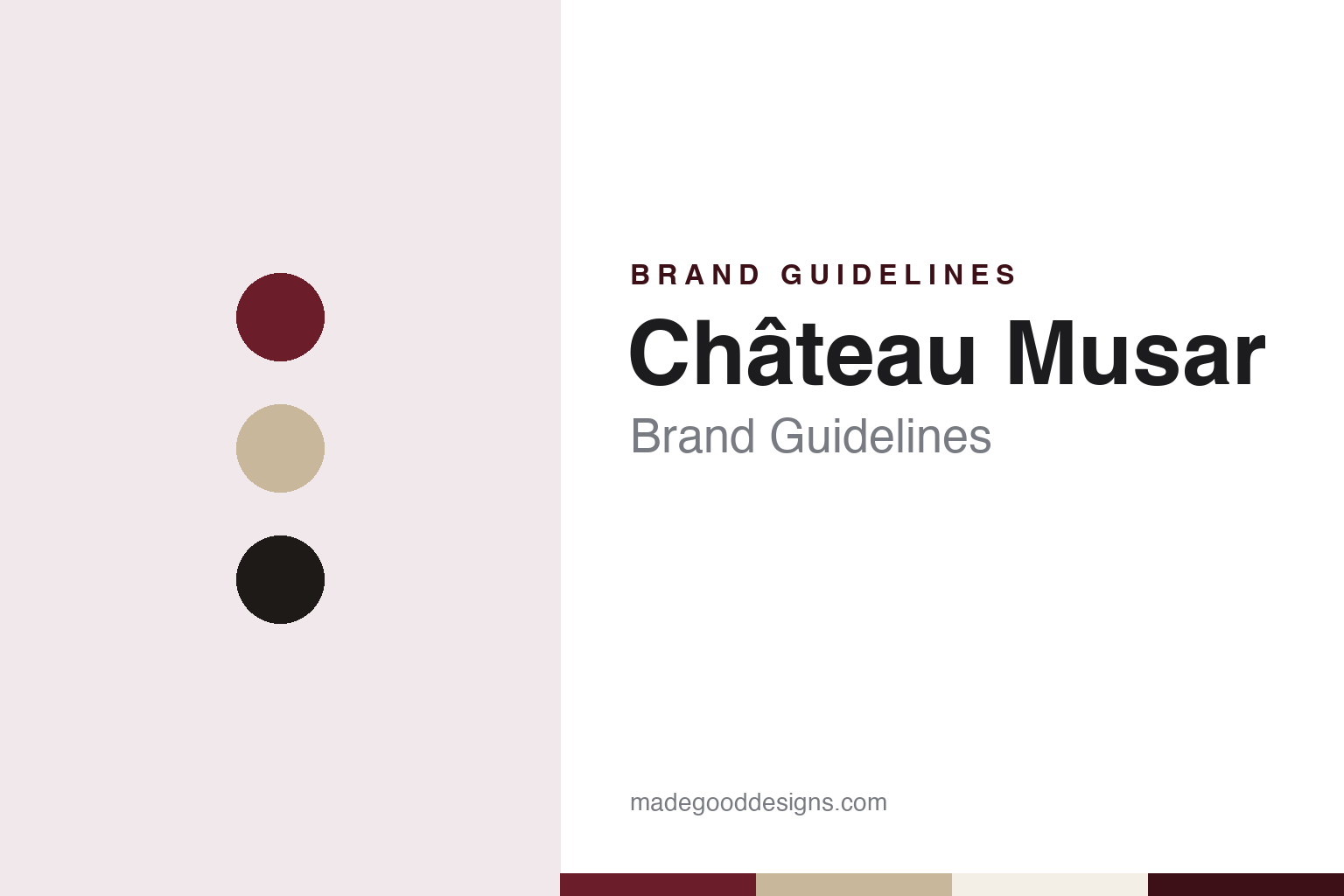
Two constants: a Musar red, Bekaa stone and label cream palette and a classical serif register. Abstract homage — not a Château Musar product or mark; no label, logo or bottle is reproduced.
A winery in Ghazir
A Bordeaux-trained founder, a mountain cellar and vineyards across the range.
Château Musar is a family winery in Ghazir, a town about 24 kilometres north of Beirut, founded in 1930 by Gaston Hochar. English Wikipedia says he started it after returning from Bordeaux, and the wine writer Ken Gargett, in Quill & Pad in October 2022, gives the same founder and the same year. The wine is made and aged in Ghazir, in cellars that Musar’s American importer, Broadbent Selections, describes as carved into the mountainside. The grapes come from the other side of the mountains, in the Bekaa Valley, at around 1,000 metres, English Wikipedia says. Broadbent names the vineyard sites as Kefraya and Aana in the Bekaa, plus a newer site at Mehrine, and says the vineyards, farmed organically since the 1960s, received organic certification in 2006.
The early years tie the estate to Bordeaux. English Wikipedia says that in the 1930s and 1940s, under the French mandate, the winery supplied French army troops stationed locally, and that a French officer, Ronald Barton of the Bordeaux châteaux Langoa-Barton and Léoville Barton, influenced the early wines. Gaston Hochar named his second son after him.
That son, Ronald Hochar, joined in 1962 to look after marketing and finance, English Wikipedia says, and Beirut’s Daily Star still described him in that role in October 2015. The eldest son, Serge Hochar, studied oenology in Bordeaux, where English Wikipedia names Émile Peynaud among his teachers, and made his first Musar vintage in 1959. Wine Spectator, in an obituary published on 2 January 2015, says he started work at the winery in 1958 and took control of it in 1974.
Colour
Serge Hochar, the war years and a wine that waits.
Serge Hochar is the figure most associated with the name abroad. Lebanon’s civil war, which ran from 1975 to 1990, began a year after he took control, and Wine Spectator reported in 2015 that he kept the winery going, losing only the 1976 and 1984 vintages, and turned to exports, which reached three-quarters of production within two decades. English Wikipedia credits Ronald Hochar with promoting the wine abroad, and says it grew popular outside Lebanon in the late 1970s and early 1980s; it adds that at the 1979 Bristol Wine Fair, the critics Michael Broadbent and Roger Voss called the 1967 Musar the “discovery of the Fair.”
In 1984 the British magazine Decanter named Serge Hochar its first Man of the Year. The Daily Star reported the award in October 2015, quoting Decanter’s publishing director Sarah Kemp, and Gargett’s 2022 article for Quill & Pad gives the same year. Wine Spectator says Hochar was also president of the Lebanese Institut de la Vigne et du Vin.
The wines themselves follow a few fixed habits. The flagship red is a blend of Cabernet Sauvignon, Cinsault and Carignan, the Daily Star and English Wikipedia say, in proportions that change from year to year, while the white is made from two local grapes, Obaideh and Merwah. Gargett writes that the red is not released until it is about seven years old, after time in barrel, tank and bottle. Broadbent Selections describes the winemaking as non-interventionist, with natural fermentation, little sulphur and no fining or filtering, and lists a range that runs from Château Musar red, white and rosé to the Hochar Père et Fils red and the younger Musar Jeune wines, along with an arak, L’Arack de Musar. English Wikipedia notes that Musar is known for variation from bottle to bottle and from vintage to vintage, and attributes this to Serge Hochar’s approach to winemaking.
Typography
Design and documentation.
The seven brands in this group are Armenian brandy houses and Georgian, Lebanese and Israeli wineries: Ararat, Noy, Tbilvino, Teliani Valley, Château Musar, Ixsir and Golan Heights Winery. Brandy and wine brands in general sit at many different points in the trade, from family houses that still carry a founder’s name to labels that now belong to much larger drinks groups, and a single brand can be sold everywhere from a corner shop to a restaurant list.
A brandy or wine brand’s identity is usually carried less by a single bottle than by a label, a name and the place it promises, because the company behind the name may have changed hands, moved its production or grown far beyond the place where it started. That makes the questions behind each name worth asking plainly: who started it, who owns it now, and where its brandy or wine is actually made and bottled.
Each guide separates what independent sources record from what the company says about itself — its founding story, its owners over time, where its brandy or wine is made and how its labels have changed — and marks plainly what rests only on the company’s own word.
Aa
A classical serif for an old family estate name. (Specimen set in Cormorant Garamond, a serif STAND-IN; NOT the Château Musar logo.)
Château Musar
From Serge Hochar to his sons.
Serge Hochar died on 31 December 2014 while on a family holiday in Mexico, Wine Spectator reported on 2 January 2015; the magazine said he had been working at Musar with his sons Gaston and Marc, his brother Ronald and his nephew Ralph. The Daily Star wrote in October 2015 that he had gradually handed the winery’s duties to his sons in his later years, and reported on the estate’s 85th anniversary, held that month at the Palais Mzar in Ghazir.
The winery remains with the family. English Wikipedia says Serge’s sons succeeded him, with Gaston running day-to-day operations and Marc handling the commercial side, and Gargett described the same split in 2022, with Gaston on winemaking and Marc on the commercial work. Broadbent Selections adds that the brothers work with their cousin Ralph and with Tarek Sakr, the long-serving winemaker and viticulturist. The division set out by English Wikipedia and Broadbent still holds: the grapes are grown in the Bekaa Valley, and the wine is made and aged in the Ghazir cellars.
For a design guide, Château Musar shows how a family name, a place and a long ageing habit can carry a brand for nearly a century without a designer’s story attached to it. Compare it with another Lebanese wine house’s spirit, Ksarak, the arak of Château Ksara, and with a far younger Lebanese winery, Ixsir, founded in 2008. For this guide we use a deep Musar red, Bekaa stone and label cream with a classical serif, an unofficial interpretation; no product or logo is reproduced.
Explore & save
Keep Château Musar’s identity on hand — save it to a board in the Made Good inspiration library.
Château Musar identity set
Pin the Château Musar red, Bekaa stone and label cream palette and the classical serif register to your own board.