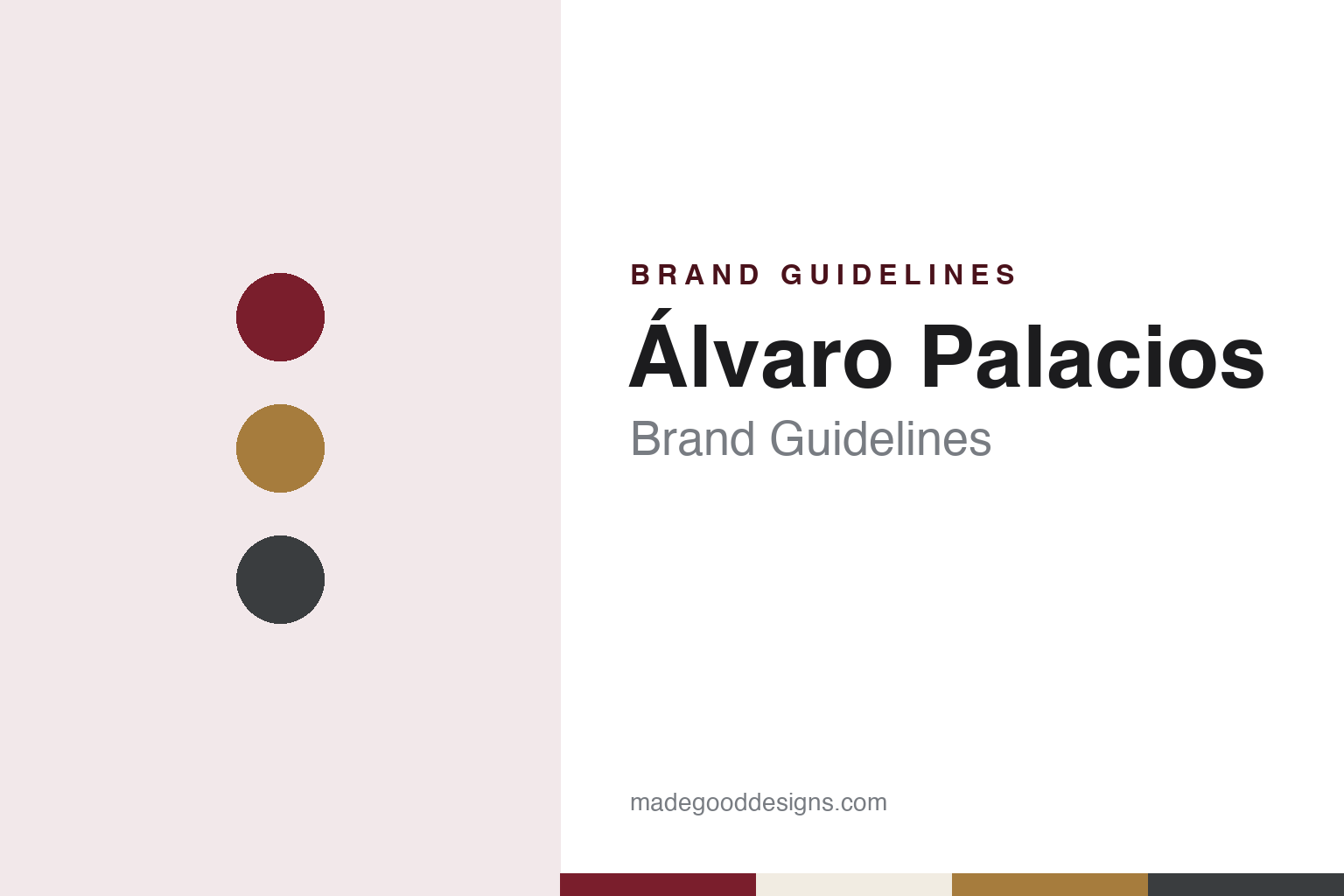
Álvaro Palacios Brand Guidelines
The Priorat winery behind L’Ermita, founded in Gratallops.
Aa
Two constants: a garnacha, schist ochre and llicorella slate palette and an old-style book serif register. Abstract homage — not an Álvaro Palacios product or mark; no label, logo or bottle is reproduced.
A Rioja son in Priorat
The seventh of nine children, a Bordeaux apprenticeship and a borrowed car.
Álvaro Palacios grew up in a Rioja wine family. Decanter, announcing its Man of the Year award for 2015, said he was born the seventh of nine children and belonged to the fifth generation of his family in the wine business, and that his father had founded Bodegas Palacios Remondo in 1948. The family winery is in Alfaro, in Rioja’s eastern sub-region, once called Rioja Baja and now Rioja Oriental. With so many siblings, the family business was no automatic inheritance, and Palacios looked elsewhere, Decanter’s Beverley Blanning wrote in a 2010 profile.
His training was French. Blanning reported that his father and an elder brother sent him to study in Bordeaux, where he found work with the Moueix family at Pétrus, and that he came home with a lasting belief in Europe’s classic wines. Back in Spain he travelled the country selling French oak barrels to winemakers, according to Decanter and the Rare Wine Co., his long-time American importer. The trips also served as a search for the place to make his own wine.
The invitation came from René Barbier, who, Blanning wrote, was then working for Palacios’ father in Rioja and asked Álvaro to join a new vineyard project in Priorat, the steep, isolated Catalan region in Tarragona, south of Barcelona. Palacios told Decanter he was looking for old vines and a place with monastic roots, and Priorat, where Carthusian monks had once tended vineyards, fitted. He said he sold his motorbike and borrowed a car from the family winery to get there. Decanter dates his arrival to 1989; the Rare Wine Co. says he settled on Priorat in 1990.
Priorat was then in decline. Decanter reported in 2016 that by 1989 its vineyard area had shrunk to about 600 hectares. Palacios was the youngest of a group Decanter has called the “Gang of Five” — with Barbier, Carles Pastrana, Josep Lluís Pérez and Daphne Glorian — who from 1989 made the first wines of the region’s revival. Escapement magazine described their “Gratallops Project,” named after the village at its centre, in which the group bought vineyards together and shared winemaking facilities until each could set up an estate of its own.
Colour
Finca Dofí, a hilltop chapel and the L’Ermita vineyard.
Palacios’ own estate grew vineyard by vineyard around Gratallops. He acquired his first, Finca Dofí, in 1990, according to Decanter and Escapement. In 1993 he bought the plot that made his name: a steep, north- and east-facing slope of Garnacha bush vines on llicorella, the region’s crumbling slate-schist soil. Decanter says it measured 1.7 hectares at the time and had been planted in 1910 and 1940; Escapement gives the planting as stages between 1900 and 1940. He named it L’Ermita after the small chapel, or hermitage, at the top of the hill. The vineyard was extended to 4.5 hectares in 1996, Decanter reported, but the newer plantings are kept out of the L’Ermita wine. It is farmed biodynamically, with horses and mules working slopes too steep for machines.
The winery itself stands on a large site overlooking Gratallops, which Blanning described in 2010 as having airy, glass-walled offices in contrast to the old village around the church tower. Palacios’ Priorat wines climb a ladder from the regional Camins del Priorat and Les Terrasses, through a village wine, Gratallops, to the single vineyards Finca Dofí and L’Ermita, Escapement explained in 2015. Palacios has also become a voice for the way the region classifies itself. Blanning reported that he had pushed within Priorat’s regulatory council to protect old terraces and to introduce a village labelling system, and in 2024 Decanter’s Sarah Jane Evans listed L’Ermita and Les Aubaguetes as Gran Vinya Classificada wines and Finca Dofí and La Baixada as Vinya Classificada, under the tiered system Palacios and his nephew helped to shape.
Garnacha is the thread through all of it. Over time he came to regard French varieties he had planted as a mistake and began replacing them with Garnatxa selected from old Priorat vines, much of it from L’Ermita, Escapement reported. Palacios told Decanter that Garnacha is “the only variety that transforms heat and aridity into such a beautiful, refreshing liquid.”
Typography
Design and documentation.
The seven brands in this group are all wine estates from Spain, New Zealand and Germany’s Mosel: Dominio de Pingus, Álvaro Palacios, CVNE, López de Heredia, Emilio Moro, Craggy Range and Markus Molitor. Wine estates in general sit at many different points in the trade, from family houses that still carry a founder’s name to names that now belong to larger groups, and a single estate can be known everywhere from a local wine shop to a restaurant list.
A wine estate’s identity is usually carried less by a single bottle than by a label, a name and the place it promises, because the company behind the name may have changed hands, bought new vineyards or grown far beyond the place where it started. That makes the questions behind each name worth asking plainly: who started it, who owns it now, and where its wine is actually made and bottled.
Each guide separates what independent sources record from what the estate says about itself — its founding story, its owners over time, where its wine is made and how its labels have changed — and marks plainly what rests only on the estate’s own word.
Aa
An old-style book serif for a winery built on old vines and old places. (Specimen set in EB Garamond, a serif STAND-IN; NOT the Álvaro Palacios logo.)
Álvaro Palacios
Bierzo with a nephew, Rioja with the family.
After Priorat came Bierzo. His nephew Ricardo Pérez had studied winemaking in Bordeaux, worked a harvest at Château Margaux and interned with the Moueix firm, the Rare Wine Co. says, and in 1998 the two agreed on a joint venture and began looking for the region’s best old Mencía vineyards. Decanter dates the start of the business to 1999. They named it Descendientes de J. Palacios after José Palacios, Álvaro’s father and Ricardo’s grandfather, and settled on the steep slate slopes around Corullón, on Bierzo’s western edge. Pérez moved to Bierzo to run the project and farms its vineyards biodynamically, the Rare Wine Co. says. In 2024 the winery celebrated 25 years of the Bierzo project, Decanter reported.
The third winery is the family’s own. Palacios Remondo in Alfaro is the largest of the three, Decanter said in 2024, and Palacios went back to run it at the turn of the century: Decanter dated his return to 1999 in 2024, while its 2010 profile said he took over as winemaker from his older brother in 2000, cut production by half and was by then based mostly in Rioja. There he has championed Garnacha in what was long the less-regarded corner of the region, and he entered his Quiñón de Valmira in Rioja’s single-vineyard category, introduced from the 2017 vintage, Decanter reported.
The business remains a family affair. Decanter named Palacios its Man of the Year for 2015, crediting him with putting Spain on the fine wine map and transforming the fortunes of Priorat and Bierzo. Its 2024 profile described a company run as a personal business, with no sales team, in which Palacios, Ricardo Pérez and, more recently, his daughter Lola make and present the wines themselves. The three wineries carry different names — Álvaro Palacios in Priorat, Descendientes de J. Palacios in Bierzo and Palacios Remondo in Rioja.
For a design guide, Álvaro Palacios shows how a personal name, a chapel on a hill and a ladder of place names from region to village to single vineyard can organise a family of wines across three regions. Compare Torres, the Penedès wine family founded in 1870, and Muga, the Haro family winery in Rioja. For this guide we use garnacha, schist ochre and llicorella slate with an old-style serif, an unofficial interpretation; no product or logo is reproduced.
Explore & save
Keep Álvaro Palacios’s identity on hand — save it to a board in the Made Good inspiration library.
Álvaro Palacios identity set
Pin the Álvaro Palacios garnacha, schist ochre and llicorella slate palette and the old-style book serif register to your own board.