Jacques Selosse Brand Guidelines
The Avize grower behind the Substance solera.
Aa
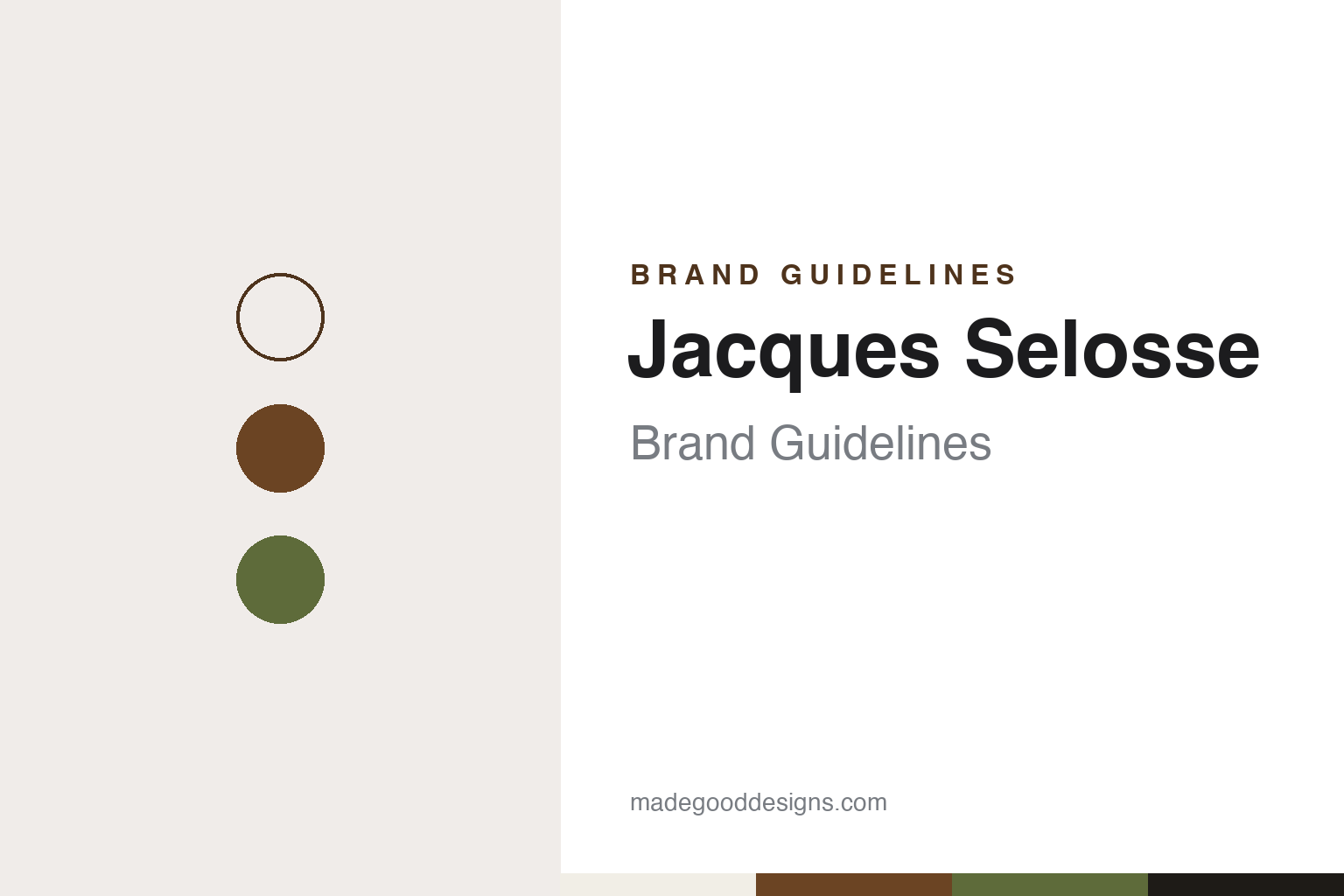
Two constants: an Avize chalk, barrel oak and vine green palette and an old-style book serif register. Abstract homage — not a Jacques Selosse product or mark; no label, logo or bottle is reproduced.
A family estate in Avize
From grapes sold to merchants to a family label of its own.
Jacques Selosse is not a merchant house but a grower: a family estate that makes Champagne from its own vineyards, based in Avize on the Côte des Blancs. French Wikipedia says Jacques Selosse settled in Avize in 1947 and founded the estate with his wife in 1949, and that for its first decade it sold its grapes to the négociants, the large houses that buy fruit from growers. The domaine’s own site and Wine Spectator, in a profile by Robert Camuto published in October 2024, both date the family’s first own Champagnes to 1964.
The name on the label stayed the founder’s, but the reputation was built by his son. Anselme Selosse studied biology and oenology in Beaune, in Burgundy, Wine Spectator says, and the domaine says he arrived at the family estate about ten years after that first vintage; French Wikipedia places his first harvest there in 1974. He took over the estate in 1980, with his wife Corinne, according to French Wikipedia and Wine Spectator. In its early years under Anselme, Wine Spectator says, the family worked about 10 acres of grand cru vines in Avize, Cramant and Oger.
Travel shaped the wines. Wine Spectator reports that in Jerez, in southern Spain, Anselme was struck by the solera, the system of fractional ageing used for Sherry, in which younger wine is added to a reserve that is never fully emptied. French Wikipedia says he has used the technique since 1986 for the cuvée Substance, a blanc de blancs from Avize, and says the reserve holds wine from every vintage since then.
The cellar work is part of the identity too. English Wikipedia notes that the estate ferments its wines in oak barrels, where most Champagne producers use stainless steel, and that Anselme was among the first to bring white Burgundy winemaking methods to Champagne. Wine Spectator wrote in 2024 that the style has since become fairly common in Champagne, but that it took years for it, and for Selosse, to become famous.
Colour
A founder’s name, a son’s methods and a grandson’s hand.
The estate is small by the standards of the big houses. The domaine says it farms 8.3 hectares in 54 parcels, of which 7.3 hectares are Chardonnay and one hectare Pinot Noir, with its oldest vines dating to 1922. Its villages are Avize, Cramant, Oger and Le Mesnil-sur-Oger on the Côte des Blancs, and Aÿ, Mareuil-sur-Aÿ and Ambonnay for its Pinot Noir.
The way those vines are farmed has changed over time, and the domaine is precise about it. It says it applied organic principles from 1990 to 1996, then biodynamics from 1996, before stepping away from biodynamics from 2002; today, the domaine says, the family follows its own system of cultivation rather than any set recipe.
The range is built around a few names. French Wikipedia describes Initial as the main cuvée, a blend of three years; Version Originale as a version without added sugar; and Substance as the solera wine. In 2010 the domaine introduced its Lieux-Dits, six single-parcel cuvées from six villages, each named after its plot, among them Les Carelles in Le Mesnil-sur-Oger and Sous le Mont in Mareuil-sur-Aÿ.
The next generation is already in charge. The Rare Wine Co. says Guillaume Selosse, Anselme’s son, has made Champagne under his own name since 2009, and that Anselme decided in 2018 to retire and hand the domaine to him. French Wikipedia gives a different sequence: shared management from 2011 and a formal handover in 2020. The domaine itself says Guillaume has been following in his father’s footsteps since 2012. In Wine Spectator’s 2024 profile, Anselme says he does not intervene unless Guillaume asks.
Typography
Design and documentation.
The seven brands in this group are all Champagne names: Louis Roederer, Salon, Jacques Selosse, Deutz, Philipponnat, Drappier and Jacquesson. Champagne houses and growers in general sit at many different points in the trade, from family houses that still carry a founder’s name to grower estates that make wine from their own vines and houses that now belong to much larger wine or drinks groups, and a single name can be sold everywhere from a wine shop to a restaurant list.
A Champagne brand’s identity is usually carried less by a single bottle than by a label, a name and the place it promises, because the company behind the name may have changed hands, changed its vineyards or grown far beyond the cellar where it started. That makes the questions behind each name worth asking plainly: who started it, who owns it now, and where its wine is actually made and bottled.
Each guide separates what independent sources record from what the company says about itself — its founding story, its owners over time, where its wine is made and how its labels have changed — and marks plainly what rests only on the company’s own word.
Aa
An old-style book serif for a family name on a grower’s label. (Specimen set in EB Garamond, a serif STAND-IN; NOT the Jacques Selosse logo.)
Jacques Selosse
A hotel in an old Champagne house, and a name to search with care.
The estate has a public face in Avize itself. The domaine says that Anselme, needing space to age wine, became interested in the empty cellars of the former Bricout-Delbeck house, which it says was founded in Avize in 1966 and closed in 2003. The house above them, the domaine says, was built by Charles Koch, who settled in Avize in 1820 and founded a Champagne house there. Corinne and Anselme Selosse opened it as Les Avisés, a ten-room hotel and restaurant, in 2011; the restaurant is run by the chef Stéphane Rossillon and his wife, Nathalie. Wine Spectator reported in 2024 that visitors to the domaine must book a stay at the hotel, and that guests can tour the cellars and taste with Anselme twice a week.
The name needs a little care when searching. French Wikipedia’s page called “Jacques Selosse” is about a French psychologist of the same name; the Champagne estate has its own article, and the domaine and hotel share the website selosse-lesavises.com.
For a design guide, Jacques Selosse shows how a grower’s identity can rest on a founder’s name, a village and a method rather than on a large house’s heritage, with a son and then a grandson keeping that name on the label. Compare Salon, the house from Le Mesnil-sur-Oger on the Côte des Blancs, and Krug, the Reims house built on a founder’s notebook. For this guide we use Avize chalk, barrel oak and vine green with a book serif, an unofficial interpretation; no product or logo is reproduced.
Explore & save
Keep Jacques Selosse’s identity on hand — save it to a board in the Made Good inspiration library.
Jacques Selosse identity set
Pin the Jacques Selosse Avize chalk, barrel oak and vine green palette and the old-style book serif register to your own board.