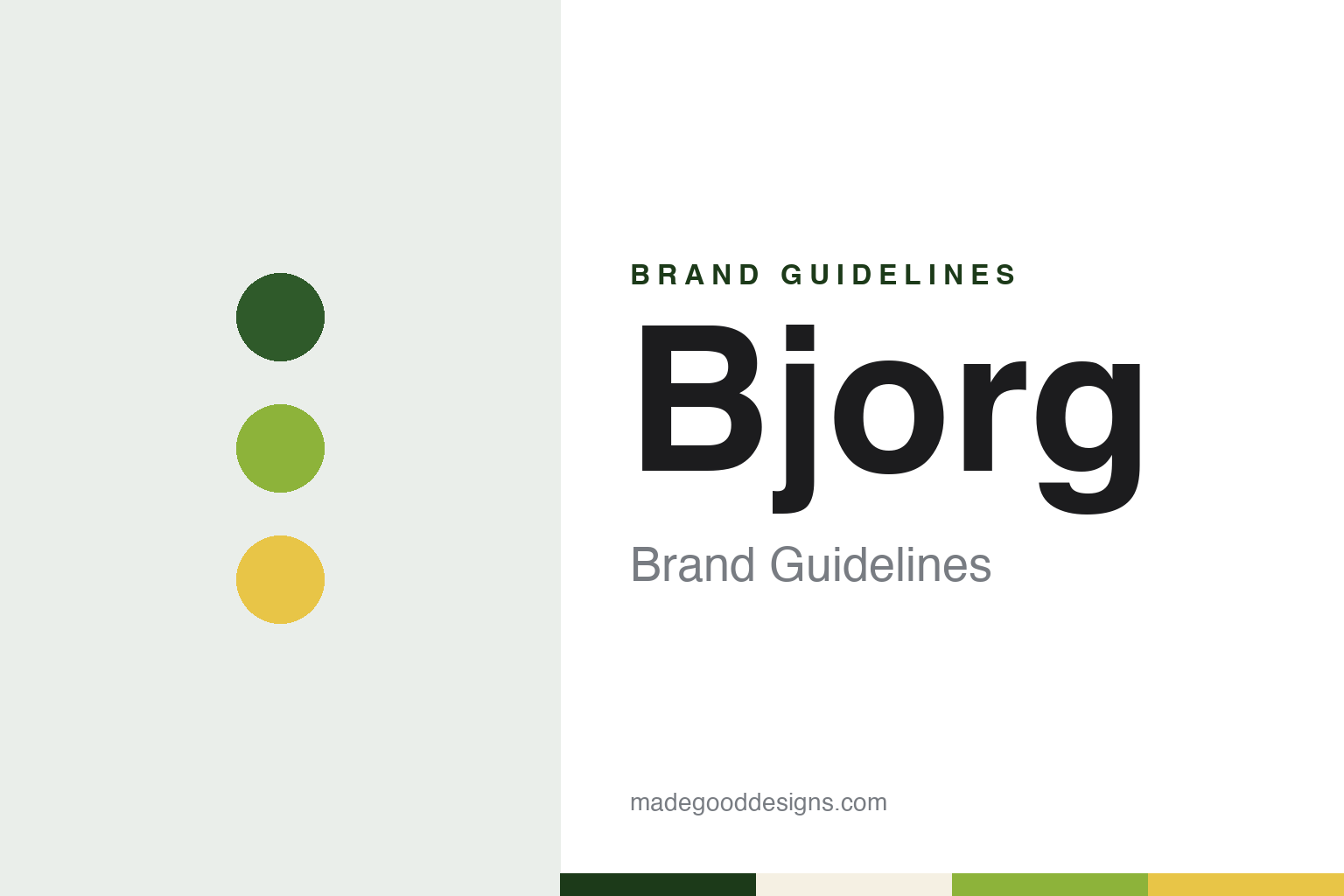
Bjorg Brand Guidelines
The Lyon organic brand with a borrowed “j”.
Aa
Two constants: a deep leaf, sprout green and grain gold palette and a clean geometric sans register. Abstract homage — not a Bjorg product or mark; no pack, logo or product is reproduced.
Distriborg
A Lyon distributor, a dietetic shelf and a name with an extra letter.
Bjorg sounds Scandinavian, but it comes from the edge of Lyon. The company behind it began in 1970, when Régis Pelen set up Distriborg in Saint-Genis-Laval, a town just south-west of the city, the regional daily Le Progrès reported in 2016. The paper said the name was simply a contraction of “distribution organisation,” and that the young firm distributed a number of brands, notably in the dietetic-food aisle. French Wikipedia, citing Les Echos, describes the same arc: a business built first on distribution that later grew by creating its own brands and products. The weekly Lyon Capitale described Pelen in 2024 as a former sales director of the Révillon chocolate company and the president of the La Vie Claire chain of organic food shops.
The brand itself dates from 1988. That year, Le Progrès wrote, Pelen decided to found a brand of his own. He wanted to call it Borg, but the name was already taken, so he added a j, and Bjorg was born. The paper said the name’s echo of the word “bio” and its Scandinavian ring helped give the brand a positive image. The company’s own account is a little different: Bjorg says it is a French brand from Saint-Genis-Laval “created in 1988 by a nutritionist,” without naming that person.
What Bjorg claims for 1988 is its route to market. The company says it set out to make organic food available to as many people as possible by selling it in ordinary French supermarkets, and that it was the first organic brand to appear there. French Wikipedia, citing Lyon Capitale, gives the same description of Bjorg as the first organic brand in French mass retail. Distriborg kept adding names around it, according to Lyon Capitale as cited by French Wikipedia: Evernat in 1995, Bonneterre in 1996 and the dietetic brand Gayelord Hauser in 1999. Bonneterre was the older business. Le Progrès said Robert Bonneterre had founded his eponymous brand at Rungis, south of Paris, in 1963, and had become a wholesaler to specialist organic shops before Distriborg bought it.
Colour
Soya drinks, a palm-oil pledge and a certification.
Bjorg’s range today covers plant-based drinks, breakfast cereals, biscuits and meat alternatives, according to its parent company, which calls Bjorg the leader and pioneer of the organic market in France. The company dates its plant-drink business to 1992, when, it says, Bjorg was the first to introduce French shoppers to a soya drink; it says the range has since grown to include almond, oat, rice and coconut drinks.
Several of the brand’s more recent milestones are promises about what goes into the packet. Bjorg says it began a large project in 2012 to remove palm oil from its recipes, and that since 2019 all of its products have been palm-oil-free. In 2017, it says, it became the first French agri-food company to be certified as a B Corp, the certification run by the non-profit B Lab that assesses a company’s social and environmental practices; the company also set up a foundation under the Bjorg, Bonneterre et Citoyens name. From 2020, Bjorg says, it has shown the Planet-score, an environmental rating for food, on its products, and that year it launched a range for children called Les P’tits Curieux.
The question of where Bjorg food is made has a split answer, all of it from the company. On its consumer website Bjorg says about a third of its products are made in France, that 99% are made in France and neighbouring countries, and that close to 30% come from the group’s own workshops, giving plant drinks in Italy and mueslis, granolas and vegetable terrines in Germany as examples. Ecotone’s list of its own workshops names three that make Bjorg products: Badia Polesine, in north-east Italy, for plant drinks; Drebber, in Lower Saxony, for breakfast cereals and cereal bars; and Freiburg, in Germany, for sweet and savoury spreads.
Typography
Design and documentation.
The seven brands in this group all make food, and all of them come from France: Herta, Fleury Michon, Banania, Tipiak, Cassegrain, Saupiquet and Bjorg. French food brands in general sit at many different points in the trade, from family firms that still carry a founder’s surname to names that now belong to much larger food groups, and a single brand can be sold everywhere from a village grocer to a hypermarket shelf.
A food brand’s identity is usually carried less by a single product than by a pack, a name and the meal or snack it promises, because the company behind the name may have changed hands, moved its factory or grown far beyond the town where it started. That makes the questions behind each name worth asking plainly: who started it, who owns it now, and where its food is actually made and packed.
Each guide separates what independent sources record from what the company says about itself — its founding story, its owners over time, where its food is made and how its packaging has changed — and marks plainly what rests only on the company’s own word.
Aa
A clean geometric sans for a brand built on plain supermarket shelves. (Specimen set in Outfit, a sans STAND-IN; NOT the Bjorg logo.)
Bjorg
From Distriborg to Wessanen to Ecotone, without leaving Saint-Genis-Laval.
Bjorg changed hands in 2000. That year, Le Progrès reported, Régis Pelen decided to retire and sold Distriborg to the Dutch food group Wessanen, keeping out only La Vie Claire, which Wessanen did not want; the trade weekly LSA reported the takeover in July 2000. Wessanen was an old company. English Wikipedia says it was founded in 1765 in Wormerveer, on the Zaan river north of Amsterdam, by Adriaan Wessanen and Dirk Laan to trade in mustard, canary and other seeds, and that royal warrants later made it Royal Wessanen.
Under Wessanen, Distriborg stayed in Saint-Genis-Laval and went on buying and building brands. French Wikipedia lists Tanoshi, created in 2008; the British tea brand Clipper, which joined in 2012; the French arm of the fair-trade brand Alter Eco, which Distriborg agreed to buy in 2013, as LSA reported that April; and the Bordeaux coffee roaster Destination in 2016. That same year the company changed its name. Le Progrès and Les Echos reported in 2016 that Distriborg had become Bjorg, Bonneterre et Compagnie, a name that put its two best-known brands up front; its website today gives the publisher as Bjorg et Compagnie.
The parent changed hands, and names, after that. In 2019 a consortium of the French investment firm PAI Partners and the American investor Charles Jobson acquired almost all of Wessanen’s shares and took it off the Amsterdam stock exchange, according to a Wessanen press release cited by English Wikipedia, which gives the split as 62% PAI and 38% Jobson. In November 2020 Wessanen renamed itself Ecotone and moved its head office to Saint-Genis-Laval, into the buildings of Bjorg et Compagnie and Bonneterre et Compagnie, which French Wikipedia, citing Les Echos, says made up the great majority of its sales. Ecotone says today that it is owned by PAI Partners, the Jobson family and about a hundred of its own staff, and that it is a French “entreprise à mission,” a company whose purpose — in its case “Nourrir la biodiversité,” or “feeding biodiversity” — is written into its articles of association.
For a design guide, Bjorg shows how a made-up, faintly Nordic name and a supermarket-first idea can carry a regional distributor’s brand through two changes of owner. Compare Alter Eco, the fair-trade name whose French business joined Distriborg in 2013, and Oatly, the Swedish oat-drink maker. For this guide we use a deep leaf green, a sprout green and a grain gold with a clean geometric sans, an unofficial interpretation; no product or logo is reproduced.
Explore & save
Keep Bjorg’s identity on hand — save it to a board in the Made Good inspiration library.
Bjorg identity set
Pin the Bjorg deep leaf, sprout green and grain gold palette and the clean geometric sans register to your own board.