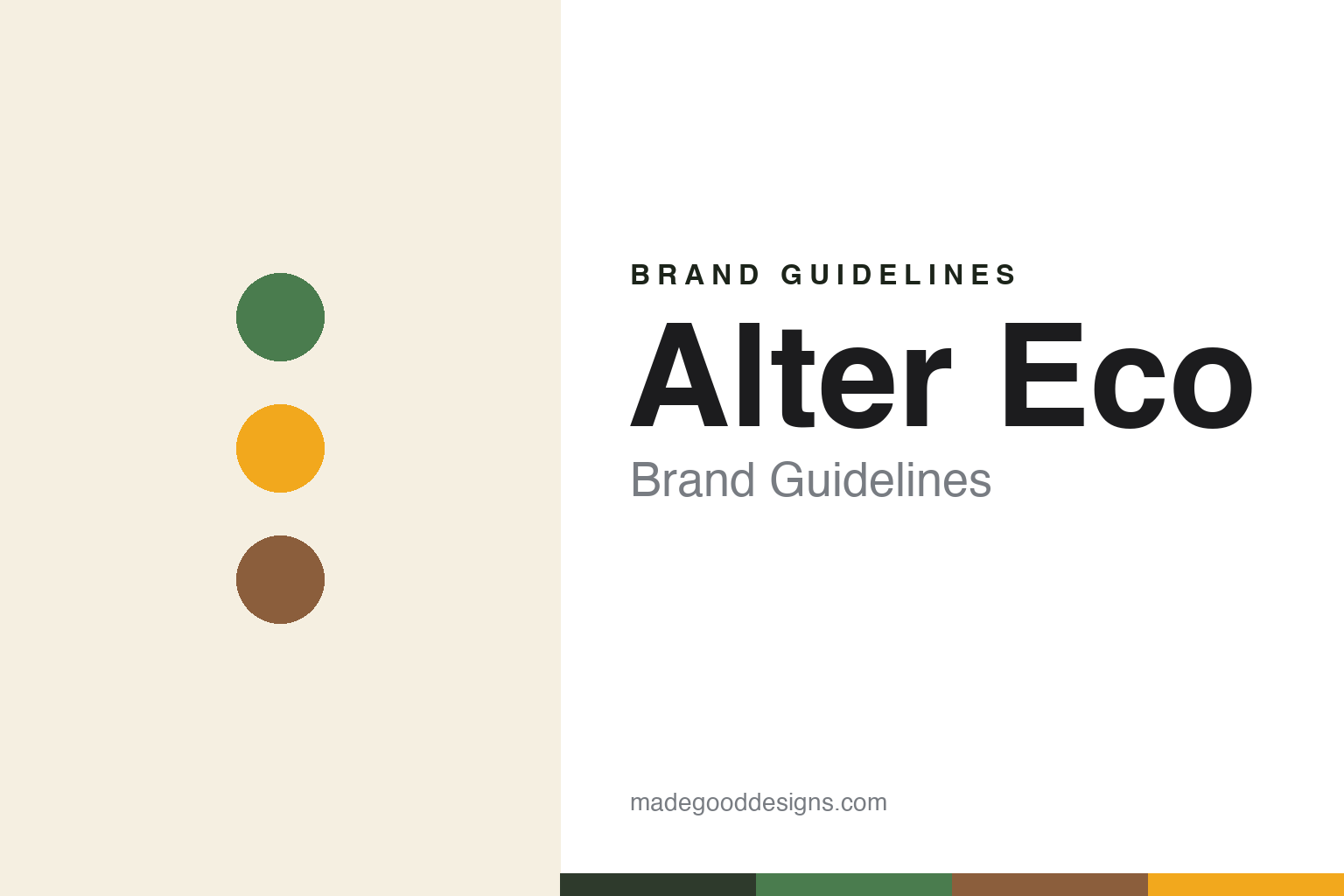
Alter Eco Brand Guidelines
Fair-trade, organic chocolate — soil to shelf.
Aa
Two constants: a clean eco palette and a clean sans. Abstract homage — not the Alter Eco wordmark or logo.
Clean, green and fair
Alter Eco leads on sustainable chocolate.
Alter Eco is a lesson in full-circle sustainability. Its roots are a French fair-trade pioneer, Alter Eco, founded in 1998 by Tristan Lecomte; the American brand that US shoppers know, Alter Eco Americas, was built in San Francisco by Mathieu Senard and Edouard Rollet in the mid-2000s. Best known for organic, fair-trade chocolate (dark bars, truffles), it is also a broader fair-trade foods brand spanning quinoa and coconut clusters.
Its real distinction is environmental leadership. In 2013 it launched what it calls the first commercially compostable candy wrapper; it has been a Certified B Corporation since 2009 and carbon-neutral since 2010, planting and protecting trees; and it now frames its work as regenerative — “restoring ecosystems, improving livelihoods, reducing waste.” Its ethos: “food for mind, body & soil,” clean “from soil to shelf.”
(Honest notes: Alter Eco has a dual origin — a French fair-trade company (Lecomte, 1998) and the US Alter Eco Americas (Senard & Rollet); chocolate is the hero but it is a broader fair-trade foods brand; its sustainability résumé is real — first compostable candy wrapper (2013), B Corp since 2009, carbon-neutral since 2010 (neutral, not asserted here as “negative”); and it is now owned by the private-equity firm NextWorld Evergreen. No official brand hex is published.)
Colour
Alter Eco lives in a clean eco palette. Click a swatch to copy the hex.
Alter Eco’s identity is clean, natural and eco-premium — a natural green, a warm cocoa, a bright amber, a cream, and a deep forest. The palette reads like its promise: fair-trade green and cocoa, a warm appetising amber, on clean natural ground. It signals sustainability and fair-trade values with a premium, appetising feel rather than crunchy austerity. The honest caveat: with no published brand hex, these tones are an original, unofficial interpretation, not first-party values.
The lesson is a clean eco palette signals fair-trade, sustainable chocolate. Alter Eco’s world reads as natural and premium. For designers, it is a reminder that a natural green with warm cocoa and a bright amber conveys eco-premium fair-trade values, matching a brand built on full-circle sustainability. The takeaways: pair a natural green with warm cocoa and one bright accent; keep it clean and premium, not crunchy; and treat any single hex as unofficial — using the deep forest for small text so the amber stays in the palette.
Typography
The wordmark spirit is a clean sans — natural and premium.
Alter Eco’s identity carries a clean, natural, premium spirit — an “ALTER ECO” wordmark whose modern forms match an eco-premium fair-trade brand. A clean sans captures the mood: it is modern and considered, the register of a polished sustainable brand rather than a crunchy health-food label. Set against a clean eco palette, the clean sans feels natural and premium — exactly the fair-trade, full-circle personality Alter Eco carries. It is polished rather than rough, mirroring premium-natural chocolate. (Alter Eco’s real wordmark is a trademark we describe but do not reproduce, and the exact typeface is not something we assert.) Because the specific mark is not ours to use, the honest description is “a clean sans spirit,” not the Alter Eco logo. The type behaves like the brand: clean, natural and premium.
Aa
A clean sans spirit — natural and premium. (Specimen set in Epilogue, a clean geometric sans; NOT the Alter Eco logo, which is a trademark.)
Full-circle sustainability as the difference
Alter Eco stands for chocolate that restores.
Alter Eco is a lesson in making sustainability the whole system, not a claim. It went beyond fair-trade sourcing to close the loop — compostable packaging, carbon neutrality, B Corp certification and regenerative agriculture — so the brand’s values run from the soil to the wrapper you throw away. That full-circle credibility, backed by real firsts (the 2013 compostable wrapper), gives an ethical chocolate brand a genuine, ownable edge. The differentiator is systemic sustainability, proven with specifics.
For designers and brand-builders, Alter Eco offers a clear takeaway: close the loop and prove it. The lessons: extend sustainability across the whole system (sourcing, packaging, carbon, farming); lead with concrete firsts (the compostable wrapper, B Corp date); and keep a clean, premium identity so “eco” reads as quality. It is also a reminder to stay accurate: Alter Eco has a French-and-US origin, its firsts are the compostable wrapper (2013) and B Corp (2009), and it is carbon-neutral (not “negative”) — with the palette here an unofficial interpretation. Alter Eco closed the loop — proof that full-circle sustainability can be the difference.
Explore & save
Keep Alter Eco’s identity on hand — save it to a board in the Made Good inspiration library.
Alter Eco identity set
Pin the clean eco palette and the clean-sans spirit to your own board.


