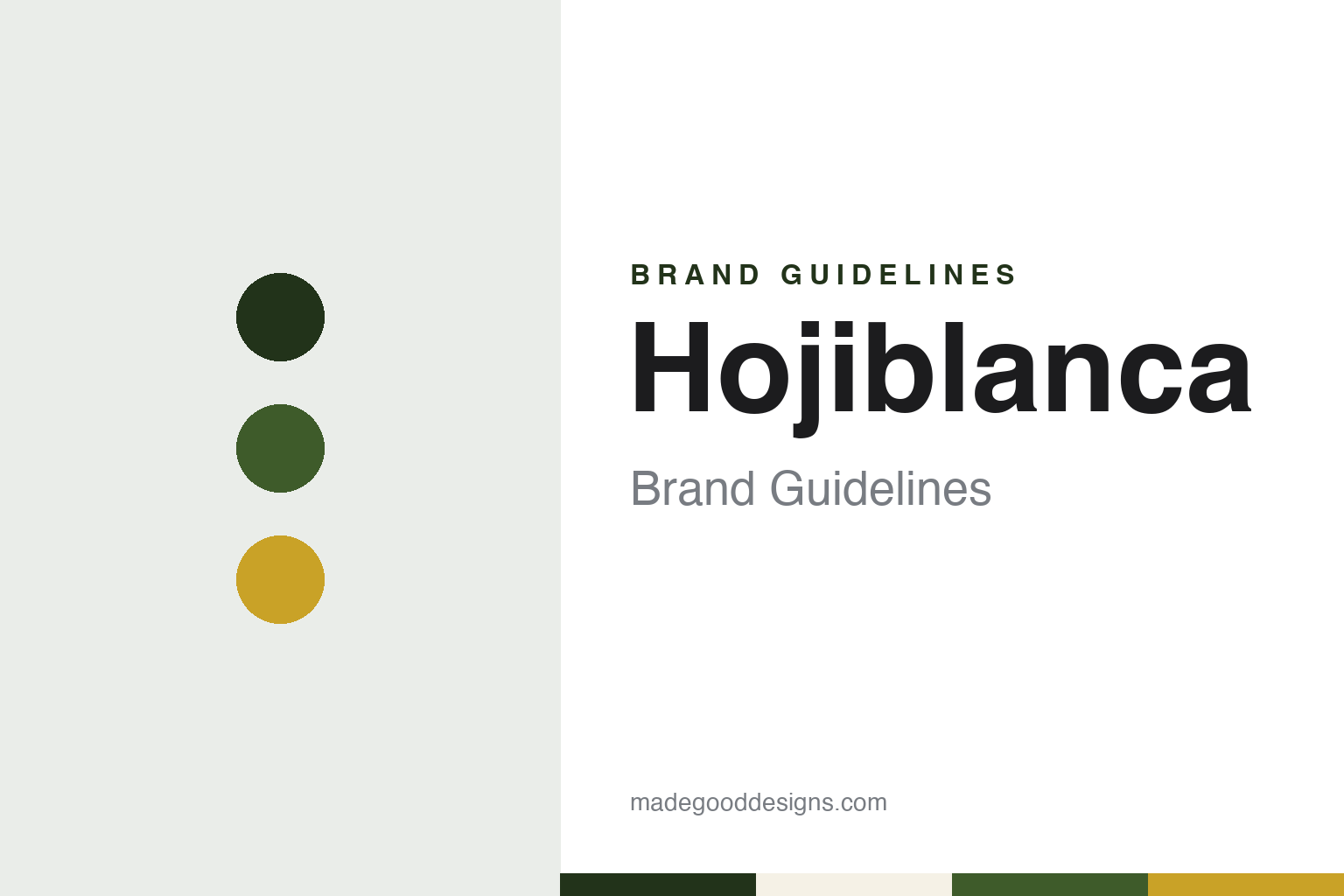
Hojiblanca Brand Guidelines
The Antequera co-op olive oil that became Maestros de Hojiblanca.
Aa
Two constants: a grove green, deep olive and oil gold palette and a crafted serif register. Abstract homage — not a Hojiblanca product or mark; no bottle, label or logo is reproduced.
A cooperative’s name
An olive, a group of mills and a rented office in Antequera.
Hojiblanca is a name before it is a brand. Spanish Wikipedia describes hojiblanca as an olive cultivar from the area around Cabra and Lucena, in the province of Córdoba, named for the pale colour of its leaves and grown across the provinces of Córdoba, Málaga, Sevilla and Granada. The olive-oil brand carries the same name as the Andalusian cooperative that launched it.
That cooperative began in Antequera, in the north of Málaga province. According to Spanish Wikipedia, Oleícola Hojiblanca de Málaga was set up in November 1987 by 13 cooperative olive mills in northern Málaga, starting out in a rented office in Antequera, with Juan Romero Montenegro as its first president. A second group, Cordoliva, had been formed in March 1980 by about twenty mills in Córdoba province, with its seat in Villarrubia. Spanish Wikipedia dates the presentation of the Hojiblanca extra-virgin olive-oil brand to 1997.
The two groups merged with effect from 1 November 2003 as Hojiblanca S. Coop. And., a federation of 42 oil cooperatives, with José Moreno Moreno of the Málaga group as its head, Spanish Wikipedia says. The merged cooperative kept growing: it formed a joint venture with Cargill in 2007, took in its first cooperative from Jaén in 2008 and merged with groups in Sevilla and Badajoz in 2010. In 2013, after a merger with Tierras Altas Aceite de Granada, it took the name Dcoop, which is still based in Antequera. When Deoleo did business with it in 2012, Deoleo called Hojiblanca the world’s leading producer of virgin olive oil.
Colour
A brand traded for shares, then renamed.
The brand left the cooperative in a deal announced on 18 October 2012. That day Deoleo — the Spanish olive-oil group that grew out of SOS Corporación Alimentaria, took the Deoleo name in 2011 and owns Carbonell and Bertolli — said its board had agreed to buy the Hojiblanca brand and the cooperative’s industrial plant in Antequera. Deoleo paid in new shares rather than cash, so the cooperative became a Deoleo shareholder with 9.63%, which Deoleo called its “industrial reference partner.” Deoleo’s shareholders then approved the purchase of the brand and the Antequera packing plant at the annual meeting that signed off its 2012 accounts, and the company reported progress in winning clearance from Spain’s competition authority.
The partnership was short. In April 2014 the British fund CVC Capital Partners agreed to buy a 29.9% stake in Deoleo from Spanish banks. Dcoop had hoped to buy those shares itself, and its director general, Antonio Luque, told Europa Press that it would not stay on merely to follow strategies it might not share, Cinco Días reported on 13 April 2014. Two weeks later Expansión reported that Dcoop had agreed to sell its 9.9% to CVC, leaving the group about a year and a half after it joined. The Hojiblanca brand stayed with Deoleo.
Under Deoleo the brand was reworked. A Deoleo brand page archived in 2015 described Hojiblanca as “a brand of Andalusian origin” that bottles only extra-virgin olive oil, with single-variety oils from Verdial, Arbequina and Cornicabra olives and a protected-origin oil from the Antequera district. On 28 March 2017 Deoleo announced that the brand was changing its own name to Maestros de Hojiblanca, “masters of Hojiblanca” — a tribute, it said, to the experts who had selected and combined extra-virgin oils for the brand for more than 30 years, and to values it listed as closeness, tradition and mastery. The house blend was renamed El Nuestro, “ours.”
Typography
Design and documentation.
The seven brands in this group are food brands, and all of them come from Spain or Italy: Fontaneda, Carbonell, Hojiblanca, Galbani, Star, Ponti and Bauli. Spanish and Italian food brands in general sit at many different points in the trade, from family firms that still carry a founder’s surname to names that now belong to much larger food groups, and a single brand can be sold everywhere from a village shop to a supermarket shelf abroad.
A food brand’s identity is usually carried less by a single product than by a pack, a name and the meal or occasion it promises, because the company behind the name may have changed hands, moved its factory or grown far beyond the town where it started. That makes the questions behind each name worth asking plainly: who started it, who owns it now, and where its products are actually made and packed.
Each guide separates what independent sources record from what the company says about itself — its founding story, its owners over time, where its products are made and how its packaging has changed — and marks plainly what rests only on the company’s own word.
Aa
A crafted serif for a brand that calls its blenders masters. (Specimen set in Cormorant Garamond, a serif STAND-IN; NOT the Hojiblanca logo.)
Maestros de Hojiblanca
An opaque bottle, numbered blends and a flavour code.
The 2017 relaunch is the best-documented design moment in the brand’s history. Deoleo said El Nuestro would come in a new opaque bottle, its shape inspired by the ripples made by oil during milling, which the company said keeps the blend’s sensory qualities intact for longer. The main logo was redrawn, and the label carried what Deoleo called a striking, evocative illustration of an olive grove. Deoleo presented El Nuestro as the first of a range of blends, and the brand’s website, as archived in February 2018, already listed three more — Alegre, Pícaro and Bravío — beside a section called “el código de sabor,” the flavour code.
Numbers became part of the system. The brand’s website in 2026 lists Alegre as Nº 2, and its limited editions continue the sequence: organic blends and oils from the protected designations of origin Poniente de Granada, Baena and Gata-Hurdes, numbered from 8 to 13. In July 2022 Deoleo said Maestros de Hojiblanca had begun a pilot with IBM Food Trust, printing a unique QR code on each bottle of three blends in its “Oda a Nuestra Tierra” range, numbered 5, 6 and 7, so buyers could follow a lot from olive grove to table; Deoleo said it was the first mass-market extra-virgin olive-oil company in Spain to do so.
Today the brand belongs to Deoleo, and the Maestros de Hojiblanca website carries a Deoleo Global copyright. Spanish Wikipedia says Deoleo is listed on the Spanish stock exchange, that a 2020 restructuring gave the group’s creditors 49% of a new holding company, Deoleo Holding, and that the group has two production plants, at Alcolea in Spain and Tavarnelle in Italy. Dcoop, the cooperative group that created the name, is still based in Antequera, Spanish Wikipedia says.
For a design guide, Hojiblanca shows how a cooperative’s name can become a corporate brand that speaks the language of craft — masters, numbered blends, an olive grove on the label. Compare Carbonell, its stablemate at Deoleo, and Bertolli, the Lucca olive-oil name in the same group. For this guide we use a grove green, a deep olive and an oil gold with a serif, an unofficial interpretation; no product or logo is reproduced.
Explore & save
Keep Hojiblanca’s identity on hand — save it to a board in the Made Good inspiration library.
Hojiblanca identity set
Pin the Hojiblanca grove green, deep olive and oil gold palette and the crafted serif register to your own board.