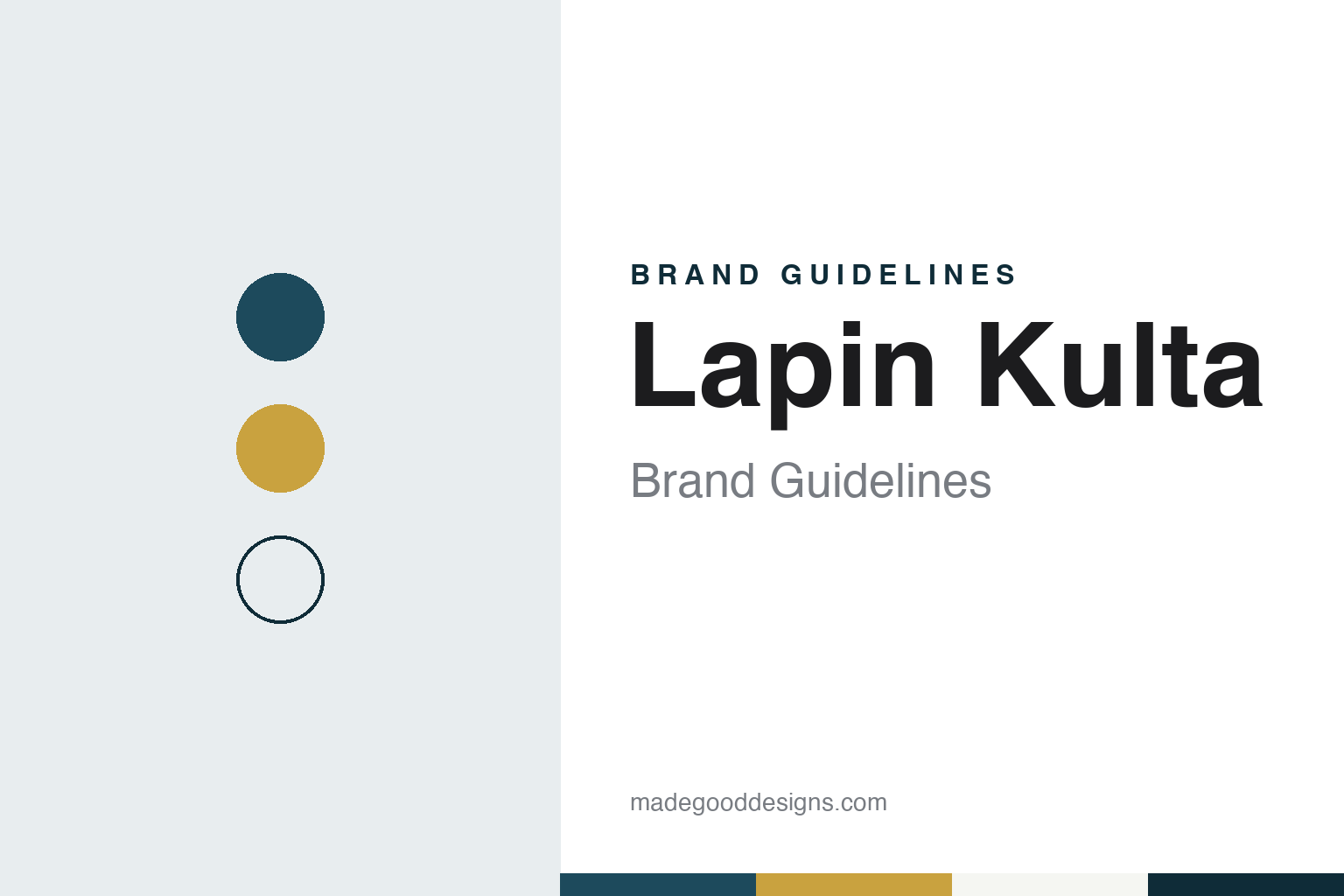
Lapin Kulta Brand Guidelines
The Tornio lager that bought a gold mine for its name.
Aa
Two constants: a Lapland gold and fell-stream teal palette and a medal serif register. Abstract homage — not a Lapin Kulta product or mark; no label, medal or logo is reproduced.
Torneå Bryggeri
A brewery on the river border with Sweden.
Lapin Kulta — “Lapland Gold” — is a beer brand older than its name. Its brewery was founded on 22 November 1873 by a group of merchants and businessmen in Tornio, the town on the Tornio river at Finland’s border with Sweden, as Torneå Bryggeri Aktiebolaget, on the island of Suensaari, according to Finnish Wikipedia, which draws on local histories including Esa Markkanen’s 1994 article in the Tornio valley yearbook and Ilkka Teerijoki’s history of Tornio (2010). The first bottles of beer and porter appeared three years later. In 1880 the business became the Tornio Porter and Beer Factory under the director G. A. Nordberg, and in 1894 it added soft drinks.
One family ran it for most of the next century. In 1899, Finnish Wikipedia says, the 23-year-old Weikko Gellin joined the brewery; he became its manager and, in 1910, its managing director. After prohibition ended, the company bought a steam brewery at Rovaniemi in 1933, which was destroyed in the Lapland War in October 1944. In 1946 the lawyer Frederik Stormbom took over as managing director, working with his wife, Irma Stormbom, Weikko Gellin’s daughter, who had trained as a brewmaster in Germany. In 1958 the company was renamed Tornion Olut.
Irma Stormbom led it through the years that made the brand. Finnish Wikipedia, citing the Finnish business biography Suomen talouselämän vaikuttajat, says she was managing director of Tornion Olut and its Rovaniemi sister company from 1961 to 1969 and of Lapin Kulta Oy from 1970 to 1971, then chaired its board until 1980; in 1974 she received the honorary title of teollisuusneuvos, industrial counsellor, the first woman in the province of Lapland to do so.
Colour
A medal on the label and a mine in the deeds.
The Lapin Kulta beer and its image of fresh fell streams were created at the start of the 1960s, Finnish Wikipedia says, and the job of finding a name for the new beer went to the advertising man Eugen Ulves. At first the beer was sold only in Lapland. The turning point, by the same account, came in 1963, when Irma Stormbom sent Lapin Kulta A to an international beer competition in Brussels, where it won a gold medal. The brewery used it at once: a picture of the gold medal was printed on the label, and the beer became Export Lapin Kulta.
The early advertising leaned on Lapland’s water. Finnish Wikipedia gives the first slogan as “Lapin vedellä askeleen edellä” — roughly “a step ahead with Lapland water” — and says the first advertisements ran in Helsingin Sanomat in 1963, promising the freshness of fell streams. To push sales in the capital, the brewery mailed a Lapland-themed postcard to Helsinki residents who had visited Lapland in the summer or autumn of 1964, telling them where Lapin Kulta could be bought.
The name came with an unusual condition. Before the company became Lapin Kulta Oy in 1969, Finnish Wikipedia says, it had to buy a state-owned gold-mining company of the same name, founded in 1924, and for many years its articles of association listed mining alongside drinks. English Wikipedia gives the line of business as “prospecting for gold and the manufacture and sales of beer.” The Rovaniemi company, Lapin Olut, was merged into Lapin Kulta the same year.
Lapin Kulta’s link with its eventual owner began before the sale. In 1968, Finnish Wikipedia says, the Tornio brewery began making Hartwall’s Jaffa soft drink under licence, and the partnership helped carry Lapin Kulta beer across Finland. In the spring of 1980 the Stormbom family sold the brewery to Hartwall, and in the spring of 1981 it became part of Hartwall as Oy Hartwall Lapin Kulta, with Lapin Kulta remaining as a marketing company.
Today the brand’s website, which sits within Hartwall’s, presents three lagers — Original, Pure and Northern Lite — and says the brand’s story began in clean, untouched northern nature, with freshness as its compass. Hartwall describes all three as all-malt beers.
Typography
Nordic food and drink.
The seven brands in this group all make food or drink, and they come from Finland and Norway: Hartwall, Koff, Mills, Solo, Olvi, Lapin Kulta and Atria. Food and drink brands in general sit at many different points in the trade, from family firms that still carry a founder’s surname to names that now belong to much larger groups, and a single brand can be sold everywhere from a corner kiosk to a supermarket aisle.
A food or drink brand’s identity is usually carried less by a single product than by a pack, a name and the meal or drink it promises, because the company behind the name may have changed hands, moved its production or grown far beyond the town where it started. That makes the questions behind each name worth asking plainly: who started it, who owns it now, and where its products are actually made and packed.
Each guide separates what independent sources record from what the company says about itself — its founding story, its owners over time, where its products are made and how its packaging has changed — and marks plainly what rests only on the company’s own word.
Aa
A medal serif — an echo of the gold-medal label, not of any documented Lapin Kulta typeface. (Specimen set in Playfair Display, a serif STAND-IN; NOT the Lapin Kulta logo.)
Lapin Kulta
From Tornio to Lahti, under three foreign owners.
Hartwall itself changed hands three times in a little over a decade. The British brewer Scottish & Newcastle bought it in 2002. When Scottish & Newcastle was divided between Heineken and Carlsberg in 2008, Hartwall went to Heineken, because Carlsberg already owned the Finnish brewer Sinebrychoff, Taloussanomat reported in January 2008. In July 2013 Heineken sold Hartwall to the Danish brewer Royal Unibrew, Yle reported; under that deal the Hartwall family’s investment company became Royal Unibrew’s second-largest shareholder, a stake it sold in 2018, according to Hartwall Capital.
The brewery did not survive the consolidation. On 8 October 2009, Finnish Wikipedia says, Hartwall announced that brewing in Tornio would end and that Lapin Kulta would move to its brewery in Lahti, in southern Finland, citing tougher competition and rising imports. Beer production in Tornio stopped at the beginning of August 2010, and on 31 August 2010 work at the plant ended, Yle reported, with some of its roughly hundred staff staying on to dismantle the equipment. By then the brewery had operated in Tornio for 137 years. Lapin Kulta has been brewed in Lahti since; Yle reported in April 2010 that canning of the beer there would begin that August. In 2020 Hartwall ended production of Lapin Kulta III, the brand’s traditional medium-strength version, Ilta-Sanomat reported.
Brewing has since returned to the Tornio site under another name. Finnish Wikipedia says the old brewery reopened in September 2016 as Tornion Panimo, a separate company funded by a crowdfunding campaign; it does not brew Lapin Kulta. Hartwall, founded in Helsinki in 1836 by Victor Hartwall, has its head office in Helsinki and its brewery in Lahti.
For a design guide, Lapin Kulta shows how a brand can carry a place in its name long after production has left it. Compare Hartwall, the company that has owned it since 1980, and Olvi, the Iisalmi brewery that stayed independent. For this guide we use a gold, a deep teal and a snow white with a serif, an unofficial interpretation; no product or logo is reproduced.
Explore & save
Keep Lapin Kulta’s identity on hand — save it to a board in the Made Good inspiration library.
Lapin Kulta identity set
Pin the Lapland gold and fell-stream teal palette and the medal serif register to your own board.