Vöslauer Brand Guidelines
The Bad Vöslau spring water with Hundertwasser labels.
Aa
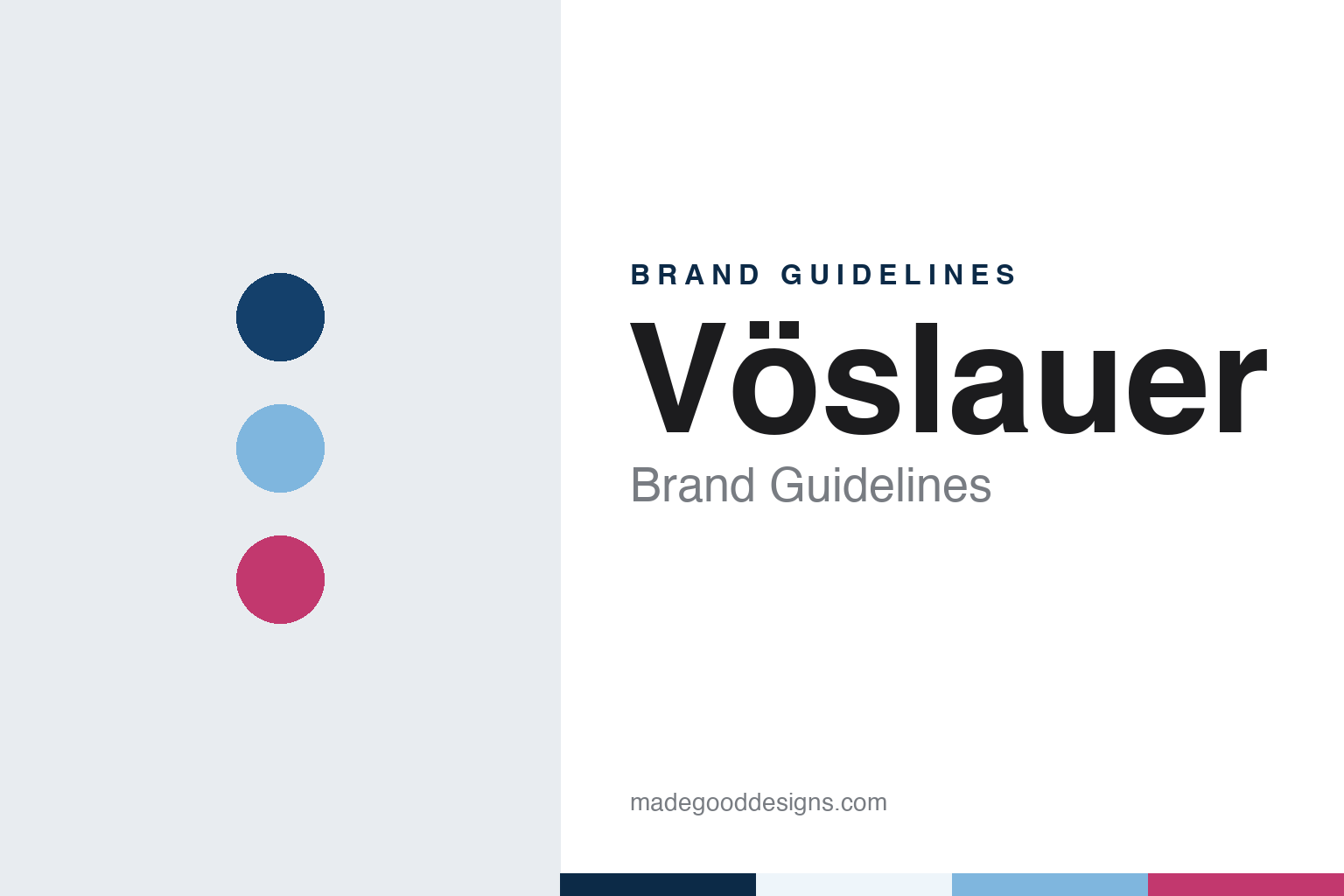
Two constants: a deep spring blue, wave blue and rose palette and a clean geometric sans register. Abstract homage — not a Vöslauer product or mark; no bottle, label or logo is reproduced.
A spa spring
A Roman spring, a count’s baths and a bank’s company.
Vöslauer is the water of a spa town. Bad Vöslau lies in Lower Austria, south of Vienna, and its artesian spring rises from about 660 metres below ground on the grounds of the town’s thermal baths, according to German Wikipedia. The same source feeds the baths and the bottles. The company says the place was first recorded in 1136, and German Wikipedia says the spring was already known to the Romans.
The spa came first. The company says that in 1822 Count Moritz I von Fries built a basin at the spring and opened a bathing establishment, and that in 1825 Dr Malfatti von Monteregio, Beethoven’s physician, analysed the water and the spring was captured for the first time. In 1873, it says, the baths were extensively renovated under the architect Theophil Hansen because of rising visitor numbers.
Bottling began long before the present company. German Wikipedia says the water was first bottled in 1909, under municipal management, carbonated and sold as “Vöslauer Thermal-Tafelwasser,” with 35,000 bottles in the first year. The company that owns the brand today traces itself to 1936, when the savings bank Zentralsparkasse founded the Vöslauer Heilquellenverwertungs Gesellschaft, a company set up to market the healing spring; the company calls it the forerunner of today’s Vöslauer Mineralwasser GmbH.
The modern operation took shape in the 1990s. In 1993 a new bottling plant opened on the edge of Bad Vöslau, German Wikipedia and the company say. In 1998 it added a still water, sold as “Vöslauer ohne,” alongside the sparkling original.
Colour
Six-packs, an artist’s label and a handbag of water.
Much of Vöslauer’s design story is told through its packs, and the company’s own timeline lists them year by year. In 1975, it says, it introduced a six-bottle carton so that customers could carry water home. In 1990 the painter and architect Friedensreich Hundertwasser designed labels for the bottles Vöslauer supplied to restaurants and cafés, the company says.
Plastic arrived in 1996, with a lightweight 1.5-litre PET bottle that the company describes as a market innovation. In 2001 it introduced a light-blue restaurant bottle with a wave design. German Wikipedia says that in April 2003 Vöslauer switched its retail range to plastic deposit bottles and stopped selling glass; the company adds a nine-bottle pack that year, and in 2005 a three-bottle “City Bag” shaped like a handbag. In 2006 came Vöslauer Junior, a children’s bottle with stickers and a flip cap.
Glass and reuse returned later. In October 2014 Vöslauer introduced a returnable 1-litre glass bottle, sold in a split crate of eight. The company says its 1.5-litre PET bottles contained at least 50 percent recycled material from 2010, and that from 2020 it moved its PET bottles step by step to 100 percent recycled PET, which it calls rePET; the trade journal Plasteurope reported on the bottler’s reusable PET range in January 2022. In April 2022 Vöslauer launched a returnable 1-litre PET bottle, which the company calls the first in Austria.
Advertising has leaned on famous faces. The company lists Claudia Schiffer as its first advertising face in 1999, followed by Cindy Crawford in 2003, the soprano Anna Netrebko in 2007, Keira Knightley in 2012, Sienna Miller in 2015, Lily James in 2017 and Alexa Chung in 2019.
Typography
Design and documentation.
The seven brands in this group all make food or drink, and all of them come from Austria: Almdudler, Römerquelle, Vöslauer, Pago, Ottakringer, Stiegl and Kelly’s. Austrian food and drink brands in general sit at many different points in the trade, from family firms that still carry a founder’s surname to names that now belong to much larger food and drink groups, and a single brand can be sold everywhere from a mountain hut to a supermarket shelf.
A food or drink brand’s identity is usually carried less by a single product than by a bottle, a pack, a name and the moment it promises, because the company behind the name may have changed hands, moved its production or grown far beyond the town where it started. That makes the questions behind each name worth asking plainly: who started it, who owns it now, and where its products are actually made, bottled or packed.
Each guide separates what independent sources record from what the company says about itself — its founding story, its owners over time, where its products are made and how its packaging has changed — and marks plainly what rests only on the company’s own word.
Aa
A clean geometric sans for a clear, light-blue water brand. (Specimen set in Jost, a sans STAND-IN; NOT the Vöslauer logo.)
Vöslauer
A brewery group, a lemonade bottler and flavoured waters.
Vöslauer has belonged to a brewer for more than fifteen years. German Wikipedia says it was brought into the holding company of the Vienna brewery Ottakringer in 2009, with the change taking effect on 1 January 2010; English Wikipedia describes Vöslauer Mineralwasser GmbH as an Ottakringer subsidiary based in Bad Vöslau, with managing directors Birgit Aichinger and Herbert Schlossnikl and about 220 employees.
The plant does more than fill its own bottles. English Wikipedia says Vöslauer bottles Almdudler, the Austrian herbal lemonade, and that until the end of 2021 it also bottled and marketed Pepsi drinks; the business magazine CASH reported in October 2021 that PepsiCo was moving to a new Austrian partner.
The range has grown from plain water. German Wikipedia says Vöslauer Balance, a flavoured mineral water, arrived in 2000 and was presented as a world first; the company says it was reformulated without artificial sweetener in 2008. An organic lemonade followed in 2007, which the company calls the first in Austria; a juicier Balance Juicy line in 2012 or 2013 (the company and German Wikipedia differ); an extra-sparkling water in 2015; flavoured waters in 2016; and tea drinks in 2017, later dropped. In early 2026 it launched Fizzz, an alcohol-free aperitif range, and the company says a new aseptic PET line opened the same year. German Wikipedia adds that Vöslauer opened an office in Frankfurt in February 2026.
For a design guide, Vöslauer shows how a spa water can build an identity from its packs: an artist’s label, a handbag of bottles, a wave-patterned restaurant bottle and a long run of famous faces. Compare it with Almdudler, which it bottles, and Römerquelle, another Austrian mineral water. For this guide we use deep spring blue, wave blue and rose with a clean geometric sans, an unofficial interpretation; no product or logo is reproduced.
Explore & save
Keep Vöslauer’s identity on hand — save it to a board in the Made Good inspiration library.
Vöslauer identity set
Pin the Vöslauer deep spring blue, wave blue and rose palette and the clean geometric sans register to your own board.