Römerquelle Brand Guidelines
The Burgenland spring water that set out to wake the senses.
Aa
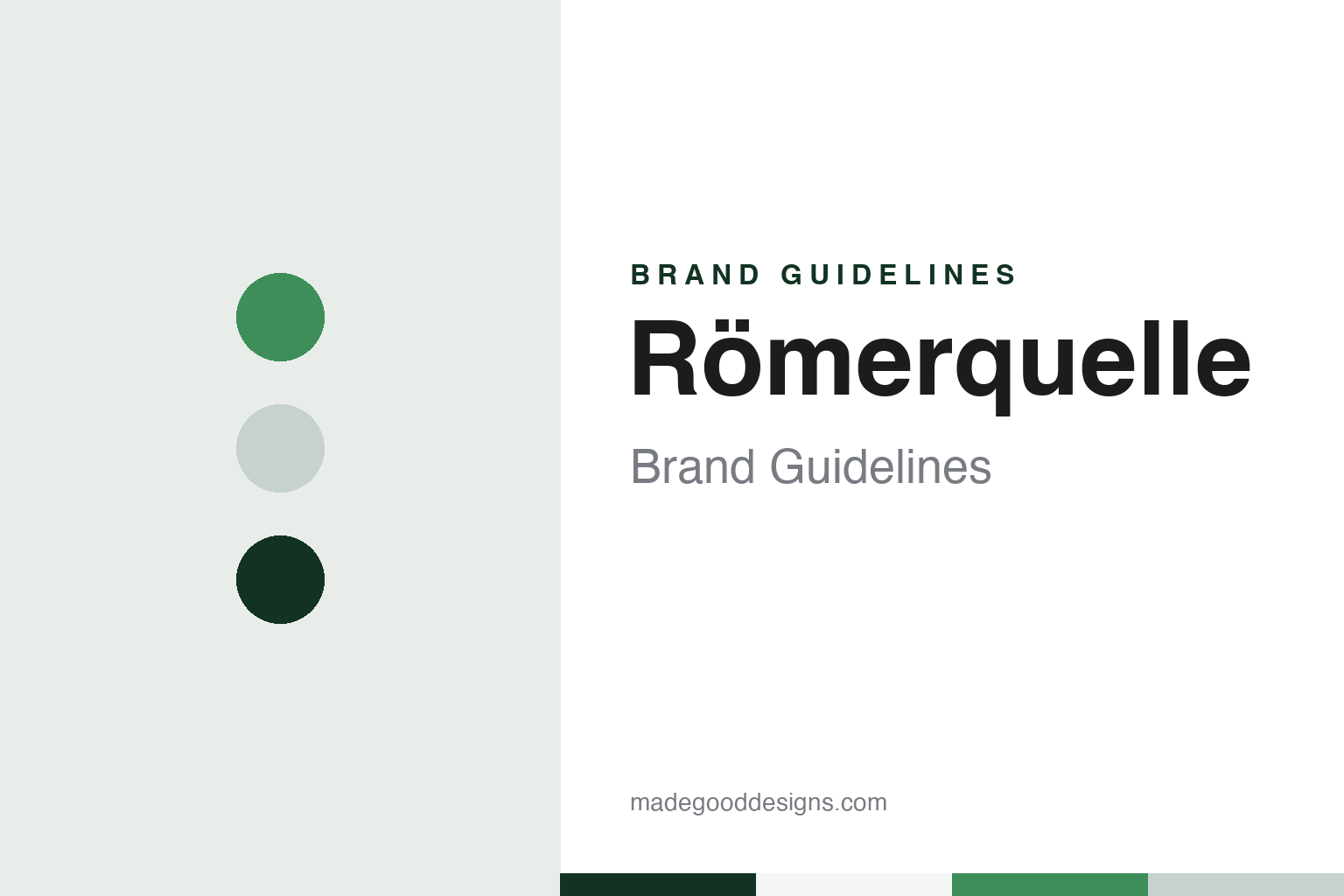
Two constants: a glass green, deep spring and mineral silver palette and a clean geometric sans register. Abstract homage — not a Römerquelle product or mark; no bottle, label or logo is reproduced.
A spring near Carnuntum
Roman roots, a wooden shed and a brand built from 1965.
Römerquelle — “Roman spring” — is a mineral water from Edelstal, a small village in the Neusiedl am See district of Burgenland, in eastern Austria. German Wikipedia says the springs and the bottling plant both lie on the so-called small thermal line, and that the springs were already known in Roman times. The brand has long tied its name to that past. Its website said in 2009 that the Romans laid pipes from Edelstal to the nearby Roman city of Carnuntum, and that the name is “no marketing invention”; a 2022 press release from Coca-Cola HBC Austria, published on the Kurier website, says the Romans used the springs for bathing, hence the name.
The modern history is better documented. German Wikipedia, citing the Kurier in 2022 and the business magazine New Business, says the springs were rediscovered in 1890, used commercially from 1925, and that a spa opened in Edelstal in 1932. Bottling began in 1948. The company’s own history page of 2002 says that a locksmith named Alois Bauer took over the commercial use of the spring that year and filled bottles in a wooden shed for spa guests and some Viennese pharmacies, and that the name “Römerquelle” was first used officially in the interwar years.
The brand as Austrians know it dates from 1965. That year the Römerquelle GesmbH & Co KG was founded, German Wikipedia says, and the water was marketed across Austria for the first time, according to Coca-Cola HBC Austria’s own company history. The 2002 company history says that after several changes of ownership the business was taken over that year by Prohaska & Cie.; it describes the plant as run down, with an old filler, seven vehicles and 13 employees. The new owners bought the surrounding land and a new bottling line, replaced the brittle wooden crates with plastic ones and dropped the plain standard bottles, and, in the company’s words, “building a brand had begun.”
Colour
A slogan, a provocative triangle and a racing champion.
Römerquelle’s advertising has been built around one line: “Römerquelle belebt die Sinne” — “Römerquelle revives the senses.” The company’s 2002 history credits the market psychologist Eva Braunegger with laying the groundwork, recommending that the brand be positioned in a “magic triangle” of food, eroticism and vitality, from which the slogan came. By 2015 the brand’s website said the line had been linked with Römerquelle for 45 years.
The same 2015 website described how the triangle was put on screen. From 1974, it said, Römerquelle advertising showed a ménage à trois — “at the time a real breaking of taboos” — and that three-way romance shaped its campaigns for many years, with Austrian models such as Cordula Reyer and Werner Schreyer among those appearing. The brand also used famous faces. The company says that in the mid-1970s it signed the racing driver Niki Lauda, then newly crowned Formula One world champion, and that brand awareness rose above 90 per cent; its 2002 history adds that in 1978 Lauda celebrated a Grand Prix win with Römerquelle, which it calls “the champagne of mineral waters.” The company says 1974 was also the year Römerquelle first became market leader in Austria.
Packaging has changed often, and the company has presented many of the changes as firsts. Its 2003 chronicle lists a switch from crown corks to metal screw caps in 1973, an Austrian first in 1978 with a still, low-carbonation mineral water, the divisible Split-Box crate in 1987, Römerquelle Lemon in 1992 — which it calls the first flavoured water in Austria — and, in 1997, what it describes as the world’s first 1.5-litre returnable PET bottle for mineral water. A dedicated design bottle for restaurants followed in 2006, the company’s 2009 website says. In 2015 came what the brand called the biggest relaunch in its history, with a reduced design, a rejuvenated wordmark, strong colours and metallic effects, according to its website at the time. In April 2019 Römerquelle moved its whole PET range to bottle bodies made entirely from recycled PET, New Business reported, and Coca-Cola HBC Austria calls it the first large Austrian mineral-water brand to do so.
Typography
Design and documentation.
The seven brands in this group all make food or drink, and all of them come from Austria: Almdudler, Römerquelle, Vöslauer, Pago, Ottakringer, Stiegl and Kelly’s. Austrian food and drink brands in general sit at many different points in the trade, from family firms that still carry a founder’s surname to names that now belong to much larger food and drink groups, and a single brand can be sold everywhere from a mountain hut to a supermarket shelf.
A food or drink brand’s identity is usually carried less by a single product than by a bottle, a pack, a name and the moment it promises, because the company behind the name may have changed hands, moved its production or grown far beyond the town where it started. That makes the questions behind each name worth asking plainly: who started it, who owns it now, and where its products are actually made, bottled or packed.
Each guide separates what independent sources record from what the company says about itself — its founding story, its owners over time, where its products are made and how its packaging has changed — and marks plainly what rests only on the company’s own word.
Aa
A clean geometric sans for a spring water sold on clarity. (Specimen set in Montserrat, a sans STAND-IN; NOT the Römerquelle wordmark.)
Römerquelle
A Coca-Cola bottler’s brand, still filled at the source.
Römerquelle has belonged to the Coca-Cola system since 2003. The brand’s own website said in 2009 that Coca-Cola HBC Austria, then part of Coca-Cola Hellenic, had held a majority since 2003, and Coca-Cola HBC Austria’s company history says that in 2003 Römerquelle “becomes a brand of Coca-Cola Hellenic Österreich.” German Wikipedia cites a 2003 notice from Austria’s Federal Competition Authority reviewing the Coca-Cola and Römerquelle merger. Since the takeover, German Wikipedia says, the range has been widened with several so-called wellness drinks; the company had already launched its “emotion” drinks in 2001 and set up a Hungarian subsidiary, Römerquelle Hungaria, in 2000.
The water is still bottled where it rises. Coca-Cola HBC Austria says Römerquelle mineral water is filled directly at the source in Edelstal. In May 2013 the bottler opened a production and logistics centre there, where it fills all its soft drinks as well as Römerquelle and distributes them across Austria, its company history says; New Business reported in 2019 that the site had become the third-largest production centre in the whole Coca-Cola HBC group. A can line followed in 2021 and a returnable-glass line in 2023, the company says. The current website says the returnable glass bottles, in 0.33-, 0.5- and 1-litre sizes, carry the Austrian Ecolabel, and that Römerquelle has held the Austria Gütezeichen quality mark since 1962, which it calls one of the longest-running holders of that seal.
Two other names are easy to confuse with it. German Wikipedia notes that a German medicinal water also sold as “Römerquelle,” by Aqua Römer of Mainhardt, has nothing to do with the Austrian brand, and the Bad Niedernau spring of the same name is also unrelated. The brand’s old website, roemerquelle.at, now leads to Coca-Cola’s Austrian site.
For a design guide, Römerquelle shows how a regional spring water can turn a single slogan about the senses into a national brand that lasted through a change of owner. Compare Vöslauer, another Austrian mineral-water brand, and Almdudler, the Viennese herbal lemonade. For this guide we use a glass green, a deep spring green and a mineral silver with a geometric sans, an unofficial interpretation; no product or logo is reproduced.
Explore & save
Keep Römerquelle’s identity on hand — save it to a board in the Made Good inspiration library.
Römerquelle identity set
Pin the Römerquelle glass green, deep spring and mineral silver palette and the clean geometric sans register to your own board.