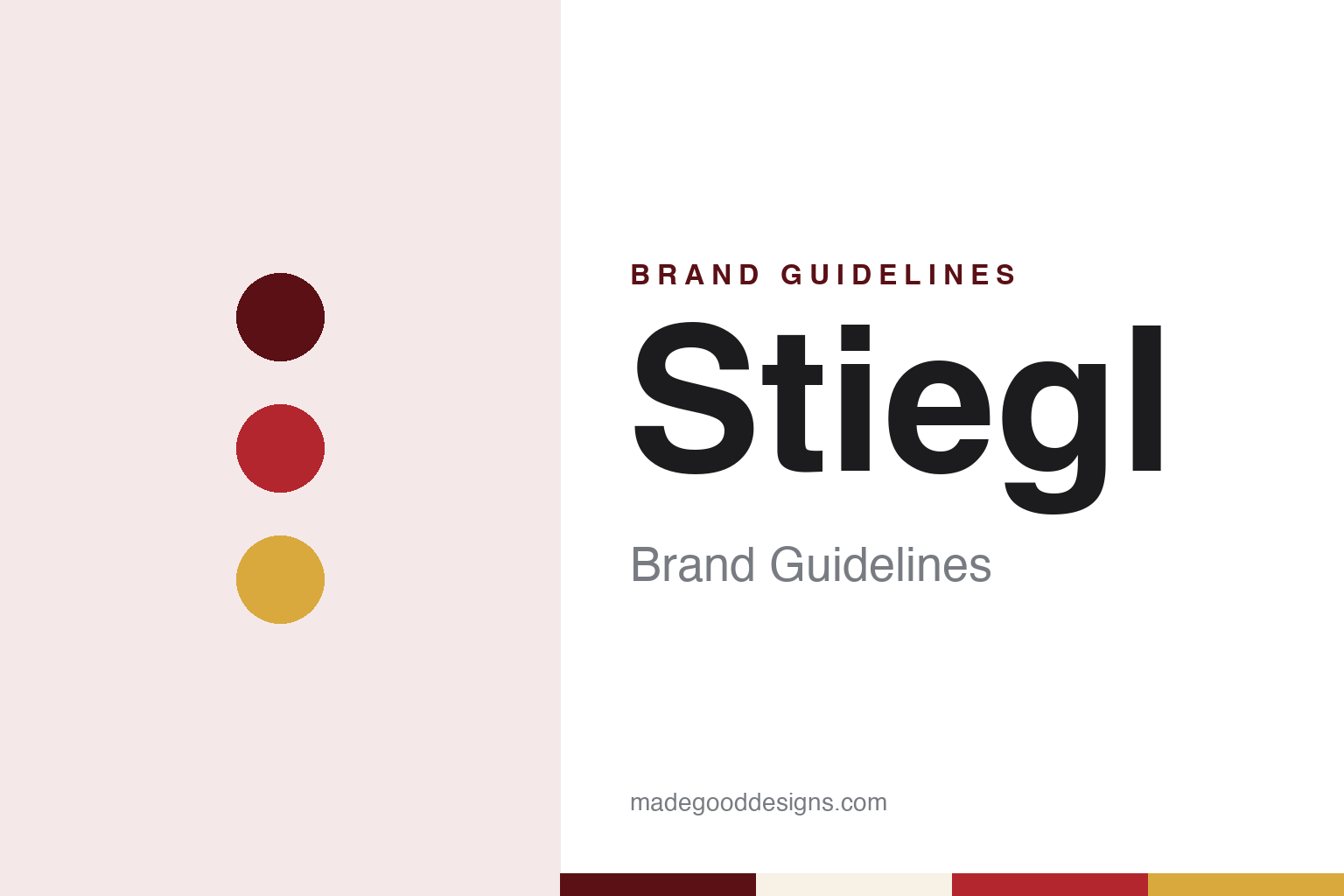
Stiegl Brand Guidelines
Salzburg’s brewery by the little stair, recorded since 1492.
Aa
Two constants: a Stiegl red, cellar red and Goldbräu gold palette and a heraldic old-style serif register. Abstract homage — not a Stiegl product or mark; no bottle, label, coat of arms or logo is reproduced.
Bey der Stiegen
A deed of 1492 and a stair down to the canal.
Stiegl takes its founding year from a document. The brewhouse “auff der Gestettenn,” in the Gstätten quarter of Salzburg’s old town, is first mentioned in a deed of 16 June 1492, the company says; German Wikipedia adds that in that year Hans Peuntner left the brewery to the widow of his son Jörg. The name came a little later, from a small stair — a Stiege — that ran from the brewhouse down to the Almkanal, the canal that brought fresh water into the city and from which the brewers drew their water. The company places the old brewhouse where Salzburg’s Haus der Natur museum now stands.
For centuries Stiegl was one of a dozen private breweries inside the city. The company says that by 1664 it was brewing 1,800 Eimer, roughly 100,000 litres, a year, the most of the twelve, and that in 1765 Johann Ambros Elixhauser, from another Salzburg brewing family, married into the house. It quotes a diary entry of August 1780 by Nannerl Mozart, recording that she and her brother Wolfgang went “zum stieglbreü” to watch the skittles. The brewery’s coat of arms dates from around 1808, the company says.
The modern business took shape in the nineteenth century. Johann Schreiner bought the brewery in 1819, German Wikipedia says, and in 1820 he and his wife Anna Holzegger acquired a house on the Festungsgasse and set up a lager cellar in the rock below Salzburg’s fortress. Its beer garden became the Stieglkeller, which still trades there; it was rebuilt with gables and turrets by the builder Jacob Ceconi in 1901 and last remodelled by the Munich architect Franz Zell in 1926. In 1863 Josef Schreiner moved brewing out of the narrow old town to a new plant in Maxglan, then on the city’s edge, where Stiegl still brews. A fire in the malt kiln destroyed the new brewery on 29 December 1875, the company says, quoting the Salzburger Zeitung, and brewing restarted within months.
Colour
Huemer, Kiener and the Goldbräu name.
The family that runs Stiegl today arrived in the late 1880s. In 1887, the company says, the farmer and grain dealer Franz Huemer took over the brewery and made his nephew Heinrich Kiener its manager; German Wikipedia dates Kiener’s entry to 1889, and says Huemer raised output from 18,000 to 90,000 hectolitres within ten years. Kiener’s descendants have led the brewery ever since. In 1901 the brewery bought the former Rochus barracks next door, with its plague-saint chapel, and the buildings now hold the stables for its dray horses, a staff canteen and offices.
The name on most Stiegl bottles goes back to 10 December 1912, when, the company says, the brewery registered “Goldbräu” as a trademark with the Salzburg chamber of commerce, naming it after the gold medals its Märzen beer had won. From 1920 the brewery had its own rail siding, the Stieglbahn, German Wikipedia says, citing Salzburg newspapers of February 1920, and by 1924 every second beer drunk in Salzburg was a Stiegl, according to both the company and German Wikipedia.
The two world wars cut deep. In 1944–45 the Kiener family could brew only about 40,000 hectolitres of thin beer, and in the first year of peace, the company says, only 67,000 litres of a weak beer. American troops stationed in Salzburg had their own raw materials, and their beer was brewed at Stiegl with labels and beer mats reading “Brewed and bottled at the Stieglbrauerei,” German Wikipedia and the company record. Under Heinrich Kiener II the brewery grew by 100,000 hectolitres between 1950 and 1960, and in 1954, the company says, he founded a bottling firm, the Salzburger Getränkeindustrie, that brought Coca-Cola to Salzburg.
Typography
Design and documentation.
The seven brands in this group all make food or drink, and all of them come from Austria: Almdudler, Römerquelle, Vöslauer, Pago, Ottakringer, Stiegl and Kelly’s. Austrian food and drink brands in general sit at many different points in the trade, from family firms that still carry a founder’s surname to names that now belong to much larger food and drink groups, and a single brand can be sold everywhere from a mountain hut to a supermarket shelf.
A food or drink brand’s identity is usually carried less by a single product than by a bottle, a pack, a name and the moment it promises, because the company behind the name may have changed hands, moved its production or grown far beyond the town where it started. That makes the questions behind each name worth asking plainly: who started it, who owns it now, and where its products are actually made, bottled or packed.
Each guide separates what independent sources record from what the company says about itself — its founding story, its owners over time, where its products are made and how its packaging has changed — and marks plainly what rests only on the company’s own word.
Aa
A heraldic old-style serif for a brewery with a coat of arms. (Specimen set in Libre Caslon Text, a serif STAND-IN; NOT the Stiegl logo.)
Stiegl
A private brewery, a beer world and an organic farm.
In 1990 Heinrich Dieter Kiener took over the brewery, the company says, and his wife Alessandra Kiener also works in the business. He expanded the fermentation and lager cellars from 1991, set up a distribution company in 1992 and in 1995 opened the Stiegl-Brauwelt, a beer museum and event venue on the brewery site in Maxglan, which the company calls Europe’s largest beer exhibition. German Wikipedia describes it as including a cinema, a small in-house brewery for organic specialty beers and three places to eat and drink. In 2004 the rail sidings were extended, and on 16 December 2009, the company says, Stiegl brewed its millionth hectolitre in a single year for the first time.
German Wikipedia calls Stiegl the largest privately owned brewery in Austria, with sales of around one million hectolitres a year, most of it in Salzburg, Upper Austria and Tyrol, and a national market share of around 11%. The Scottish Licensed Trade News described it in 2016 as Austria’s most common beer brand. The company has added specialty ranges alongside Goldbräu: the Stiegl-Hausbiere house beers, several of them seasonal, and a grapefruit Radler, which the Chicago site Chicagoist picked as its beer of the week in 2013. At the Stiegl-Gut Wildshut, an organic farm near the border with Upper Austria, the brewery grows old grain varieties such as spelt, emmer and black oats and malts and roasts them on site for its Wildshuter beers, the company says.
The beers have collected competition medals in recent years. German Wikipedia lists a European Beer Star gold in 2018 for the Gipfelstürmer house beer and a silver in 2019 for Stiegl-Pils, and first place for Stiegl-Pils in its category at the Falstaff Bier Trophy 2020. The brewery is a partner of the Salzburg Festival, German Wikipedia says, and in 2021 it was one of ten founding members of an association of Austria’s independent private breweries, alongside Ottakringer.
For a design guide, Stiegl shows how a small stair, a coat of arms and a registered name from 1912 can carry a brewery through more than five centuries. Compare Ottakringer, Vienna’s family-controlled brewery, and Darbo, the Tyrolean family jam maker. For this guide we use Stiegl red, a cellar red and a Goldbräu gold with an old-style serif, an unofficial interpretation; no product or logo is reproduced.
Explore & save
Keep Stiegl’s identity on hand — save it to a board in the Made Good inspiration library.
Stiegl identity set
Pin the Stiegl red, cellar red and Goldbräu gold palette and the heraldic old-style serif register to your own board.