Darbo Brand Guidelines
The Tyrolean family jam maker from Görz to Stans.
Aa
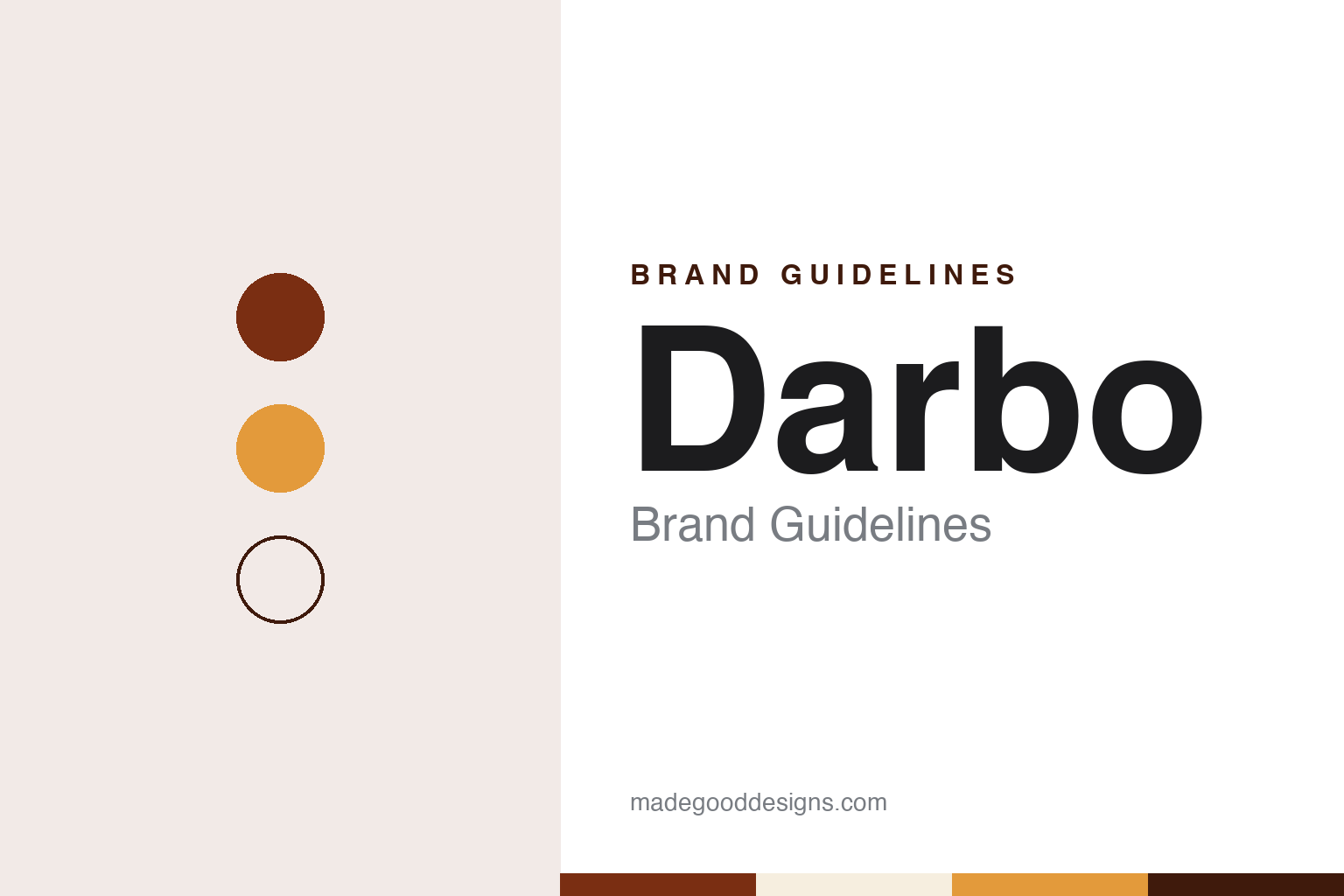
Two constants: a Darbo apricot, fruit brown and cream palette and a soft old-style serif register. Abstract homage — not a Darbo product or mark; no jar, label or logo is reproduced.
Görz to Stans
A fruit works on the Isonzo and an inn in the Inn Valley.
Darbo traces its beginnings to 1879 and to Görz — today Gorizia, in Italy’s Friuli-Venezia Giulia, but then an Austrian city. There Rudolf Darbo, also written d’Arbo, ran a fruit steam works and distillery, English and German Wikipedia say. The company says the family made jams, syrups and fine fruit liqueurs there and that its products won several awards.
The First World War ended that chapter. The company says the works were badly damaged in the war and that the family moved to Stans, a village in the Lower Inn Valley of Tyrol. Wikipedia and the Austrian broadcaster ORF date the move to 1918, while the company’s own history says the 1920s. In Stans the family at first ran an inn, English Wikipedia says. Adolf Darbo senior, a trained confectioner, began making jam and bottling honey alongside it, and later had the idea of supplying small portions to the catering trade, according to German Wikipedia.
Tyrol’s growth as a holiday region after the Second World War brought demand for jam and honey, and Wikipedia says Darbo became the leading jam maker in Austria. The company says it built a new plant in the 1950s and moved into retail as well as hospitality. The business still carries the family name: it is the Adolf Darbo AG, often styled A. Darbo AG, with its head office in Stans, and the company dates its family tradition to 1879.
Colour
Naturrein, honey and fruit preparations.
Klaus Darbo joined the company in 1970 and was running it by the late 1970s, widening it from catering supply into food retail, English Wikipedia says. German Wikipedia credits him with the Naturrein range. In Austria “naturrein” is a protected term for jam, which, German Wikipedia explains, may then be made only from fruit, gelling sugar and lemon juice.
The company says it opened another plant in Stans in 1990 and, from the mid-1990s, began making fruit preparations for dairies, bakeries and confectioners, alongside its jams, honey and syrups. Today it describes itself as the market leader in Austria’s traditional jam and honey market and says it works from four sites in Tyrol. In June 2025 it told ORF that it continued to produce exclusively at its Tyrolean sites; we give that as the company’s statement.
The business has grown with exports. In 2009 ORF reported revenue of €99.7 million for 2008 and 292 employees. For 2024 Darbo reported record revenue of €197.1 million, up 4.01 per cent, 440 employees and an export share of 60 per cent, with deliveries to more than 50 countries including Germany, Italy, the Middle East, China and the United States, ORF reported in June 2025. The German trade magazine wir reported in January 2024 that Darbo’s share of the German jam market had risen from 3 per cent in 2016 to 6.7 per cent in 2023.
The company’s own report on 2023, issued as a press release through the Tyrolean business portal top.tirol, gave slightly different figures: revenue of €189.5 million, up 12.1 per cent, a 62 per cent share of the Austrian jam market and a 6.6 per cent share in Germany, with customers in 55 countries. The same release said a blind tasting by the editors of the restaurant guide Gault&Millau had placed its Fruchtreich Rosen-Marille apricot jam first among many apricot jams in 2023, and announced Haselkuss, a hazelnut cream in a dosing bottle, together with a dispenser made for breakfast buffets in hotels and restaurants. English Wikipedia adds that Darbo also makes products under retailers’ own labels.
Typography
Jam, marmalade and fruit spreads.
The seven brands in this group all make jam and fruit spreads, and they come from Switzerland, Austria, Germany, the United States and France: Hero, Darbo, Zentis, Schwartau, Smucker’s, Andros and St. Dalfour. Jam brands in general sit at many different points in the trade, from family firms that still carry a founder’s surname to names that now belong to much larger food groups, and a single brand can be sold everywhere from a village shop to a supermarket shelf in another continent.
A jam brand’s identity is usually carried less by a single product than by a jar, a lid, a label and the breakfast it promises, because the company behind the name may have changed hands, moved its factory or grown far beyond the town where it started. That makes the questions behind each name worth asking plainly: who started it, who owns it now, and where its jam is actually cooked and filled.
Each guide separates what independent sources record from what the company says about itself — its founding story, its owners over time, where its jam is made and how its packaging has changed — and marks plainly what rests only on the company’s own word.
Aa
A soft old-style serif — for a family name carried since 1879. (Specimen set in Fraunces, a serif STAND-IN; NOT the Darbo logo.)
Darbo
A stake held by a rival, then bought back.
For fifteen years part of Darbo belonged to a rival. In 1994 the German jam maker Schwartau bought a 25 per cent stake and later raised it to 42.4 per cent through further purchases, cash.at reported in June 2009. Schwartau’s Swiss parent, Hero, then offered the shares to the family, which bought them; since June 2009 Darbo has been about 98 per cent family-owned, with 2 per cent in free float, ORF reported.
The same year brought a change of generation. In July 2009 ORF reported that Klaus Darbo, who had led the company since 1970, had handed the chair of the executive board to his son Martin Darbo, then 31. The company counts Martin as the fifth generation, and he ran the business with his uncle Adolf, wir reported. In January 2024 the magazine reported Adolf Darbo’s retirement and a new arrangement in which Martin and his brother Klaus Darbo lead the company; ORF named Klaus Darbo as chairman of the executive board in 2025, and the company says he took over the chair in 2024.
For a design guide, Darbo shows how a family name, one valley and one category can carry a brand from the catering trade to export shelves. Compare Schwartau, the German jam maker that once held a large stake in Darbo, and Manner, another Austrian food brand. For this guide we use apricot, a deep fruit brown and cream with a serif, an unofficial interpretation; no product or logo is reproduced.
Explore & save
Keep Darbo’s identity on hand — save it to a board in the Made Good inspiration library.
Darbo identity set
Pin the Darbo apricot, fruit brown and cream palette and the soft old-style serif register to your own board.