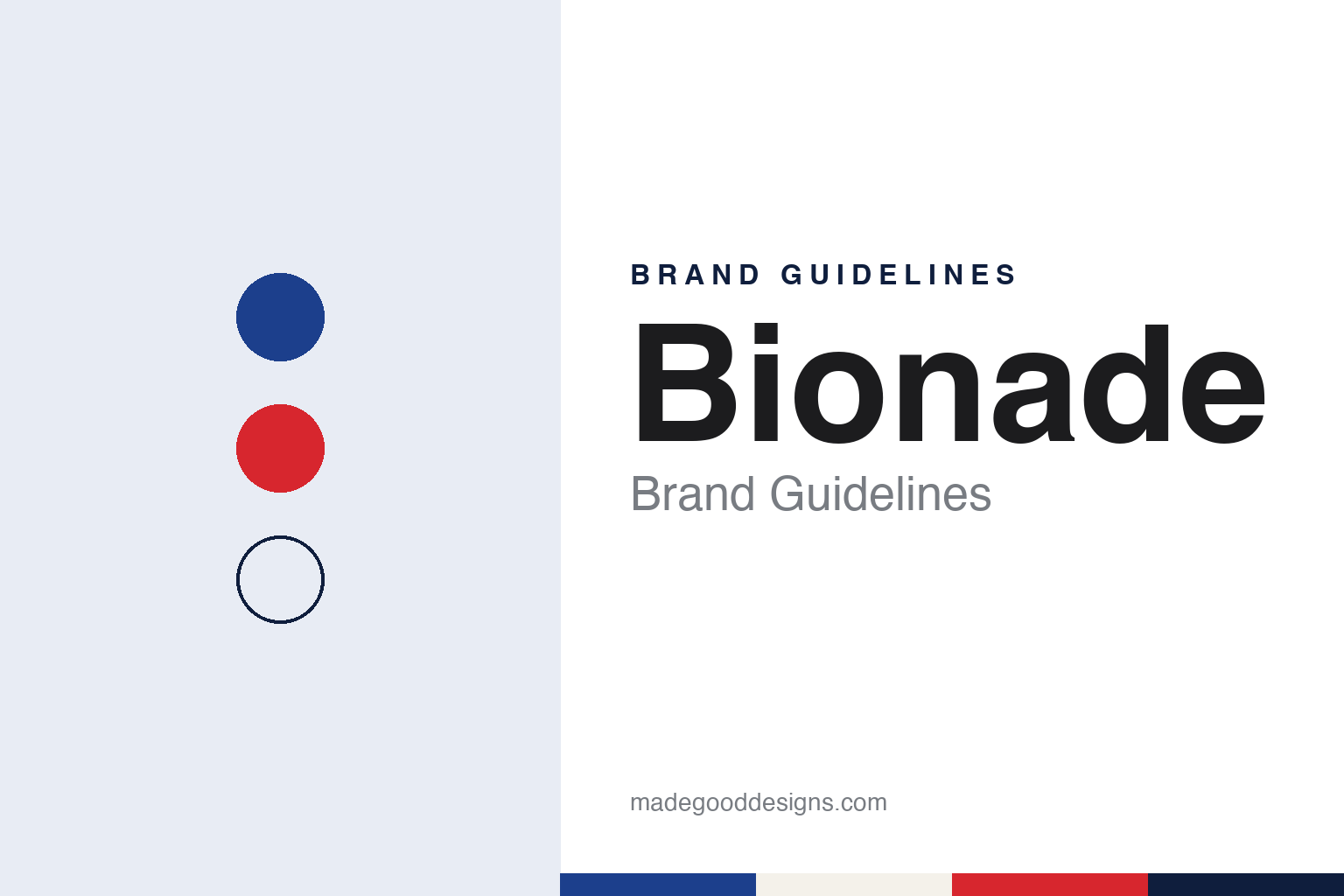
Bionade Brand Guidelines
The brewed organic soft drink from a small Rhön brewery.
Aa
Two constants: a Bionade blue, red and white palette and a rounded sans register. Abstract homage — not a Bionade product or mark; no bottle, label or logo is reproduced.
The Peter brewery
A brewmaster’s alcohol-free brew from the Rhön.
Bionade comes from Ostheim vor der Rhön, a small town in Lower Franconia, in the north of Bavaria. It was the work of Dieter Leipold, master brewer at the town’s Peter brewery, which the Leipold and Kowalsky families owned and which was facing insolvency, according to German Wikipedia, citing die tageszeitung in 2006. Leipold wanted a soft drink brewed like beer but without alcohol. His answer was a fermentation in which a bacterium found in kombucha, Gluconobacter oxydans, turns sugar into gluconic acid rather than alcohol. Malt and water form the base, as in beer, and carbon dioxide, sugar and natural fruit and herb flavours are added after storage and filtering, German Wikipedia says, citing a 2011 book co-written by Peter Kowalsky.
The company tells the story with dates of its own. Bionade says Leipold first had the idea in 1960, succeeded in turning sugar into gluconic acid by fermentation in 1989, chose the name in 1990 — from “biotechnical,” it says — and in 1994 patented the process and launched the first flavour, lychee. German Wikipedia also dates the invention to 1994; English Wikipedia, citing Time and die tageszeitung, says sales began in 1995, at first in spa clinics and fitness centres. Elderflower followed in 1996, under the name Red Berry, and herbs in 2002, the company says.
The breakthrough came through Hamburg. The Hamburg drinks wholesaler Göttsche took Bionade into its range — in 1997 according to German Wikipedia, in 1998 according to English Wikipedia and the company — and it spread through the city’s bars, cafés and clubs. Der Tagesspiegel pointed in 2006 to one reason: it was a non-alcoholic drink in a classic beer bottle. Articles in brand eins and manager magazin in 2003 helped bring it into the big supermarket chains, German Wikipedia says.
Colour
A round mark, a longneck and a slogan.
Bionade’s look rests on a clear glass bottle and a round red, white and blue mark, and two sources credit it differently. The company says Leipold himself designed new labels in 1997, “including the red-white-blue dot” that it still calls its trademark. English Wikipedia says that after Peter Kowalsky hired the marketing expert Wolfgang Blum in 1999, a retro blue, white and red logo was designed and the bottle was made of clear rather than brown glass while keeping the shape of a classic longneck beer bottle, which eased distribution and helped the drink sell in bars and nightclubs.
Growth was rapid. German Wikipedia, citing company figures, gives sales of about 2 million bottles in 2002 and 2003, 7 million in 2004, 20 million in 2005, 70 million in 2006 and 200 million in 2007. From 1 October 2006 Deutsche Bahn served it in its dining cars, and in 2007 it reached McDonald’s McCafé outlets, the Financial Times Deutschland reported. A half-litre PET bottle joined the glass bottle in 2005, sold mainly at petrol stations, railway stations and airports.
Bionade’s first advertising campaign ran in 2007, on billboards in fifteen German cities and on radio, with the line “Bionade. Das offizielle Getränk einer besseren Welt” — “the official drink of a better world” — Die Welt reported. That November the journalist Henning Sußebach coined the term “Bionade-Biedermeier” in Die Zeit to describe life in Berlin’s Prenzlauer Berg, and the word has since been used for eco-minded urban milieus and for gentrification. Look-alike drinks followed; in July 2007 Bionade obtained an injunction in Hamburg against the discount chain Plus over a similarly styled product, die tageszeitung reported.
Typography
Design and documentation.
The seven brands in this group are all soft-drink names from Germany and Italy: Bionade, fritz-kola, Afri-Cola, Chinotto Neri, Crodino, Lurisia and Sanbittèr. German and Italian soft-drink brands in general sit at many different points in the trade, from family firms that still carry a founder’s name to names that now belong to much larger food and drink groups, and a single brand can be sold everywhere from a corner bar to a supermarket shelf.
A soft-drink brand’s identity is usually carried less by a single recipe than by a bottle, a name and the moment it promises, because the company behind the name may have changed hands, moved its production or grown far beyond the place where it started. That makes the questions behind each name worth asking plainly: who started it, who owns it now, and where its drinks are actually made and bottled.
Each guide separates what independent sources record from what the company says about itself — its founding story, its owners over time, where its drinks are made and how its packaging has changed — and marks plainly what rests only on the company’s own word.
Aa
A rounded sans for a round mark. (Specimen set in Nunito, a sans STAND-IN; NOT the Bionade logo.)
Bionade
From the founding families to Hassia.
Ownership changed several times. The company says that in 2002 it set up Bionade International GmbH for exports and that Rhön-Sprudel took 51 percent of Bionade GmbH; German Wikipedia names the holder of that stake as the Egon Schindel holding. English Wikipedia says Coca-Cola offered to buy the drink in 2004 and was turned down. On 1 October 2009 Der Spiegel reported that the Radeberger Group, the brewing arm of Dr. Oetker, would take over the Schindel stake; by April 2010 Oetker’s share had risen to 70 percent, the Neue Westfälische reported, and in February 2012 the founding family sold its remaining 30 percent to Radeberger, Focus reported. Sales had meanwhile fallen, to 60 million bottles in 2010 and 2011, according to German Wikipedia, citing Die Zeit.
On 11 October 2017 manager magazin reported that Radeberger would pass Bionade and Ti Erfrischungstee to Hassia, the mineral-water company of Bad Vilbel near Frankfurt, at the start of 2018. Hassia took over Bionade GmbH in full on 1 January 2018, German Wikipedia says. At the time of the sale, the trade site Beverage World reported that the production site in Ostheim would remain part of the brand and that its staff would stay on; sales and marketing moved to Hassia in Bad Vilbel. The company says all its agricultural ingredients are organic and that its drink is “brewed, not just mixed.”
The range has widened under Hassia: cloudy lemon and orange in 2019, which the company says came with a new label design; maté in 2020; blood orange in 2023; and iced teas in 2024. In January 2025 W&V covered a design competition run by the brand.
For a design guide, Bionade shows how a single round mark and a borrowed bottle shape can carry a brand through several owners. Compare Dr. Oetker, whose brewing group owned it from 2009 to 2017, and fritz-kola, another drink that made its name in Hamburg’s bars. For this guide we use blue, red and a warm white with a rounded sans, an unofficial interpretation; no product or logo is reproduced.
Explore & save
Keep Bionade’s identity on hand — save it to a board in the Made Good inspiration library.
Bionade identity set
Pin the Bionade blue, red and white palette and the rounded sans register to your own board.