Chocomel Brand Guidelines
The Dutch chocolate milk that was Cécémel in Belgium.
Aa
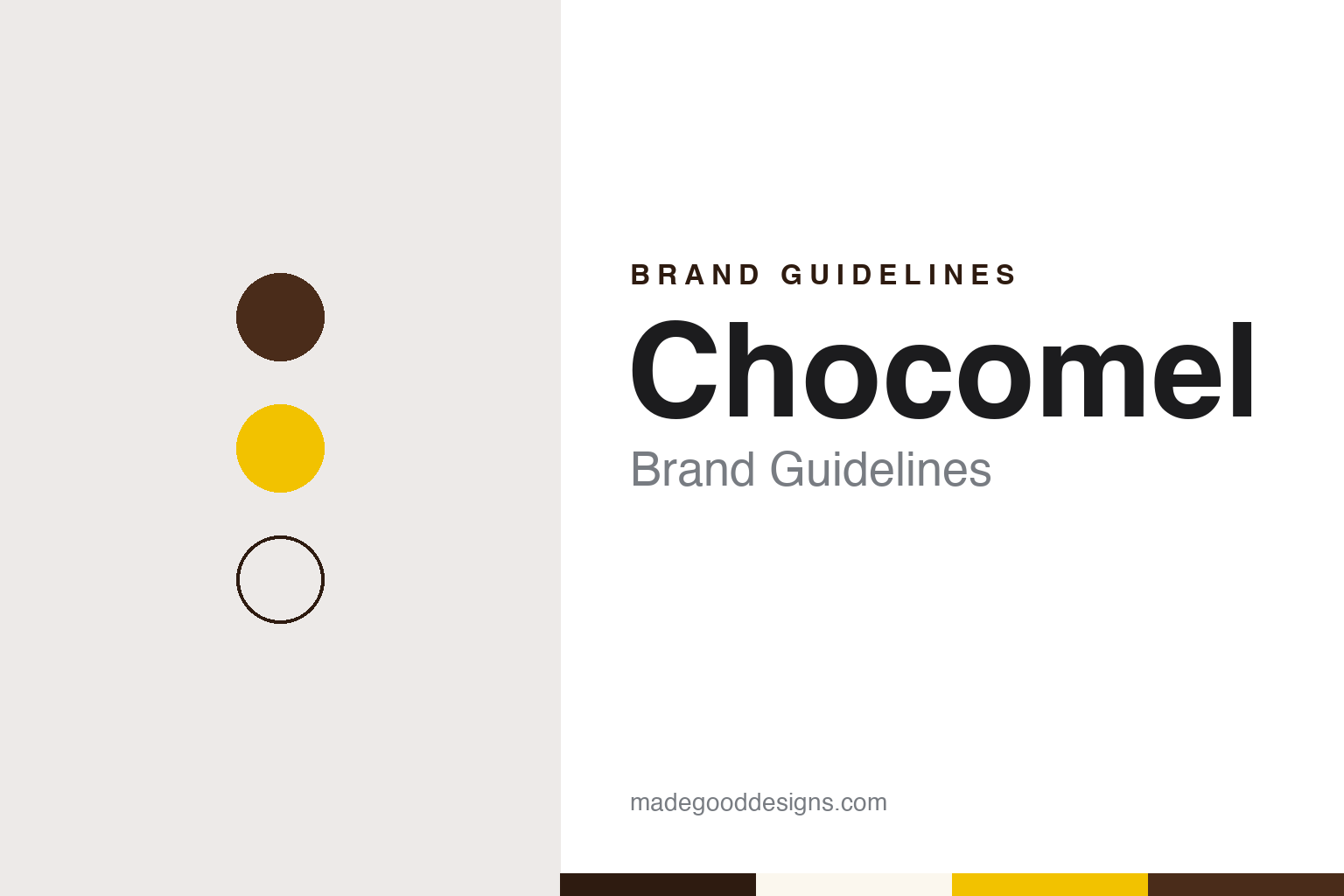
Two constants: a pack yellow, cocoa brown and milk white palette and a rounded bold sans register. Abstract homage — not a Chocomel product or mark; no pack, logo or carton is reproduced.
Melcola and Chocomel
A Zoetermeer company, a Baarn dairy and a name from 1932.
Chocomel is a Dutch chocolate milk, and its story starts in 1932. FrieslandCampina, which owns the brand today, tells it this way on the history page of its Belgian website: in 1932 the Dutch company Nutricia, of Zoetermeer, found a way to make chocolate milk keep for longer, which let it supply the drink to cafés and restaurants, and it called the result Melcola. The name was later changed to Chocomel. A June 2026 report by the Belgian broadcaster VRT, based on a story from the Belga news agency, gives the same outline: the drink began in the Netherlands in 1932 as Melcola and was soon renamed.
Dutch Wikipedia adds a second strand. It says the Chocomel name itself was introduced and registered as a trademark in 1932 by Martien Breij, a director of the Melkinrichting J.A. Breij, a dairy in Baarn that had developed its own chocolate milk, while Nutricia registered its shelf-stable drink as Melcola in the same year. According to the same article, Nutricia wanted the Chocomel name and bought it some years later from Breij’s widow. The two accounts agree on the year and on Nutricia becoming the owner of the name; they differ on who first used it.
For most of the twentieth century Chocomel was a Nutricia product. English Wikipedia, citing a 2015 report in the Dutch food-technology magazine VMT, says it was formerly made by Nutricia in Zoetermeer and by Riedel Drinks. In 2001 Nutricia sold its dairy and drinks division, which included Chocomel and the yoghurt drink Fristi, to Friesland Coberco Dairy Foods, Dutch Wikipedia says; the company’s own Belgian timeline dates the takeover by Friesland Foods to the same year. Friesland Foods merged with Campina in 2008 to form FrieslandCampina, which has owned Chocomel since.
Colour
C..c.mel, Expo 58 and a yellow pack.
Chocomel’s most unusual chapter played out across the border. When Nutricia launched the drink in Belgium in 1949, it could not use the Chocomel name there. The company’s history says the name was already in use in Belgium, and Dutch Wikipedia says its Belgian owner would not sell it. The solution, by the company’s account, was to replace some of the letters with dots, giving “C..c.mel”. Belgians read it aloud as “c-c-mel,” and the spelling followed the pronunciation: Cécémel.
The Belgian timeline is the most detailed design history the brand has published. It says millions of bottles were served at Expo 58, the Brussels world’s fair of 1958, and that the following year, as Cécémel turned ten, the Belgian graphic artist and sculptor Paul Ibou, then working for the brand, designed new packaging and a new logo. Cécémel went on sale in shops in glass bottles in 1969, by the company’s account, and moved to a Tetra Brik carton in 1979. In the 1990s, the company says, it registered the yellow of its pack as a trademark, calling that yellow “the” colour of Cécémel. Its timeline also lists a new design in 2013 and a new look for its website and communications in 2018.
That Belgian split lasted 77 years. On 8 June 2026 VRT reported that FrieslandCampina was renaming Cécémel as Chocomel in Belgium, keeping production at its plants in Aalter and Bornem and keeping the slogan. English Wikipedia also names Aalter as the place where Chocomel is made. The slogan, used on both sides of the border, is “De enige échte,” “the one and only”; Dutch Wikipedia gives the French version used in Belgium as “Le seul vrai.”
Typography
Design and documentation.
The seven brands in this group are all food and drink names from the Netherlands and Ireland: Calvé, Duyvis, Chocomel, Unox, Odlums, Club Orange and Brennans. Dutch and Irish food and drink brands in general sit at many different points in the trade, from family firms that still carry a founder’s name to names that now belong to much larger food and drink groups, and a single brand can be sold everywhere from a corner shop to a supermarket shelf.
A food or drink brand’s identity is usually carried less by a single product than by a pack, a name and the meal, snack or drink it promises, because the company behind the name may have changed hands, moved its production or grown far beyond the place where it started. That makes the questions behind each name worth asking plainly: who started it, who owns it now, and where its products are actually made and packed.
Each guide separates what independent sources record from what the company says about itself — its founding story, its owners over time, where its products are made and how its packaging has changed — and marks plainly what rests only on the company’s own word.
Aa
A rounded bold sans for a sweet, everyday dairy drink. (Specimen set in Rubik, a sans STAND-IN; NOT the Chocomel logo.)
Chocomel
A brand name that became a word.
Chocomel is sold mainly in the Netherlands and Belgium. Dutch Wikipedia lists limited availability in Germany, the United Kingdom, Austria, Australia and Denmark, and the brand’s Dutch website offers country versions for the Netherlands, Belgium, the United Kingdom and Denmark. The website describes a range of several variants, including a plant-based one, to be drunk cold or warm.
The name has also passed into the language. The Van Dale dictionary of Dutch, cited by Dutch Wikipedia, records “chocomel” as a word for chocolate milk in general. English Wikipedia, citing a 2011 Dutch marketing book, notes that Chocomel has also been sold in pods for the Senseo coffee machine developed by Philips and Douwe Egberts.
For designers, the most useful facts are the ones the company has put on record itself. The Belgian line, by its own account, put its identity in the hands of a working graphic artist, Paul Ibou, in 1959, and later protected a single pack colour as a trademark. The rename of 2026 brings two names that parted in 1949 back under one, with the same slogan and, VRT reported, the same Belgian factories.
For a design guide, Chocomel shows how a dairy drink can hold on to one name and one slogan for decades, and how a name that could not cross a border became a small piece of graphic play with dots. Compare Van Houten, the Amsterdam cocoa name, and Droste, the Haarlem cocoa tin. For this guide we use pack yellow, cocoa brown and milk white with a rounded sans, an unofficial interpretation; no product or logo is reproduced.
Explore & save
Keep Chocomel’s identity on hand — save it to a board in the Made Good inspiration library.
Chocomel identity set
Pin the Chocomel pack yellow, cocoa brown and milk white palette and the rounded bold sans register to your own board.