Crodino Brand Guidelines
The non-alcoholic bitter aperitif named after a Piedmont spa town.
Aa
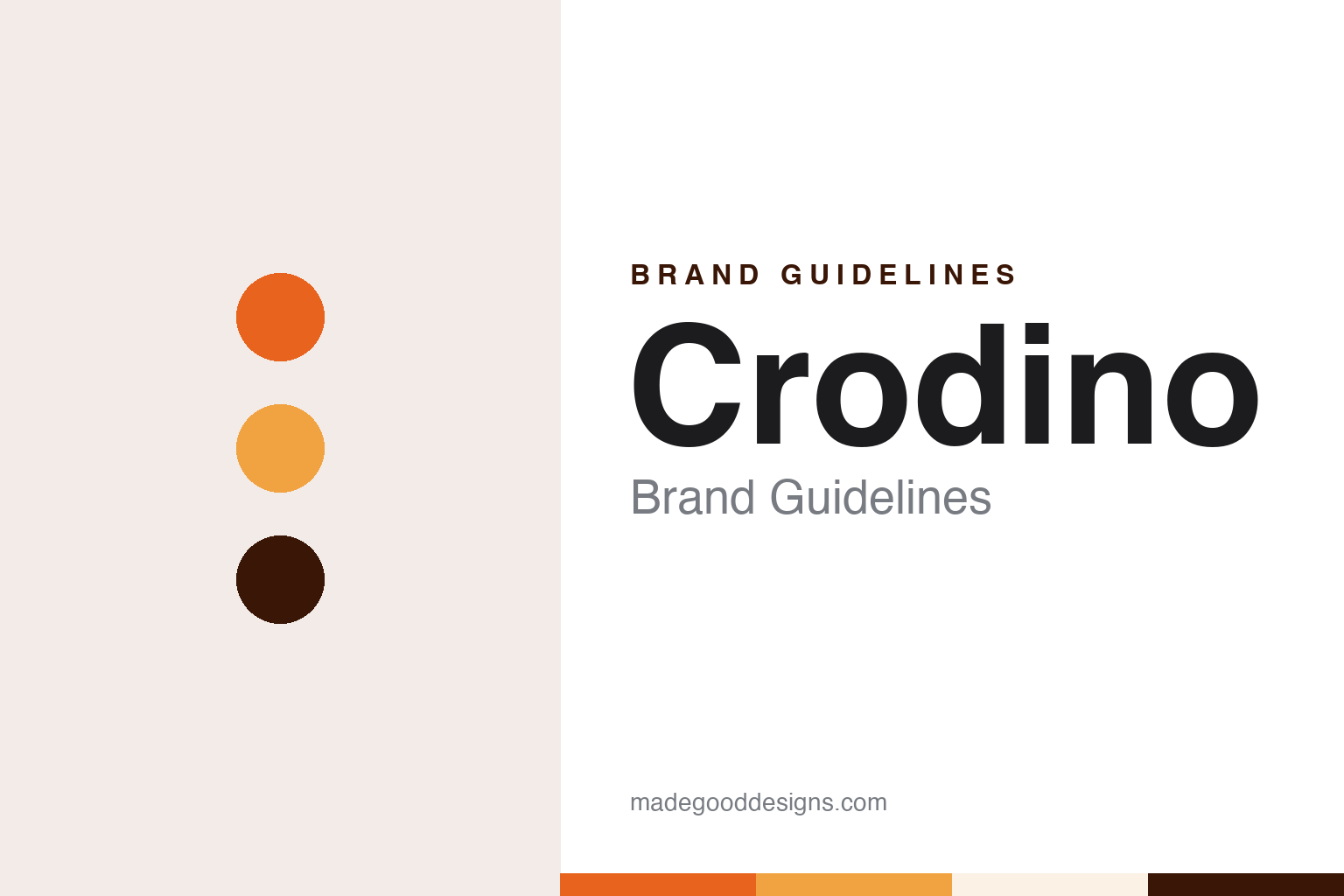
Two constants: a Crodino orange, amber and brown palette and a display serif register. Abstract homage — not a Crodino product or mark; no bottle, cap or logo is reproduced.
Terme di Crodo
A mineral-water company in the Ossola valley.
Crodino takes its name from Crodo, a town of about 1,400 people in the province of Verbano-Cusio-Ossola, in northern Piedmont, Il Post wrote in October 2023. The business behind the drink was the Società Anonima Terme di Crodo, a mineral-water company that the industrialist Piero Ginocchi owned from 1933. Italian Wikipedia, citing a 2021 article in la Repubblica’s Venerdì magazine, says Ginocchi first bottled water in Milan, on viale Brianza, and moved the work to Crodo after an air raid destroyed the Milan buildings in February 1943.
After the war the company widened its range. Italian Wikipedia lists tamarind, chinotto and a Crodo cola among its soft drinks, and Il Post says the Crodo plant, which had bottled mineral water, began making soft drinks in the post-war years. Ginocchi, the same paper says, wanted an original non-alcoholic product that would stand apart from classics such as chinotto and tamarind. Italian Wikipedia puts it in similar terms: to lift the company to a new level it needed a distinctive non-alcoholic drink that would catch consumers’ attention, and from that came the idea of a “blonde” non-alcoholic aperitif.
He asked Maurizio Gozzelino, an oenologist from Cuneo, to create it. Italian Wikipedia, citing La Stampa (2020), says the result went on sale on 1 December 1964 under the name Picador, was then renamed Biondino, and became Crodino on 14 July 1965 — the year the brand still gives as its starting point. In 2021, La Stampa reported, the town of Crodo made Gozzelino an honorary citizen.
Colour
The blonde non-alcoholic.
The recipe has always been the brand’s secret. Il Post describes Crodino as a sparkling drink made by macerating herbs and spices in water and sugar for up to six months, with the full list of ingredients kept secret; Italian Wikipedia names cloves, cardamom, coriander and nutmeg among those that are known, and says the mixture rests in oak casks. The company says its botanicals infuse for six months and that the 1965 recipe has never changed; that is its own claim.
Its colour gave the brand its best-known line. The drink is a light orange, and that, Il Post says, is where the promotional slogan “l’analcolico biondo” — “the blonde non-alcoholic” — came from. The paper also says Crodino became famous through television commercials featuring the French actress Brigitte Bardot.
The pack has stayed small. Italian and English Wikipedia describe Crodino as sold in 10 cl glass bottles closed with a crown cap. Italian Wikipedia says a variant called Crodino Twist, in citrus and red-fruit flavours, followed in 2014 in 17.5 cl bottles, made at the Fava plant in Mariano Comense, in the province of Como. The brand’s website now lists the original Crodino and Crodino Rosso, which it describes as having blood-orange notes, calls Crodino “the Italian Non-Alcoholic Spritz,” and uses the line “Since 1965, a sip of Italian sunset.”
The drink has also travelled. English Wikipedia, citing the trade press, says distribution began in the United Kingdom in 2021, and the French trade title Rayon Boissons reported in May 2022 that Crodino had arrived on the shelves of Carrefour in France. English Wikipedia, citing a 2024 Just Drinks interview with Campari, links the move into new markets to the worldwide popularity of the spritz and its bitter taste.
Typography
Soft drinks and documentation.
The seven brands in this group are all soft-drink names from Germany and Italy: Bionade, fritz-kola, Afri-Cola, Chinotto Neri, Crodino, Lurisia and Sanbittèr. German and Italian soft-drink brands in general sit at many different points in the trade, from family firms that still carry a founder’s name to names that now belong to much larger food and drink groups, and a single brand can be sold everywhere from a corner bar to a supermarket shelf.
A soft-drink brand’s identity is usually carried less by a single recipe than by a bottle, a name and the moment it promises, because the company behind the name may have changed hands, moved its production or grown far beyond the place where it started. That makes the questions behind each name worth asking plainly: who started it, who owns it now, and where its drinks are actually made and bottled.
Each guide separates what independent sources record from what the company says about itself — its founding story, its owners over time, where its drinks are made and how its packaging has changed — and marks plainly what rests only on the company’s own word.
Aa
A display serif — our register for a brand built on an aperitivo ritual. (Specimen set in DM Serif Display, a serif STAND-IN; NOT the Crodino logo.)
Crodino
From Bols to Campari, and out of Crodo.
The brand left the Ginocchi company’s hands in the 1980s. In 1983, Italian Wikipedia says, Terme di Crodo and its brands were sold to the Dutch drinks company Lucas Bols, later Bols Wessanen. In 1995 the Milan spirits group Campari bought Bols Wessanen’s Italian business, including Crodino; the Corriere della Sera covered the deal in January 1995, and Crodino has belonged to Campari Group ever since.
The town and the drink were separated in two steps. In 2017, Il Post reported, Campari sold most of its non-alcoholic brands, together with the Crodo plant, its spring and its warehouse, to the Danish brewer Royal Unibrew, but kept Crodino, which Royal Unibrew went on bottling at Crodo under contract. In October 2023 the trade title Just Drinks reported that the contract would end, and Il Post said production would move in 2024 to Campari’s plant at Novi Ligure, in the province of Alessandria, while Royal Unibrew said its other drinks would stay at Crodo with no job losses. English Wikipedia gives Crodino’s years of bottling in Crodo as 1964 to 2023, and Just Drinks noted that the drink had been made in the town since 1965. The brand still carries the town’s name.
For a design guide, Crodino shows how a small bottle, a single colour and a nickname can carry a non-alcoholic drink through three owners and a change of factory. Compare Sanbitter, another Italian non-alcoholic bitter, and Appleton Estate, a rum brand from the same Campari Group. For this guide we use aperitivo orange, sunset amber and bitter brown with a serif, an unofficial interpretation; no product or logo is reproduced.
Explore & save
Keep Crodino’s identity on hand — save it to a board in the Made Good inspiration library.
Crodino identity set
Pin the Crodino aperitivo orange, sunset amber and bitter brown palette and the display serif register to your own board.