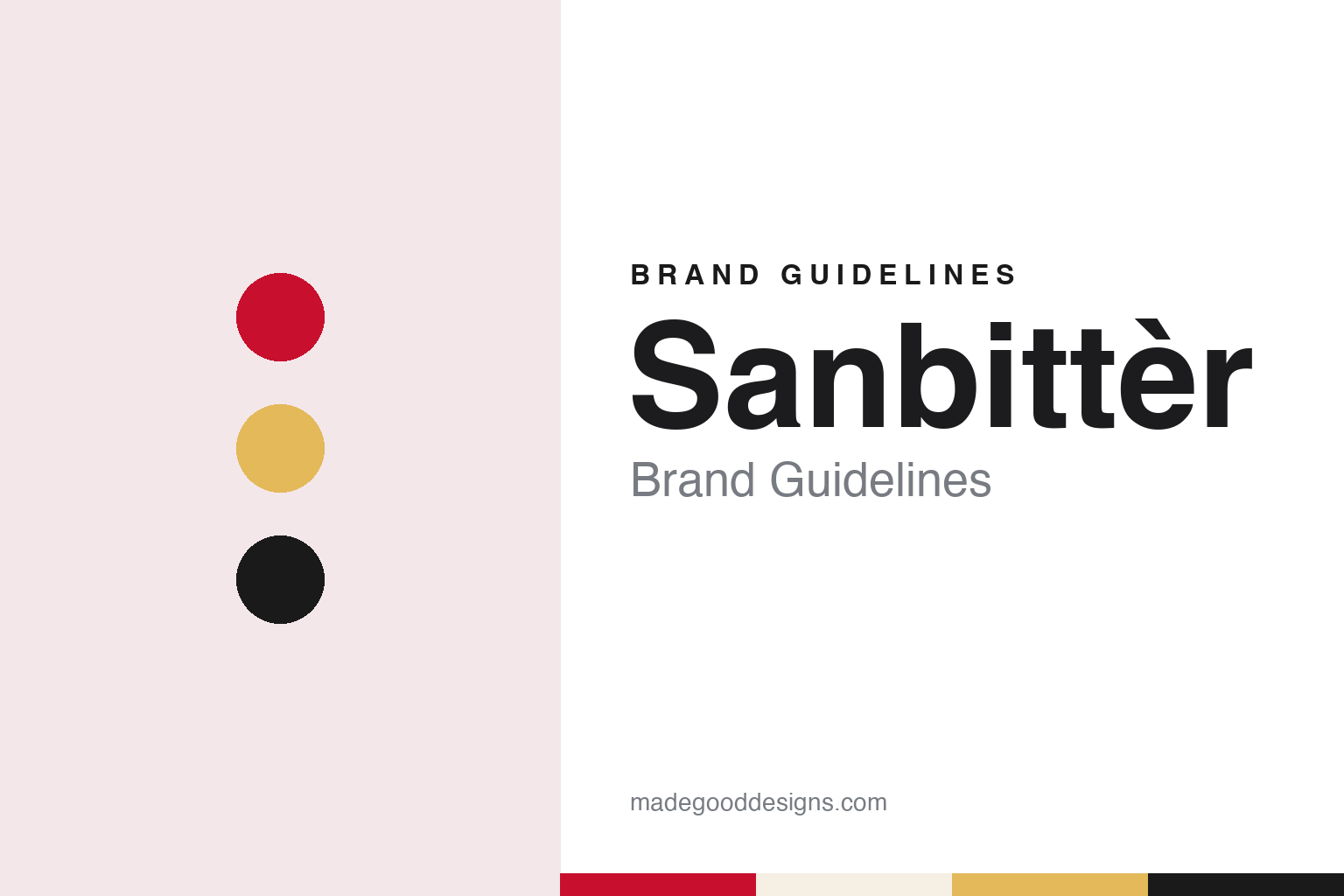
Sanbittèr Brand Guidelines
Sanpellegrino’s little red bitter, poured since 1961.
Aa
Two constants: a bitter red, dry gold and bar cream palette and a bright aperitivo serif register. Abstract homage — not a Sanbittèr product or mark; no bottle, label or logo is reproduced.
Bitter Sanpellegrino
A mineral-water company, a son-in-law and a single-serve bottle.
Sanbittèr is a red, non-alcoholic bitter sold in small single-serve bottles, and it belongs to Sanpellegrino S.p.A., the company best known for the sparkling mineral water drawn at San Pellegrino Terme, in the province of Bergamo. Italian Wikipedia says the company was founded there on 21 May 1899 as the Società Anonima delle Terme di San Pellegrino and took the shorter name Sanpellegrino in 1970. By the 1930s it was already making citrus soft drinks alongside its water: its orangeade was devised in 1932 and launched in 1937, Italian Wikipedia says.
The bitter came a generation later. According to Italian Wikipedia, in the late 1950s the running of the business passed from Ezio Granelli to his son-in-law Giuseppe Mentasti, who helped bring about the birth, a few years later, of a non-alcoholic aperitif called Bitter Sanpellegrino. The company dates its launch to 1961 and says it was the first non-alcoholic aperitif in Italy. It describes the original idea as an aperitif that was both alcohol-free and portioned for one, to be drunk at the bar counter or at home, and says its red colour made it recognisable from the start.
The company says the recipe is based on citrus extracts, spices and herbs; Italian Wikipedia adds sugar to that list. When the American food site Serious Eats reviewed the drink in March 2012, it described a bright red soda in tiny 100 ml glass bottles with the name engraved on the side, and compared its bitter, herbal taste to a Campari without the alcohol.
Colour
From black-and-white television to “c’est plus facile.”
Advertising has carried the brand for most of its life. The company says the first television spot for Bitter Sanpellegrino went out in 1971, still in black and white, and was filmed at Portovenere on the Ligurian coast. A second, paler variant arrived in 1981: the company dates Sanbittèr Dry, lighter in colour and gentler in taste, to that year, and says a yellow variant called Doré joined the range in the same period. Italian Wikipedia lists both Doré and Sanbittèr Dry among the products Sanpellegrino added after the late 1960s.
In 1985 the company officially changed the name from Bitter Sanpellegrino to the shorter Sanbittèr, spelled with a grave accent on the final e. Its own history page pairs the change with the line “Sanbittèr… c’est plus facile!” — a French tag on an Italian drink. Italian Wikipedia records another remembered spot that ended on the slogan “Fatti un Sanbittèr”, followed by a familiar seven-note jingle played as a tuba solo. In 2001 a Sanbittèr commercial paired the actress Anna Longhi with the comedian Dario Vergassola, according to their Italian Wikipedia entries.
The bottle itself was redrawn at the turn of the century. The company says that in 2000 Sanbittèr changed the design of its small bottle thanks to the talent of Giugiaro, making it simpler, more refined and easier to tell apart. Italian Wikipedia’s entry on Italdesign Giugiaro, the Italian design firm best known for its car designs, lists the graphics and the small bottle of Sanbittèr among its product-design work for Sanpellegrino. The company later refreshed the packs again: in 2020, it says, they became more colourful to tie every product more closely to the Sanbittèr mother brand, and in 2021 it gathered the whole range under a single signature, “Sanbittèr. Tutti i colori dell’aperitivo” — all the colours of the aperitif.
Typography
Design and documentation.
The seven brands in this group are all soft-drink names from Germany and Italy: Bionade, fritz-kola, Afri-Cola, Chinotto Neri, Crodino, Lurisia and Sanbittèr. German and Italian soft-drink brands in general sit at many different points in the trade, from family firms that still carry a founder’s name to names that now belong to much larger food and drink groups, and a single brand can be sold everywhere from a corner bar to a supermarket shelf.
A soft-drink brand’s identity is usually carried less by a single recipe than by a bottle, a name and the moment it promises, because the company behind the name may have changed hands, moved its production or grown far beyond the place where it started. That makes the questions behind each name worth asking plainly: who started it, who owns it now, and where its drinks are actually made and bottled.
Each guide separates what independent sources record from what the company says about itself — its founding story, its owners over time, where its drinks are made and how its packaging has changed — and marks plainly what rests only on the company’s own word.
Aa
A bright, high-contrast serif for a brand built on the aperitivo hour. (Specimen set in Playfair Display, a serif STAND-IN; NOT the Sanbittèr logo.)
Sanbittèr
Flavours, long-necks and a Nestlé parent.
For half a century the range stayed close to the original red and the Dry. That changed in 2011, when the company launched Sanbittèr Emozioni di Frutta, beginning with grapefruit, in a 20 cl long-neck bottle that it presents as a ready-to-drink aperitif. Passion fruit followed in 2012 and blackcurrant in 2014, the company says, and in 2013 a spiced line, Emozioni di Spezie, came in chilli and cinnamon versions, the drinks-trade site Beverfood reported at the time. In September 2014 the Emozioni range took second place in the beverages category of the first “Premio Food – Scelto dagli esperti”, an award run by the trade magazine Food, Beverfood reported. Ginger (2016), lime (2017), elderflower (2020) and a ready-to-mix bottled-cocktail line (2018) followed, according to the company’s timeline, and in 2021 it added Sanbittèr Fizz, which is opened, given a wedge of lemon and drunk straight from the bottle.
Ownership sits a level above the brand. In November 1997 Nestlé, through its Perrier Vittel water business, agreed to buy the rest of the San Pellegrino group, The New York Times reported; English Wikipedia dates the purchase of Sanpellegrino S.p.A. to that year, while Italian Wikipedia places the company’s complete absorption into Nestlé in 1999. Sanpellegrino S.p.A. remains the Italian company behind the brand, and its corporate site lists Sanbittèr today in two core versions, the historic Rosso and the paler Dry, with the red also sold in a 10 cl bottle. The company calls the red version Italy’s best-loved non-alcoholic aperitif. Its sister brands at Sanpellegrino include the S.Pellegrino water and the Aranciata, Limonata and Chinò soft drinks.
For a design guide, Sanbittèr shows how one colour, one bottle size and one renamed word can carry a drink from 1961 to today. Compare San Pellegrino, the mineral-water brand from the same company, and Crodino, another Italian non-alcoholic bitter aperitif. For this guide we use a bitter red, a dry gold and a bar cream with a bright serif, an unofficial interpretation; no product or logo is reproduced.
Explore & save
Keep Sanbittèr’s identity on hand — save it to a board in the Made Good inspiration library.
Sanbittèr identity set
Pin the Sanbittèr bitter red, dry gold and bar cream palette and the bright aperitivo serif register to your own board.