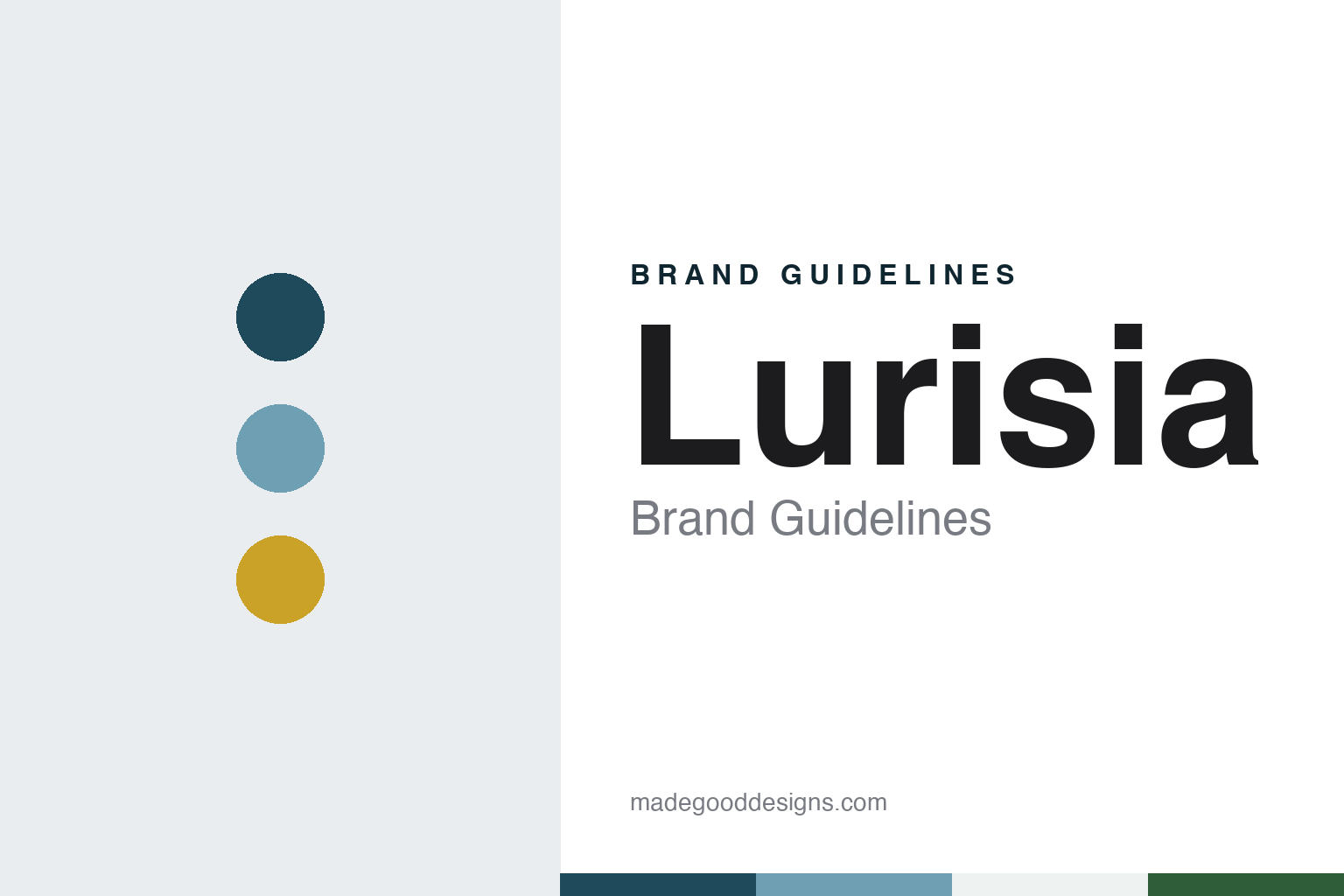
Lurisia Brand Guidelines
The Monte Pigna spa water that became a chinotto brand.
Aa
Two constants: a Lurisia mountain blue, green and gold palette and a geometric sans register. Abstract homage — not a Lurisia product or mark; no bottle, label or miner symbol is reproduced.
Monte Pigna
A slate quarry, a spring and a spa.
Lurisia is a place before it is a brand. Italian Wikipedia describes it as a hamlet of about 200 residents in the comune of Roccaforte Mondovì, in the province of Cuneo, at the foot of Monte Pigna in the Ligurian Alps, some 13 kilometres from the French border. It says the name probably comes from the Piedmontese word for the flat stones of the local stream.
The water’s story begins underground. Early in the twentieth century, Italian Wikipedia says, citing a local history by Giuseppe and Paolo Raschio, miners working the “Nivolano” slate quarries above the village found a radioactive spring. On 16 August 1918 the physicist Marie Curie came to Lurisia, invited by Italy’s war ministry to assess whether the area’s radioactive minerals could be put to use during the First World War; a fresco on a house in the village recalls her visit. The company’s own history tells the discovery as a legend of a miner who found the spring around 1900, and gives Curie a place in it.
A spa followed. Italian Wikipedia dates the opening of the thermal establishment to August 1940, and the company says a doctor, Pietro Cicoglini, persuaded two Ligurian entrepreneurs, David Garbarino and Piero Sciaccaluga, to found it. The spa drew guests including the presidents Luigi Einaudi and Giovanni Gronchi, Italian Wikipedia says, and after the war the village grew into a resort with ski lifts on Monte Pigna; by the 1970s, it says, as many as 17 hotels were open at the same time. The spa still operates today as a wellness centre, Italian Wikipedia says.
Colour
A miner on the label, Chinotto in the bottle.
Bottling grew out of the spa. Italian Wikipedia says that after the thermal establishment opened, a bottling operation began using the miner symbol — a reminder of how the spring was found — which the brand still carries. The company dates industrial bottling, and its first bottling plant, to 1950. When Coca-Cola HBC Italia agreed to buy the business in 2019, la Repubblica described it as bottling still and sparkling mineral waters from springs about 1,400 metres up Monte Pigna, in plastic and glass.
The modern brand took shape in the 2000s. The company says it began working with Eataly, the Italian food retailer, in 2004, with Eataly selling its Bolle (sparkling) and Stille (still) waters and later its whole soft-drink range. In 2008, it says, Lurisia launched its first soft drinks — Chinotto, Gazzosa, Aranciata and a tonic water — with recipes drawn from Italian tradition and ingredients from producing areas including Slow Food Presidia, and the Bolle and Stille bottle was designed by Sottsass Associati, the Milan studio founded by Ettore Sottsass. Both are the company’s own accounts. An Aranciata Amara, an Aranciata Rossa and a Limonata followed between 2011 and 2019, it says.
Lurisia also had a long partnership with Slow Food. La Repubblica reported in 2019 that the company had supported the association since 2007, mainly as a partner of its large events — Cheese in Bra, Slow Fish and the Salone del Gusto.
Typography
Soft drinks and documentation.
The seven brands in this group are all soft-drink names from Germany and Italy: Bionade, fritz-kola, Afri-Cola, Chinotto Neri, Crodino, Lurisia and Sanbittèr. German and Italian soft-drink brands in general sit at many different points in the trade, from family firms that still carry a founder’s name to names that now belong to much larger food and drink groups, and a single brand can be sold everywhere from a corner bar to a supermarket shelf.
A soft-drink brand’s identity is usually carried less by a single recipe than by a bottle, a name and the moment it promises, because the company behind the name may have changed hands, moved its production or grown far beyond the place where it started. That makes the questions behind each name worth asking plainly: who started it, who owns it now, and where its drinks are actually made and bottled.
Each guide separates what independent sources record from what the company says about itself — its founding story, its owners over time, where its drinks are made and how its packaging has changed — and marks plainly what rests only on the company’s own word.
Aa
A geometric sans — our register for a brand with a miner on its label. (Specimen set in Josefin Sans, a sans STAND-IN; NOT the Lurisia logo.)
Lurisia
From Eataly’s water to Coca-Cola HBC.
By 2019 the company was in investors’ hands. On 18 September 2019, la Repubblica reported, Coca-Cola HBC Italia announced a preliminary agreement to acquire Acque Minerali srl, the company behind Lurisia, which until then had been controlled by the investment fund IDeA Taste of Italy, whose partners were DeA Capital Alternative Funds, the Invernizzi family and Eataly Distribuzione. The paper called Lurisia “the water of Eataly” and named Oscar Farinetti, Eataly’s owner, among its shareholders. The deal was due to complete at the end of 2019, with the company’s chairman and chief executive, Piero Bagnasco, and Alessandro Invernizzi staying on its board. Italian Wikipedia says the industrial site was acquired, but not the thermal park.
Slow Food reacted at once. The day after the announcement, la Repubblica reported, Slow Food said its collaboration with Lurisia would end with that year’s Cheese festival and would not be renewed; the paper’s headline summed up the reason as “different philosophies.” The same paper noted that the deal brought Coca-Cola production back to Piedmont six years after a plant at Gaglianico, near Biella, had closed.
The Piedmont plant joined Coca-Cola HBC Italia’s four other Italian factories, in Campania, Abruzzo, Basilicata and Veneto, la Repubblica said. Today the old lurisia.it address forwards to the brand’s page on Coca-Cola’s Italian website, which presents “Lurisia Premium Beverages” in three lines: water, soft drinks and aperitivo. The company says it marked its 80th anniversary in 2020 and in 2022 launched two non-alcoholic aperitifs, one made with Piedmontese great wormwood and one with Alpine gentian.
For a design guide, Lurisia shows how a mountain spring, a miner symbol and a designer bottle can turn a spa water into a soft-drink brand. Compare Chinotto Neri, another Italian chinotto, and Crodino, a soft drink born at another Piedmont spa. For this guide we use Monte Pigna blue, chestnut-wood green and citrus gold with a sans, an unofficial interpretation; no product or logo is reproduced.
Explore & save
Keep Lurisia’s identity on hand — save it to a board in the Made Good inspiration library.
Lurisia identity set
Pin the Lurisia Monte Pigna blue, chestnut-wood green and citrus gold palette and the geometric sans register to your own board.