Ricola Brand Guidelines
Emil Richterich’s Laufen herb drops and the buildings that house them.
Aa
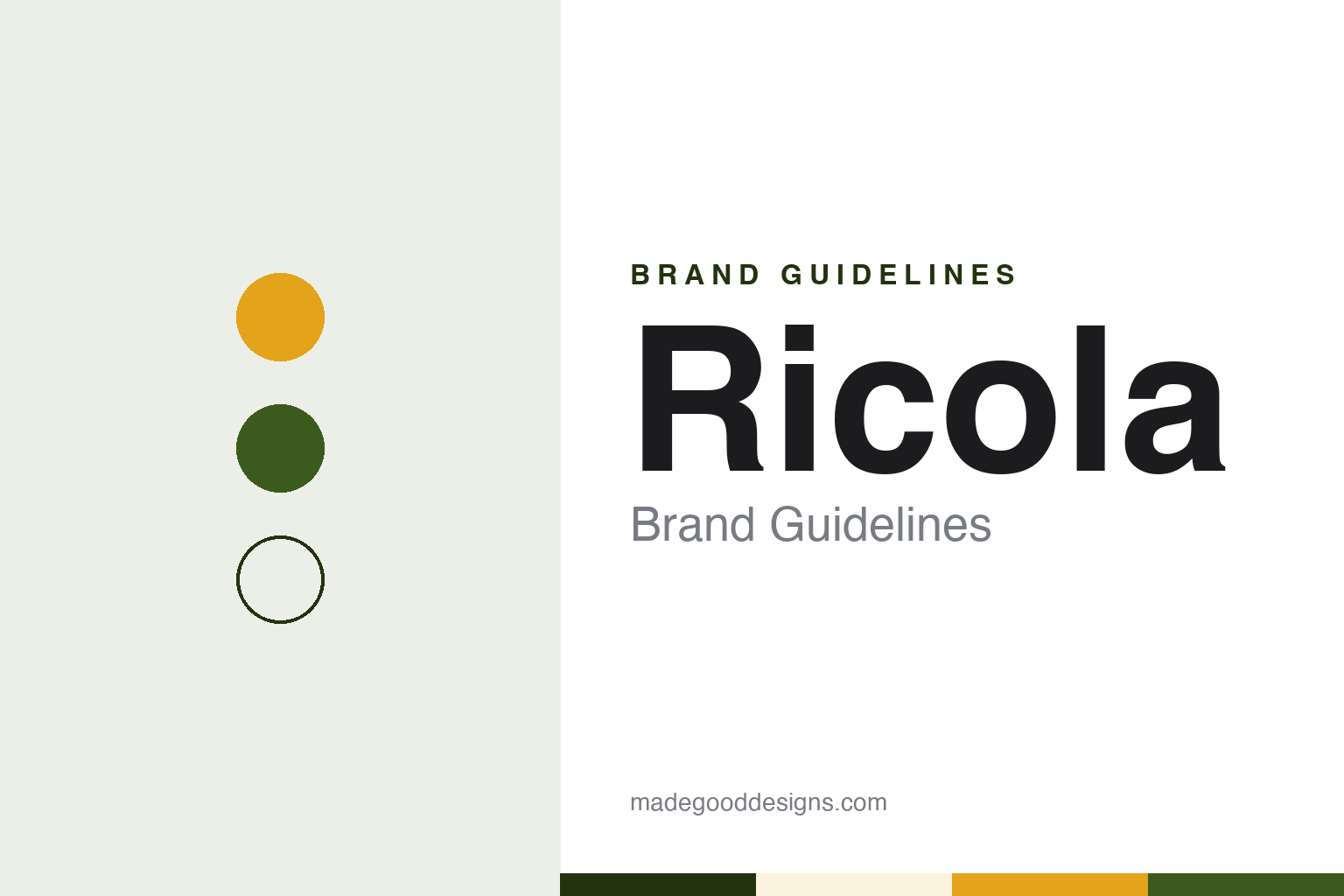
Two constants: a Ricola amber, herb green and white palette and a friendly geometric sans register. Abstract homage — not a Ricola product or mark; no pack, logo or drop is reproduced.
Richterich & Compagnie
A baker’s confectionery works in Laufen.
Ricola began in Laufen, a small town near Basel, in 1930. That year the master baker Emil Richterich set up a confectionery works in his home town, German Wikipedia says, as the Confiseriefabrik Richterich & Compagnie. With his staff he developed sweets that he sold in the region; English Wikipedia names one of them as Fünfermocken, a caramel-like sweet.
The brand name comes from the company name. Ricola is built from the first syllables of Richterich, Compagnie and Laufen, German Wikipedia says, and the company spells it out the same way on its own history page, where “Richterich & Co., Laufen” is abbreviated to “Ri-co-la.” The company says it became a public limited company in 1967; English Wikipedia says the name Ricola was adopted that year by Emil Richterich and his sons Hans Peter and Alfred.
The product that defined the business came a decade after the founding. In 1940, German Wikipedia says, Emil Richterich mixed for the first time the blend of 13 herbs for his Schweizer Kräuterzucker, or Swiss herb sugar, and that blend remains almost unchanged as the basis of Ricola’s products. The company calls 1940 “the invention of the original.” English Wikipedia says that in the 1950s the sweets also became valued for dissolving in hot water as a herbal infusion, which inspired Richterich to make a Ricola herbal tea; German Wikipedia says the company has sold instant tea for about 40 years and added tea bags in 2007.
Colour
Thirteen herbs, mountain farms and architects.
Exports began after the war. The company’s history page dates its first exports, to Germany and Italy, to 1962, with a million drops sold in the first year, while German Wikipedia gives 1960; both agree that from 1970 the company expanded to Japan, Hong Kong, Singapore and the United States. English Wikipedia says Ricola launched Switzerland’s first chewable sugar-free herbal sweet in 1976, and the company says it brought sugar-free drops to market in a “convenient click-box” in 1988.
The herbs are grown in Switzerland. The company dates its systematic herb cultivation with farmers in the Swiss mountain regions to 1979, while both Wikipedias give 1985 for the start of cultivation under Bio Suisse organic standards. German Wikipedia says more than 100 independent farms in the Valais, the Emmental, the Val Poschiavo, the southern foot of the Jura, central Switzerland and Ticino grow herbs for Ricola under contract. The company also runs display herb gardens open to visitors, including at Nenzlingen near its headquarters, at Kandersteg, Zermatt and Pontresina.
Ricola is also known for its architecture. The Basel practice Herzog & de Meuron has worked for it since the 1980s: according to the practice and English Wikipedia’s list of its works, it converted offices in Laufen in 1983, designed a storage building there in 1986–87, a factory addition in 1989–91, a production and storage building for Ricola-Europe at Mulhouse-Brunstatt in France in 1992–93, and a marketing building in Laufen in 1997–99. The Mulhouse building’s long walls are translucent panels printed with a repeated plant motif based on photographs by Karl Blossfeldt, the practice says, and the Museum of Modern Art in New York holds a model and a facade panel from it. The most recent is the Kräuterzentrum, or herb centre, completed in Laufen in 2014: German Wikipedia calls it Europe’s largest clay building, developed with the Austrian clay-building pioneer Martin Rauch, and the company says it is made of clay, gravel and marl from the Laufental.
Typography
Mints, pastilles and throat sweets.
The seven brands in this group all make mints, pastilles, throat sweets or chews, and they come from the Netherlands, Italy, Britain and Switzerland: Mentos, Tic Tac, Altoids, Polo, Fisherman’s Friend, Ricola and Fruittella. Sugar confectionery brands in general sit at many different points in the trade, from family firms that still carry a founder’s surname to names that now belong to much larger confectionery groups, and a single brand can be sold everywhere from a station kiosk to a supermarket checkout.
A sweet brand’s identity is usually carried less by a single sweet than by a pack, a name and the moment it promises, because the company behind the name may have changed hands, moved its factory or grown far beyond the town where it started. That makes the questions behind each name worth asking plainly: who started it, who owns it now, and where its sweets are actually made and packed.
Each guide separates what independent sources record from what the company says about itself — its founding story, its owners over time, where its sweets are made and how its packaging has changed — and marks plainly what rests only on the company’s own word.
Aa
A friendly geometric sans, after a mark built on a trapezoid. (Specimen set in Figtree, a sans STAND-IN; NOT the Ricola logo.)
Ricola
A family company that makes in Switzerland.
Ricola is still owned by the Richterich family. Felix Richterich chairs the board, both Wikipedias say; he also ran the business from late 2011 until May 2019, when Thomas P. Meier took over as chief executive, and since then the operational management has been entirely in the hands of people from outside the family. Raphael Richterich, of the fourth generation, joined the board of Ricola Group AG in 2018. In December 2023 Ricola was certified as a B Corporation.
Its products are made in Switzerland. German Wikipedia says all Ricola products are made in Laufen, where the company produces seven billion sweets a year; a new sweet factory opened there in 2006. In September 2024 SRF reported that Ricola, which it said makes all its products in Switzerland, mainly in Laufen, was taking over part of the jam maker Hero’s plant in Lenzburg, in Aargau — production infrastructure, offices and a staff restaurant — to relieve bottlenecks, with about 40 new jobs and the first sweets planned for the first quarter of 2026. A year later the plan slowed: on 16 September 2025 the Swiss food-trade site foodaktuell reported that Ricola had halted the building of two production lines in Lenzburg because of US tariffs, the United States accounting for 40 per cent of its revenue, and quoted Meier as saying the company was easing off the gas a little.
The look was renewed in 2021. A company release of 4 October 2021 says the agency Lewis Moberly designed new global packaging and a customised logo: an amber drop shown with a botanical illustration of the herbs; the historical Ricola trapezoid, which the company likens to a plant marker, kept at the centre with a white keyline; and Swiss Alpine panoramas on the click-box lids. The advertising is as familiar: German Wikipedia dates the sung “Ri-co-la” jingle to 1980 and the campaign line “Wer hat’s erfunden?” (“Who invented it?”) to 1998.
For a design guide, Ricola shows a family firm treating its packaging and its buildings as parts of one brand. Compare Fisherman’s Friend, another family-owned lozenge maker that has stayed in its home town, and Kambly, a Swiss family biscuit maker from the Emmental. For this guide we use amber, herb green and white with a sans, an unofficial interpretation; no product or logo is reproduced.
Explore & save
Keep Ricola’s identity on hand — save it to a board in the Made Good inspiration library.
Ricola identity set
Pin the Ricola amber, herb green and white palette and the friendly geometric sans register to your own board.