HP Sauce Brand Guidelines
The Nottingham grocer’s brown sauce that took Parliament’s name.
Aa
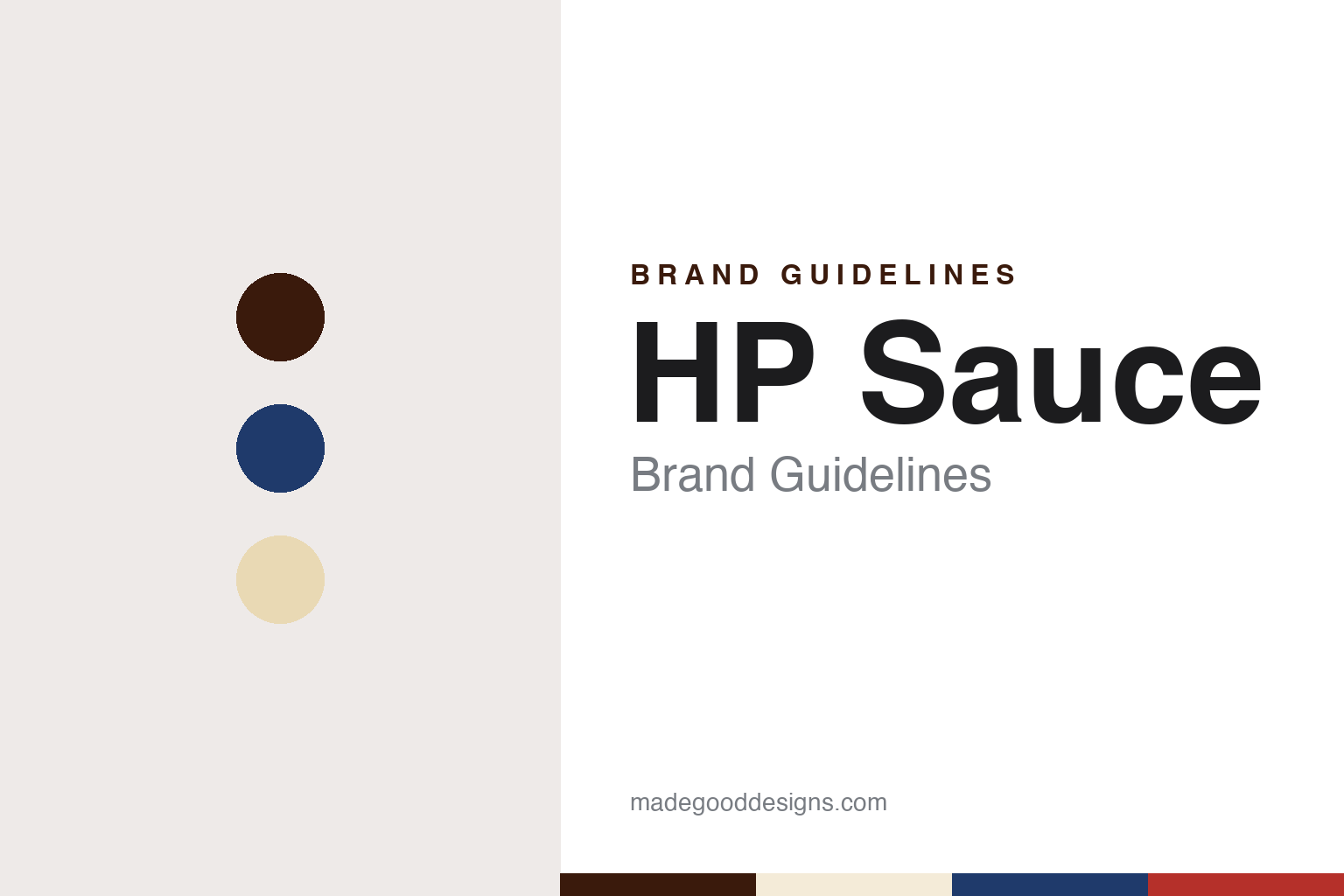
Two constants: a brown sauce, Westminster blue and label red palette and a condensed label sans register. Abstract homage — not an HP Sauce product or mark; no bottle, label or logo is reproduced.
A grocer in Nottingham
A shop, a back-yard sauce works and a debt.
HP Sauce began in Nottingham, not in Westminster. English Wikipedia says Frederick Gibson Garton kept a grocery and provisions shop on Milton Street and made pickles and sauces in a small factory at the back of his home in New Basford. The Guardian’s food writer Oliver Thring, in a 2010 history of brown sauce, said the recipe went back to the 1870s and leaned on ingredients that came through the British Empire: tamarind, dates and molasses. Garton registered the name H.P. Sauce in 1895.
The initials stood for the Houses of Parliament. English Wikipedia says Garton chose the name because he had heard that a restaurant in Parliament had begun serving his sauce, and the Guardian reported in 2006 that he put “HP” in the name to reflect that. BBC News, writing in 2006, said only that the sauce was “reputedly” once served there. From the start, the Guardian said in 2010, Garton decorated his bottles with a lithograph of the Commons.
The brand soon left Nottingham. Garton owed money to his vinegar supplier, the Midland Vinegar Company of Aston Cross in Birmingham, which Edward Eastwood and his nephew Edwin Samson Moore had set up in 1875, English Wikipedia says. Moore came to settle the debt, and Garton sold him the name and recipe for £150. Wikipedia puts the sale in 1899; the Guardian’s 2010 piece gave 1903. Under the deal Garton agreed to stay out of the sauce and pickle trade, though his name stayed on HP bottles for many years afterwards, English Wikipedia says.
Birmingham became the sauce’s home for more than a century. BBC News said in 2006 that the factory had stood in Aston since 1875, and that it had become a landmark at the gateway to the city; a city councillor told the BBC he grew up nearby and remembered the smell of HP Sauce as part of Birmingham.
Colour
Big Ben on the label, French on the back.
The label is the brand’s best-known asset. English Wikipedia, citing the Guardian and the London blog ianVisits, says the bottle has carried a picture of the Houses of Parliament since 1903; today’s front shows a group of London landmarks including the Elizabeth Tower, the Palace of Westminster and Westminster Bridge. When Heinz confirmed in 2006 that production would leave Britain, its spokesman told BBC News that the picture would stay “because of its historical association.”
For much of the twentieth century the bottle also carried a block of French text about the sauce’s qualities. The Guardian said in 2010 that when HP dropped it in 1984, readers wrote to The Times to mourn “that much loved and most piquant of French primers.” The same piece described the bottles as octagonal and recalled a former strapline, “The Official Sauce of Great Britain.”
Politics gave the brand a nickname. In the 1960s and 1970s HP was known as “Wilson’s gravy”, BBC News said, after the wife of the prime minister Harold Wilson was quoted as saying he would drown his food in it. English Wikipedia, citing a 2018 Guardian obituary of Mary Wilson, says the line probably came from Private Eye’s long-running “Mrs Wilson’s Diary” column, and that she later said her husband much preferred Worcestershire sauce.
The brand has also lent itself to special editions. In 2005 the designer Paul Smith created an HP Sauce bottle for Harrods’ Truly British series, BBC News reported; all 1,899 bottles sold out within days. In spring 2006 HP ran a campaign to “Save the Proper British Cafe,” selling wristbands to back it. HP led its market: a Competition Commission report on the Heinz takeover put its share of UK brown-sauce retail sales at 73.8% in 2005, and the Guardian gave 71% in 2010.
Typography
Design and documentation.
The seven brands in this group all make sauces, pickle, gravy or savoury spreads, and all of them come from Britain or Australia: HP Sauce, Lea & Perrins, Branston, Bisto, Marmite, Bovril and Vegemite. British and Australian pantry brands in general sit at many different points in the trade, from names that still carry a founder’s surname to names that now belong to much larger food groups, and a single brand can be sold everywhere from a corner shop to a supermarket shelf.
A sauce or spread brand’s identity is usually carried less by a single recipe than by a bottle, a jar, a name and the meal it promises, because the company behind the name may have changed hands, moved its factory or grown far beyond the town where it started. That makes the questions behind each name worth asking plainly: who started it, who owns it now, and where its jars and bottles are actually filled.
Each guide separates what independent sources record from what the company says about itself — its founding story, its owners over time, where its products are made and how its packaging has changed — and marks plainly what rests only on the company’s own word.
Aa
A condensed sans for a sauce known by two initials. (Specimen set in Oswald, a sans STAND-IN; NOT the HP Sauce logo.)
HP Sauce
From Aston Cross to Elst.
The company behind the sauce changed names and owners several times. English Wikipedia says the Midland Vinegar Company became Smedley HP Foods and then HP Foods, and that it bought Lea & Perrins, the Worcestershire sauce maker, in 1930. In 1939 the Birmingham Gazette listed H.P. Sauce Ltd’s subsidiaries as including the Midland Vinegar Co., F.G. Garton & Co. and Lea and Perrins. HP Foods later passed to Imperial Group, the tobacco company, through its Imperial Foods division, and stayed with Hanson after Hanson took over Imperial. Hanson sold HP Foods to the French group BSN, now Danone, for £199 million; Wikipedia dates the sale to 1988, while BBC News, reporting in 2005, gave 1998.
In June 2005 the American food company Heinz bought HP Foods from Danone for £470 million, beating Premier Foods and Associated British Foods, BBC News reported. Heinz said the deal fitted its plan to focus on ketchups, condiments and sauces. The Office of Fair Trading referred the takeover to the Competition Commission in October 2005, and the commission cleared it in spring 2006.
Within weeks Heinz proposed closing the Aston factory. Its vice-president David Hobin told the Guardian in May 2006 that there was spare capacity at Heinz’s plant in Elst, in the Netherlands, and that Aston, which normally ran only three days a week, was not viable. The plan drew protests from unions, MPs and Birmingham’s council, and the Labour MP Khalid Mahmood held up a bottle at Prime Minister’s Questions. Heinz confirmed the closure in August 2006, and the last bottle made in Birmingham came off the line on 16 March 2007, with the loss of 125 jobs, BBC News reported. Demolition began that July. HP Sauce has been made by Heinz in the Netherlands since; Heinz merged with Kraft in 2015 to form Kraft Heinz, which owns the brand today.
For a design guide, HP Sauce shows how a borrowed landmark can outlast the factory, the city and even the country where a product is made. Compare Lea & Perrins, its Worcester stablemate since 1930, and Grey Poupon, another heritage condiment in the Kraft Heinz fold. For this guide we use a sauce brown, a Westminster blue and a label red with a condensed sans, an unofficial interpretation; no product or logo is reproduced.
Explore & save
Keep HP Sauce’s identity on hand — save it to a board in the Made Good inspiration library.
HP Sauce identity set
Pin the HP Sauce brown, Westminster blue and label red palette and the condensed label sans register to your own board.