Branston Brand Guidelines
The 1922 Staffordshire pickle now made in Suffolk.
Aa
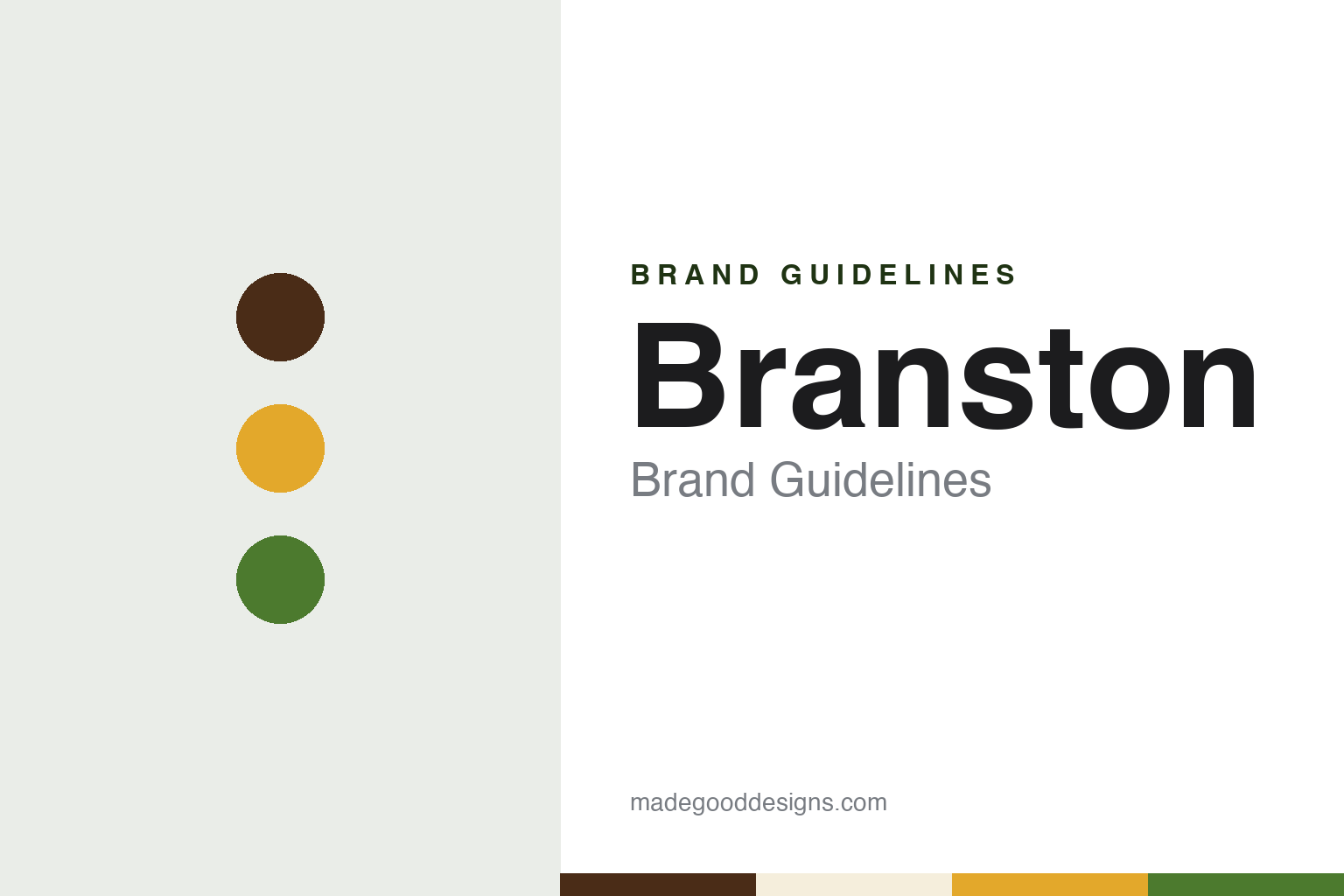
Two constants: a pickle brown, mustard yellow and leaf green palette and a chunky slab serif register. Abstract homage — not a Branston product or mark; no jar, label or logo is reproduced.
A village name
A wartime factory, a pickle and a quick move to London.
Branston takes its name from a village. The company that owns the brand today says Crosse & Blackwell first produced Branston Pickle in 1922 and named it after Branston, a small village near Burton upon Trent in Staffordshire. The Daily Telegraph gave the same year and place when it reported on the brand’s sale in 2012, and John Ayto’s Diner’s Dictionary, published by Oxford University Press, also dates the pickle to 1922 at Branston.
The factory had not been built for food. English Wikipedia, citing a local-history site for Burton upon Trent, says the government chose Branston in 1917 for a new National Machine Gun Factory, which was finished only after the Armistice and never made weapons. In 1920 Crosse & Blackwell, the London pickle and preserves house, bid successfully for the site and pledged to turn it into the largest and best-equipped food-preserving plant in the British Empire. The same local-history source attributes the pickle’s recipe to a Mrs Caroline Graham and her daughters Evelyn and Ermentrude.
Branston’s stay in Branston was short. The factory proved uneconomic, and production there ended in January 1925, English Wikipedia says, causing large-scale local unemployment; many local people boycotted Crosse & Blackwell products as a result. Production moved to the company’s site in Crimscott Street, Bermondsey, in south London, which belonged to E. Lazenby & Son, a sauce and pickle maker Crosse & Blackwell had bought in 1919. The Evening Standard reported in 2016 that the Bermondsey buildings put up for the pickle in 1924 and 1926 stayed in use until 1969. The Staffordshire site went on to other uses, later becoming the army’s Branston Depot. The company says Crosse & Blackwell registered the Branston trademark in 1929.
Kenneth Martin’s 2017 book Famous Brand Names and Their Origins describes it as diced vegetables, including swede, carrots, onions and cauliflower, in a sauce of vinegar, tomato, apple and spices, with a sweet, chutney-like character. It is now sold in a chunky original, a small-chunk version and a smooth one.
Colour
Nestlé, Premier Foods and a vinegar maker from Japan.
Branston has changed hands with its parent companies. English Wikipedia, citing Nestlé’s own 125-year company history, says Nestlé bought the Crosse & Blackwell group in 1960. Four decades later Nestlé sold its British grocery business: in a 2002 filing, Premier International Foods said that on 27 May 2002 it had completed the purchase from Nestlé of its UK ambient food business, naming Crosse & Blackwell, Branston Pickle, Sarson’s vinegar, Sun Pat peanut butter and Rowntree’s jelly among its brands. The company behind the brand today says Premier moved Branston’s manufacturing to Bury St Edmunds, Suffolk, in 2004.
Under Premier Foods the name was stretched beyond the jar. In October 2005 Premier launched Branston Baked Beans, aimed at the market leader, Heinz; Hamish Pringle’s 2008 book Brand Immortality describes a “Great British Bean Poll” blind taste test in which, the brand said, 76% of people chose Branston. Brand Republic reported in February 2006 that Heinz would change its baked-beans recipe in the face of the challenge. Relishes followed the same year.
Then Premier began to sell. In February 2011 it sold the Crosse & Blackwell brand, with Fray Bentos, to Princes for £182 million, The Guardian reported, leaving Branston under its own name. In June 2012, the BBC reported, Premier sold Sarson’s vinegar and Haywards pickled onions to Mizkan, the Japanese vinegar maker, for £41 million. On 30 October 2012 the BBC and the Telegraph reported that Branston would follow, for £92.5 million. Mizkan says the purchase, by its European arm Mizkan Euro, was completed in February 2013.
Mizkan traces its own story to 1804, when, it says, the sake brewer Matazaemon Nakano began making vinegar in Handa, near Nagoya; English Wikipedia says the group is still based there and is run by the Nakano family. Mizkan says Branston is still made at the Bury St Edmunds site it moved to in 2004, and that more than 17 million jars of the pickle are sold to one in three UK households every year.
Typography
Design and documentation.
The seven brands in this group all make sauces, pickle, gravy or savoury spreads, and all of them come from Britain or Australia: HP Sauce, Lea & Perrins, Branston, Bisto, Marmite, Bovril and Vegemite. British and Australian pantry brands in general sit at many different points in the trade, from names that still carry a founder’s surname to names that now belong to much larger food groups, and a single brand can be sold everywhere from a corner shop to a supermarket shelf.
A sauce or spread brand’s identity is usually carried less by a single recipe than by a bottle, a jar, a name and the meal it promises, because the company behind the name may have changed hands, moved its factory or grown far beyond the town where it started. That makes the questions behind each name worth asking plainly: who started it, who owns it now, and where its jars and bottles are actually filled.
Each guide separates what independent sources record from what the company says about itself — its founding story, its owners over time, where its products are made and how its packaging has changed — and marks plainly what rests only on the company’s own word.
Aa
A chunky slab serif for a pickle sold by the chunk. (Specimen set in Alfa Slab One, a slab-serif STAND-IN; NOT the Branston logo.)
Bring out the Branston
A 1972 jingle, a crisp flavour and a centenary refresh.
The company says its first television advertisement, in 1972, introduced the lyric “Bring out the Branston,” and the phrase is still the brand’s slogan and the name of its website. The company also says Branston was voted one of the top 50 UK brands of the 20th century in 1999, and that in 2006 Branston Pickle alone sold more than 28 million jars and was on sale in more than 50 countries.
The name travelled into other products. From around 2003, Walkers made a Cheese and Branston Pickle crisp, which had been discontinued by 2023, Chronicle Live reported. Under Mizkan the range has added Caramelised Onion and Mediterranean Tomato chutneys in 2014, the company says, and a sweet chilli pickle and new “rich” table sauces in 2015, the trade site FoodBev Media reported. In 2017 the brand’s ketchup, mayonnaise and brown sauce went into single-serve sachets for caterers, the trade site KamCity reported.
The centenary in 2022 brought the most recent design change. Transform magazine reported in May 2022 that the London agency This Way Up had updated Branston’s logo and packaging, keeping the brand’s established colours but making the palette bolder and dropping the bevels and shadows of the earlier label for a cleaner finish. The Dieline said the refresh kept the brand’s “instantly recognizable features” while making it feel more contemporary. In August 2022 Creative Review reported that Wonderhood Studios had built a wider visual and verbal identity around the new packs, with chunky typography and a palette leaning on the brand’s yellows and greens, as part of the “Bring out the Branston” campaign. Transform also noted that the brand had launched a “hit of home” creative platform in 2020.
For a design guide, Branston shows how a village name, a single jingle and a steady label can carry a pickle through a century of owners. Compare HP Sauce, another British brown condiment, and Robertson’s, the marmalade Premier Foods also sold in 2012. For this guide we use pickle brown, a mustard yellow and a leaf green with a chunky slab serif, an unofficial interpretation; no product or logo is reproduced.
Explore & save
Keep Branston’s identity on hand — save it to a board in the Made Good inspiration library.
Branston identity set
Pin the Branston pickle brown, mustard yellow and leaf green palette and the chunky slab serif register to your own board.