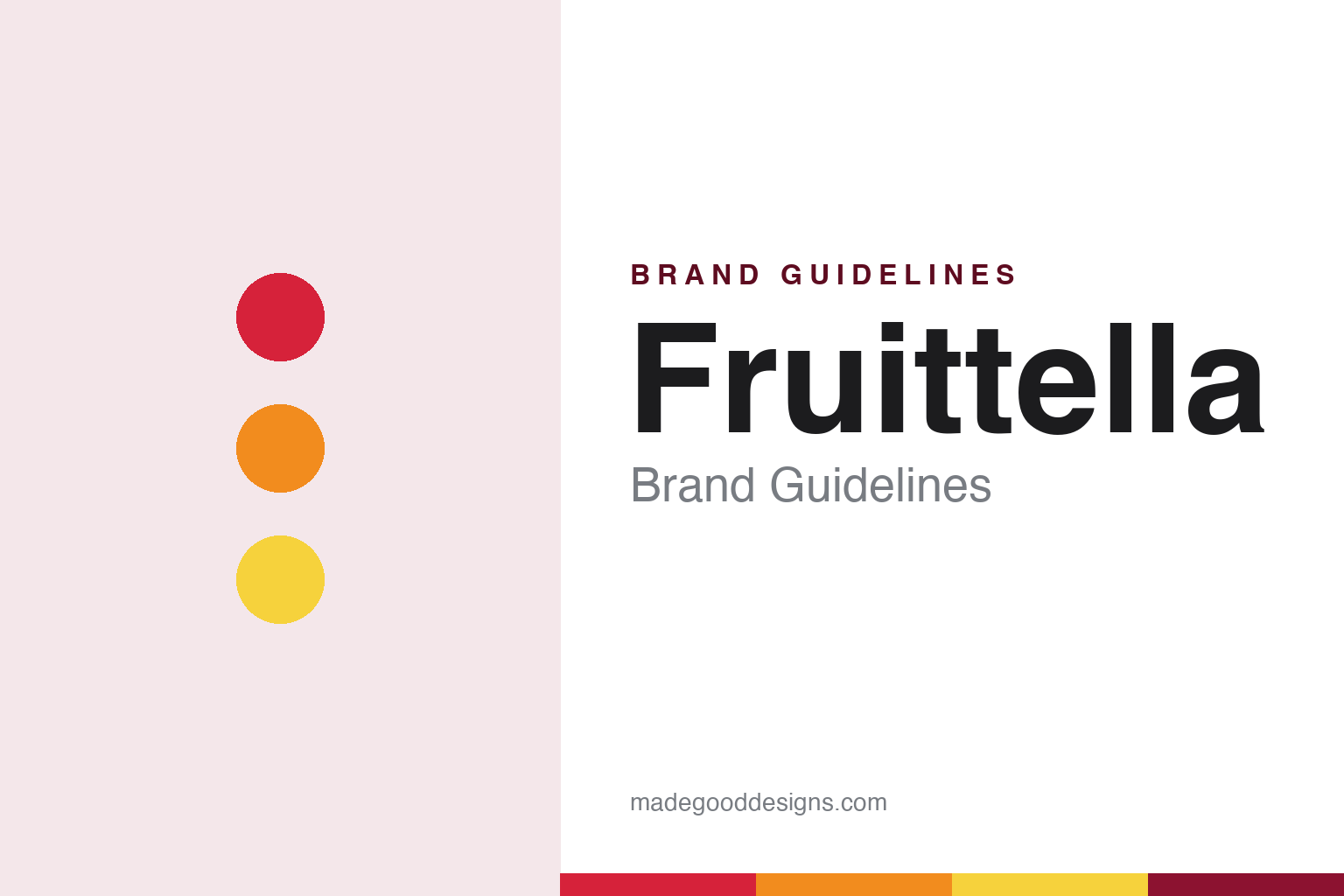
Fruittella Brand Guidelines
The Dutch fruit chew that came in a roll that cannot roll.
Aa
Two constants: a strawberry, orange and lemon palette and a rounded sans register. Abstract homage — not a Fruittella product or mark; no pack, sweet or logo is reproduced.
A chew from Kraków
Van Melle’s fruit caramel, from Breskens to the Dutch market.
Fruittella is a soft fruit chew, and its story belongs to the Dutch confectioner Van Melle. The brand’s own history page dates the sweet to 1931, when, it says, Van Melle introduced a sweet under the name Fruittella, “a real fruit caramel” in a range of fruit flavours. Perfetti Van Melle’s Dutch history page tells the origin more fully: in 1932, it says, the brothers Machiel and Pierre van Melle travelled to Kraków, in Poland, and bought from the firm Jozef Lax und Sohn the rights to make a soft fruit caramel. From that chew, the company says, came Fruittella, and it also became the basis of the Mentos dragee. The two dates do not quite agree; Dutch Wikipedia, citing both company pages, gives the launch as 1931–1932.
Van Melle itself was older. Perfetti Van Melle says that in 1900 Izaak van Melle opened a small factory for sugar confectionery in Breskens, in Zeeland, across the street from his father’s bakery. Dutch Wikipedia, citing a 1923 article in the magazine Eigen Haard, describes the business as a bakery that had also sold sugar sweets, and says that from 1926 the firm began making toffees, followed by the fruit caramel and a peppermint caramel introduced from Poland.
The Breskens factory did not survive the Second World War. Dutch Wikipedia dates the Allied bombing of Breskens that destroyed it to 11 September 1944; the company says only that it was destroyed at the end of the war. Production restarted in Rotterdam, where, the company says, a new factory was officially opened on 22 November 1950. Van Melle later moved from Rotterdam to Breda: the company says the Breda plant was officially opened on 28 September 1984, while Dutch Wikipedia, citing the newspaper Het Vrije Volk of August 1982, places the move in 1982–1983.
Colour
The roll that cannot roll.
Much of what the brand records about its design concerns its pack. The brand says that in 1954 its sales rose sharply thanks to a new way of packing the sweets, the square roll; before then, it says, sweets were mostly sold loose. Perfetti Van Melle’s own timeline gives a different date, saying that in 1960 Mentos and Fruittella were sold in rolls “with great success,” so we give both.
The brand’s timeline then records a run of redesigns. In 1957, it says, Fruittella got a new white pack with silver lines. The roll was really too narrow to carry a large picture of fruit, so, according to the brand, the designer had the picture run round the corner onto the next face, which also carried a Fruittella logo; the designer is not named. In 1975 the roll took on what the brand calls typical 1970s styling. In 1988 the pack was renewed again, and each flavour was given its own recognisable background colour. In 2016 came another new look, which the brand says was meant to put the fruit first and make the Fruittella logo stand out more, a look it describes as matching the square sweet.
Television carried the brand from early on. The brand dates its first commercial to 1960, and lists later ones by their lines: in 1980 “De enige rol die niet kan rollen” — the only roll that cannot roll — in 1990 Fruittella on the back seat, and in 2014 a campaign about sharing.
The recipe has changed too. The brand says that in 2008 Fruittella recipes were changed to natural colours and flavourings and to the use of fruit juice, and that in 2017 it added sweets with 30 per cent less sugar alongside its rolls and sharing packs.
Typography
Mints, pastilles and chews.
The seven brands in this group all make mints, pastilles, throat sweets or chews, and they come from the Netherlands, Italy, Britain and Switzerland: Mentos, Tic Tac, Altoids, Polo, Fisherman’s Friend, Ricola and Fruittella. Sugar confectionery brands in general sit at many different points in the trade, from family firms that still carry a founder’s surname to names that now belong to much larger confectionery groups, and a single brand can be sold everywhere from a station kiosk to a supermarket checkout.
A sweet brand’s identity is usually carried less by a single sweet than by a pack, a name and the moment it promises, because the company behind the name may have changed hands, moved its factory or grown far beyond the town where it started. That makes the questions behind each name worth asking plainly: who started it, who owns it now, and where its sweets are actually made and packed.
Each guide separates what independent sources record from what the company says about itself — its founding story, its owners over time, where its sweets are made and how its packaging has changed — and marks plainly what rests only on the company’s own word.
Aa
A rounded, friendly sans for a square fruit chew. (Specimen set in Fredoka, a rounded-sans STAND-IN; NOT the Fruittella logo.)
Fruittella
Perfetti Van Melle, Weert and a vegan chew.
Van Melle did not stay independent. Perfetti Van Melle’s history page says the Italian confectioner Perfetti, whose business the brothers Ambrogio and Egidio Perfetti started in 1946 in Lainate, near Milan, took a 37 per cent stake in Van Melle in 1991 and bought the remaining shares in 2001; the combined company, Perfetti Van Melle, began in March 2001. English Wikipedia gives its headquarters as Lainate and Breda. The Fruittella brand site carries a copyright notice for Perfetti Van Melle Benelux.
On where the chews are made, Perfetti Van Melle says it has three production sites in the Netherlands, and that in Breda it mainly makes Mentos, in Sittard Smint and Frisk, and in Weert, in Limburg, Fruittella. Local reporting confirms a Perfetti Van Melle sweet factory in Weert: the Limburg broadcaster L1 reported in July 2015 that the factory there had been making sweets, Fruittella among them, for about 25 years. The brand’s international site lists country sites for the Netherlands, Belgium, the United Kingdom, Brazil, Poland and Italy.
In Britain the brand is spelled Fruit-tella, and it is there that its recent recipe changes have been best reported. In November 2019 Confectionery News reported that Perfetti Van Melle had launched its first gelatine-free range in the UK, two Fruittella jellies called Koalas and Sour Snakes, carrying a vegan-approved stamp. In October 2023 Grocery Gazette and vegconomist reported that the chews themselves, whose original recipe had included gelatine, were moving to a vegan recipe across Strawberry Mix, Duo Stix and Berries & Cherries, in shops from that November. A Fruit-tella brand manager told the trade press that the brand had been “synonymous with the highest quality sweets since 1931.”
For a design guide, Fruittella shows how a sweet can be identified by its pack as much as by its taste: a square roll, a flavour colour per pack and a picture that turns the corner. Compare Mentos, the Van Melle sweet that grew from the same chew, and Skittles, another fruit sweet sold on colour. For this guide we use strawberry red, orange and lemon with a deep berry ink and a rounded sans, an unofficial interpretation; no product or logo is reproduced.
Explore & save
Keep Fruittella’s identity on hand — save it to a board in the Made Good inspiration library.
Fruittella identity set
Pin the Fruittella strawberry, orange and lemon palette and the rounded sans register to your own board.