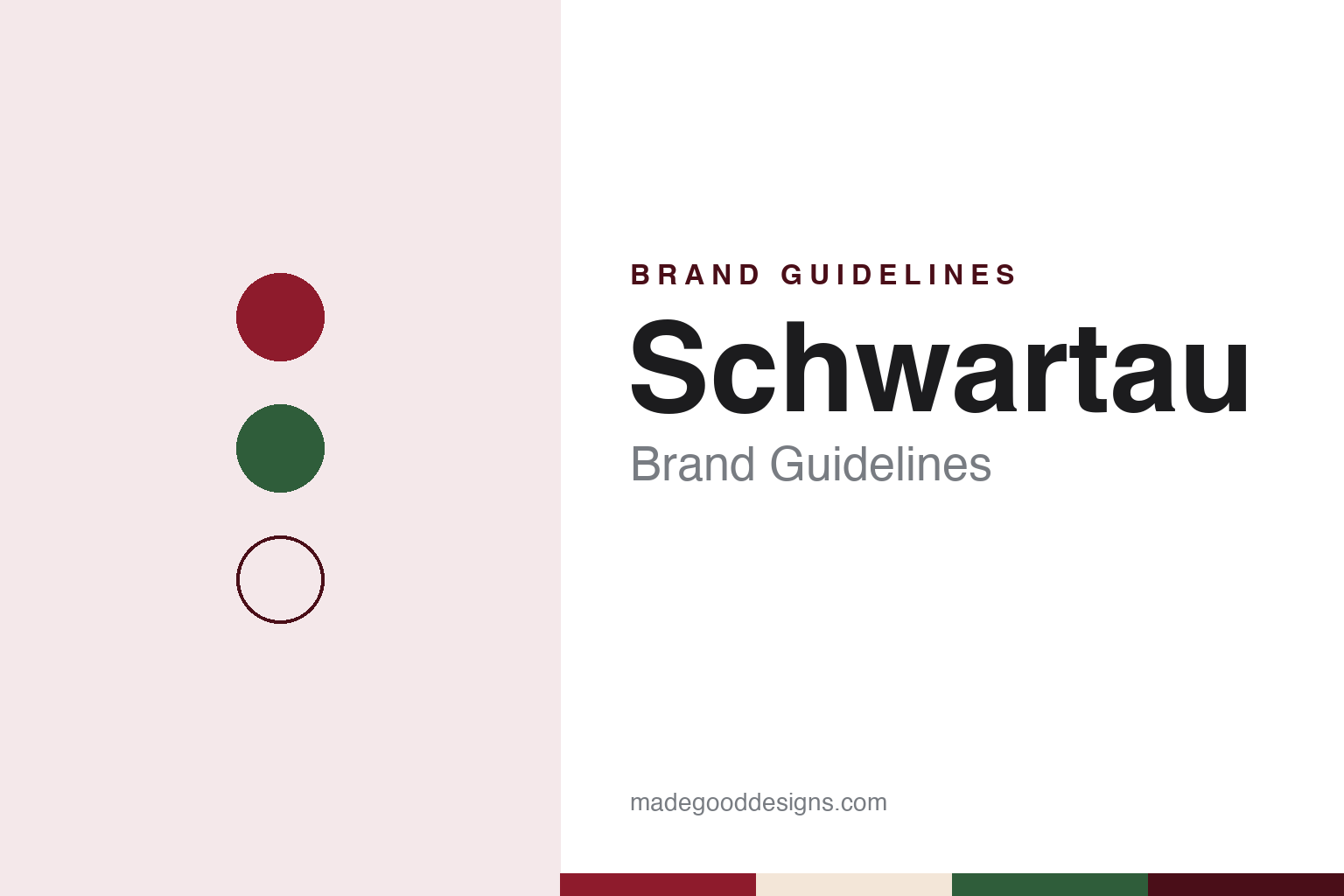
Schwartau Brand Guidelines
The Bad Schwartau jam maker of the Extra X-jar and Mahlau’s Lübeck towers.
Aa
Two constants: a Schwartau cherry, leaf green and cream palette and a soft old-style serif register. Abstract homage — not a Schwartau product or mark; no jar, logo or label is reproduced.
Chemische Fabrik Schwartau
Floor wax, artificial honey and a tin of five-fruit jam.
Schwartau did not start with jam. In 1899 the brothers Otto and Paul Fromm, both from Rostock, founded the Chemische Fabrik Schwartau in Bad Schwartau, just north of Lübeck. The company says its first years were spent making floor wax and floor oil; German Wikipedia, citing the Lübecker Nachrichten, adds artificial honey, cranberry compote and plum butter. From 1904, German Wikipedia says, the brothers built up a department for marmalade.
The company calls the business a family firm from the start: in 1907, it says, the brothers’ sisters Emma and Mathilde became partners, the floor-wax line was dropped and the business turned to fruit-based products. A sugar refinery was founded the same year. In 1912 the firm was renamed the Schwartauer Honigwerke und Zuckerraffinerie, and it launched its first jam, the Schwartauer Fünffrucht-Confitüre — a five-fruit jam that, the company says, was delivered in a tin.
Otto Fromm died in 1915, by which time Paul had left the firm, and board members took over its management, German Wikipedia says, citing Süßes von Wert, a 2019 history of the company by the historian Christian Vogt. In 1922 the company set up a jam-and-praline subsidiary and a marzipan subsidiary in Lübeck, and in 1927 the three businesses were merged into the Schwartauer Werke AG.
The company’s mark dates from this period. German Wikipedia, citing the Frankfurter Allgemeine Zeitung, says that in 1924 the artist Alfred Mahlau designed the Schwartauer Werke trademark: the towers of Lübeck’s five principal churches — St. James’s, St. Mary’s, St. Peter’s, St. Giles’s and the cathedral — seen from the north, the skyline known as the city’s “seven towers.” Mahlau, a Berlin-born painter and graphic artist who worked for many Lübeck clients, also designed the packaging for Niederegger’s marzipan, German Wikipedia says.
The Nazi years are part of the record. German Wikipedia, citing published reference works on the camp system, says the Schwartauer Werke AG used forced labourers, housed in its own camp of about 110 people. The company’s own history says that between 1933 and 1945 it abandoned its political neutrality and signalled conformity to the regime, that in 2000 it helped fund the German foundation initiative that paid former forced labourers, and that it reviewed its history with Christian Vogt for the 2019 chronicle.
Colour
The Oetker inheritance and the X-shaped jar.
After the war, jam became the core business. German Wikipedia, citing Vogt, says the workforce grew from about 500 in 1950 to as many as 1,000 during the harvest season by the late 1950s. In 1959 the company became a GmbH, and the Oetker family, which had held shares since the 1930s, gained a majority. By inheritance, Ursula Oetker became the sole owner in the mid-1960s, when, Manager Magazin reported in 2005, the company was largely unprofitable. In 1968 her son Arend Oetker took charge. Stern reported in 2004 that under him sales rose tenfold within twenty years.
The brand’s best-known product dates from that era. Schwartau Extra was launched in 1962, and the company says its real breakthrough came in 1969, when it was given a new design: an X-shaped jar with a wraparound label, which the company calls an unusual novelty at the time. The Hamburger Abendblatt reported in 2002 that around 60 million of the waisted X-jars were filled each year, 35% of them with strawberry jam. Packaging had mattered before: the company says that in the 1930s it designed a three-sided jar for jam that was technically difficult to fill.
The range widened. The company says it brought the American granola bar to Germany in 1981, and its Corny muesli bar has been on sale since Easter 1984. German Wikipedia says that in 1986 Schwartau acquired a licence to use the Mövenpick name for fruit spreads — the company dates the first Mövenpick Gourmet spread to 1987 — and Mövenpick announced a long-term extension in 2004. In 2005 came Schwartau Samt, a smooth spread without fruit pieces or seeds. In 1987 the company completed a 50-metre advertising tower beside the A1 motorway at Bad Schwartau, topped by a rotating, illuminated logo ten metres across, the Lübecker Nachrichten reported.
The jar kept changing. The company says Schwartau Extra got a new recipe, jar and design in 2017, when the X-jar was replaced by an organic shape embossed with leaves; in 2021 the Extra family got a more modern logo, a matt black lid and an all-round fruit label. In 2024, the company says, the Extra jar was named Packaging of the Year, with the jury highlighting the design history of the X-jar.
Typography
Design and documentation.
The seven brands in this group all make jam and fruit spreads, and they come from Switzerland, Austria, Germany, the United States and France: Hero, Darbo, Zentis, Schwartau, Smucker’s, Andros and St. Dalfour. Jam brands in general sit at many different points in the trade, from family firms that still carry a founder’s surname to names that now belong to much larger food groups, and a single brand can be sold everywhere from a village shop to a supermarket shelf in another continent.
A jam brand’s identity is usually carried less by a single product than by a jar, a lid, a label and the breakfast it promises, because the company behind the name may have changed hands, moved its factory or grown far beyond the town where it started. That makes the questions behind each name worth asking plainly: who started it, who owns it now, and where its jam is actually cooked and filled.
Each guide separates what independent sources record from what the company says about itself — its founding story, its owners over time, where its jam is made and how its packaging has changed — and marks plainly what rests only on the company’s own word.
Aa
A soft old-style serif for a jam maker with a church-tower trademark. (Specimen set in Fraunces, a serif STAND-IN; NOT the Schwartau logo.)
Schwartau
From Bad Schwartau to Hero, and back home.
Ownership took an unusual turn in the 1990s. In 1995, German Wikipedia says, citing Vogt, the Schwartauer Werke bought a majority of the Swiss food company Hero, of Lenzburg. Since 2002 the relationship has run the other way: the Schwartauer Werke have been part of the Hero group, in which Arend Oetker holds the majority, a structure Stern described in 2004 and German Wikipedia attributes to economic and tax considerations. Stern’s headline called it the realm of “the other Oetker.”
The jam is still made in Bad Schwartau. When the company turned 100 in 1999, Die Welt reported that it held about 40% of the German jam market and filled around 700,000 jars a day for export to 35 countries. The Lebensmittel Zeitung reported in 2012 that it had opened a second jam plant at Bad Schwartau, an investment of €20 million. In 2016 the company weighed a move to a new site, but in 2018, the Lübecker Nachrichten reported, it decided to keep all production in Bad Schwartau and modernise there, work that paper said was finished in 2024 for the 125th anniversary. A new Corny line was under construction in 2025, Lebensmittel Praxis reported. The company says that in 2025 it sourced 93% of its fruit from Europe, and gives its workforce as about 1,100.
The brand keeps refreshing its jars. The company launched sugar-reduced Extra in 2019 and Extra Zero, with no added sugar, in 2022; in June 2026 it introduced the jam, whose pack it describes as puristic, with no label and no sleeve. In 2026 the Lebensmittel Zeitung reported that the Schwartauer Werke would bring Hero’s British snack brand Deliciously Ella to Germany. The company also says it won the federal government’s CSR prize in 2025, and runs a bee-protection initiative, bee careful, begun in 2014.
For a design guide, Schwartau shows how far a jam brand can go on its glass: a 1930s three-sided jar, the 1969 X-jar and its successors, and a trademark taken from a city skyline. Compare Hero, the Swiss group it belongs to, and Niederegger, the Lübeck marzipan house whose packs Mahlau also drew. For this guide we use a cherry red, a leaf green and a warm cream with a serif, an unofficial interpretation; no product or logo is reproduced.
Explore & save
Keep Schwartau’s identity on hand — save it to a board in the Made Good inspiration library.
Schwartau identity set
Pin the Schwartau cherry, leaf green and cream palette and the soft old-style serif register to your own board.