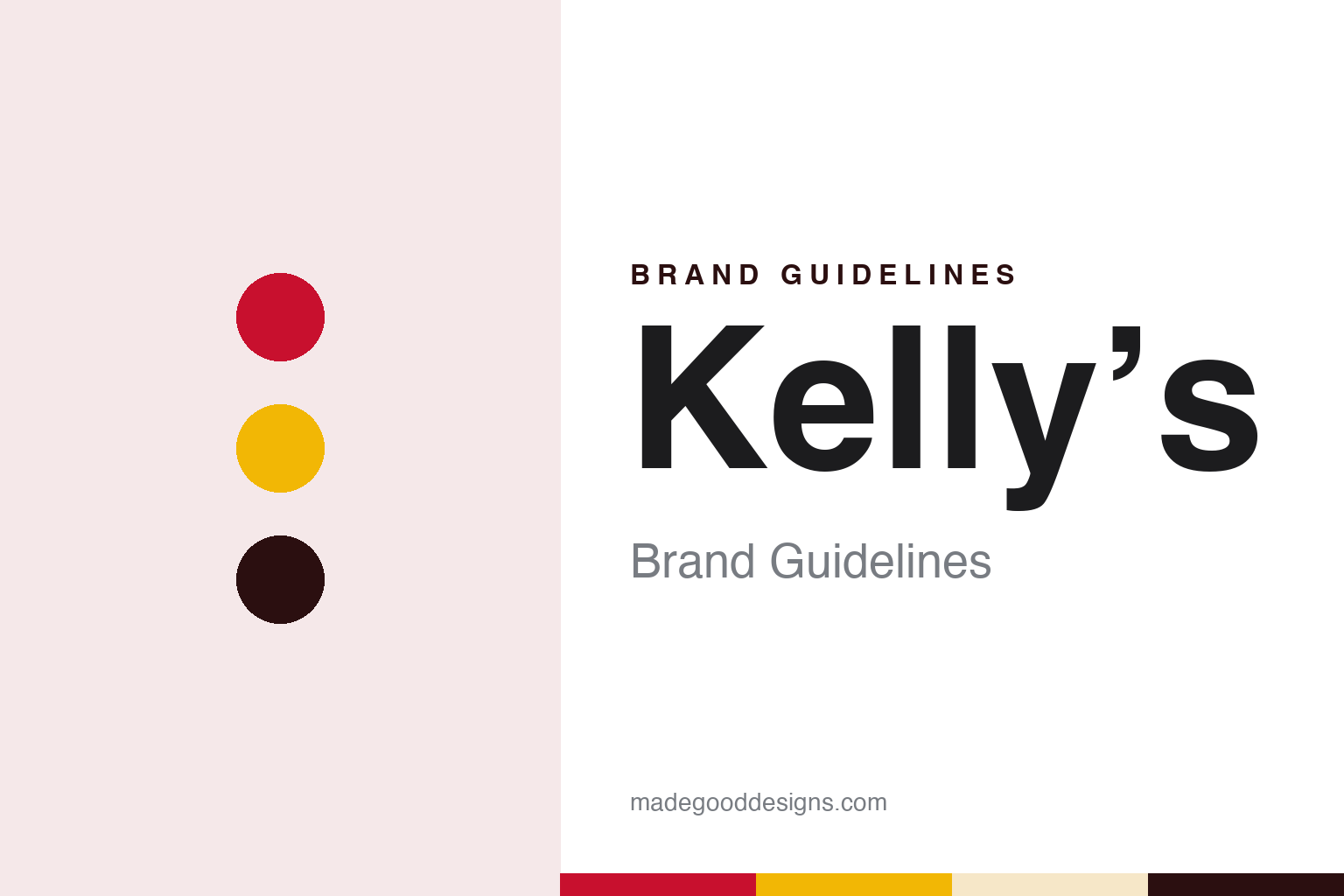
Kelly’s Brand Guidelines
The Vienna crisps brand that began as an American popcorn company in 1955.
Aa
Two constants: a paprika red, popcorn yellow and potato cream palette and a bold grotesque sans register. Abstract homage — not a Kelly’s product or mark; no pack, logo or wordmark is reproduced.
American Popcorn Company
An American major, an Austrian partner and popcorn.
Kelly’s began in Vienna in 1955. The company’s own timeline says that Major Howard Morse Kelly, an American, and the Austrian Herbert Rast founded the American Popcorn Company that year. German Wikipedia adds that Kelly was a former US Army major who had stayed on after the American forces left Austria under the 1955 State Treaty. When the Austrian newspaper Die Presse reported on the company in 2007, drawing on the APA news agency, it described the founders as an American occupation officer and an Austrian, noting that popcorn was then making its way into cinemas.
The business took the founder’s surname ten years later. In 1965, the company says, the Kelly Ges.m.b.H. was formed, and German Wikipedia says the German biscuit maker Bahlsen, of Hanover, took the company over in the same year. The brand on the bag is Kelly’s; the company behind it is the Kelly Ges.m.b.H.
Potato crisps came through an acquisition. In 1976 Kelly bought a crisps factory in Hollabrunn, in Lower Austria, and in 1985 it bought a bakery in Feldbach, in Styria, which the company describes as the largest baking line for salt sticks in Europe; German Wikipedia says the Feldbach works had been known for rusks before it was turned over to Soletti salt sticks. Herbert Rast ran the company for almost four decades. In 1994 he handed the management to Wolfgang Hötschl, who led it until 2017, according to the company timeline. The company’s timeline also records an interview with Rast, as founder, for its 60th anniversary in 2015.
Colour
From Bahlsen to v. Nordeck to Intersnack.
By German Wikipedia’s dates, Kelly spent more than three decades inside the Bahlsen group. The company says that in 1997 it took over Bahlsen’s Picanterie range of salty snacks in Austria, and that in 2001 it separated completely from Bahlsen after the German group was divided; Die Presse put the separation in 2000. German Wikipedia says that when the Bahlsen businesses were split, the Austrian Kelly brands and the Swiss Wernli biscuits went to Gisbert von Nordeck, who had married into the Bahlsen family; the press release of his v.Nordeck group in 2007 gives its base as Oberuzwil, in Switzerland.
The brand also gained a second name in that period. German Wikipedia says the Zach family brought the Soletti salt-stick brand into the Kelly group some years before 2007, and Soletti is still made at Feldbach. In 2003 crisps production moved from Hollabrunn to the company’s site in Vienna’s Donaustadt district, where a logistics and administration centre had opened in the mid-1990s; the company dates it to 1996 and German Wikipedia to 1997.
The present owner arrived in 2007. On 5 July 2007 the Swiss v.Nordeck International Holding AG announced in a press release that it, as the 62.4% majority owner, and the other shareholders would sell their shares in Kelly to the Cologne snack maker Intersnack, the company behind the Chio and funny-frisch brands, subject to approval by the competition authorities. Die Presse named the other shareholders as Raiffeisen Ware Austria, with 25.1%, and two members of the Zach family, and described the buyer as Kelly’s main competitor. English Wikipedia says Austria’s Federal Competition Authority approved the deal in March 2008; the company’s own timeline dates its move into the Intersnack snack network to 2008. Intersnack Group, now based in Düsseldorf, is part of the Pfeifer & Langen group, English Wikipedia says.
Typography
Design and documentation.
The seven brands in this group all make food or drink, and all of them come from Austria: Almdudler, Römerquelle, Vöslauer, Pago, Ottakringer, Stiegl and Kelly’s. Austrian food and drink brands in general sit at many different points in the trade, from family firms that still carry a founder’s surname to names that now belong to much larger food and drink groups, and a single brand can be sold everywhere from a mountain hut to a supermarket shelf.
A food or drink brand’s identity is usually carried less by a single product than by a bottle, a pack, a name and the moment it promises, because the company behind the name may have changed hands, moved its production or grown far beyond the town where it started. That makes the questions behind each name worth asking plainly: who started it, who owns it now, and where its products are actually made, bottled or packed.
Each guide separates what independent sources record from what the company says about itself — its founding story, its owners over time, where its products are made and how its packaging has changed — and marks plainly what rests only on the company’s own word.
Aa
A bold, slightly condensed grotesque for a crisps brand with an American name. (Specimen set in Archivo, a sans STAND-IN; NOT the Kelly’s logo.)
Kelly’s
Vienna crisps, Feldbach salt sticks and a footballer.
Kelly’s crisps are made in Vienna. German Wikipedia lists two Austrian production sites for Kelly: the Donaustadt site, which makes potato crisps, popcorn and extruded snacks and also handles picking and distribution, and Feldbach, home of Soletti. The company says the potatoes for Kelly’s crisps come from Lower Austria and Burgenland, and German Wikipedia, citing the company, says it has signed contracts with its potato growers since 2002, with about two thirds of its potatoes coming from the Marchfeld plain east of Vienna in 2007. Under Intersnack, Kelly GmbH also sells group brands such as funny-frisch, Chio, Pom-Bär and ültje in Austria, German Wikipedia says.
The range has grown well beyond the first popcorn. The brand’s own website lists plain and ridged crisps, rustic “Erdäpfelchips” (using the Austrian word for potatoes), oven crisps, nachos and nuts, together with long-running snacks such as Snips, Zirkusräder and Sing Sing, and popcorn is still sold under the Kelly name. The company calls Kelly PopcornCHIPS, launched in 2013, a “blockbuster innovation.”
Advertising has leaned on the brand’s American beginnings and on a familiar Austrian face. German Wikipedia says Kelly’s is promoted with the line “Best American Quality,” a phrase also registered as part of an EU trade mark. Since 2013, according to German Wikipedia, citing the marketing trade site werbeplanung.at, the former Austria international footballer and national team coach Herbert Prohaska has fronted campaigns for Kelly’s and Soletti, built around his catchphrase “Also ich sag’ einmal so …” (“Well, let me put it this way …”). The company’s timeline records that in 2021 Kelly’s modernised its logo and its brand appearance.
For a design guide, Kelly’s shows how a founder’s surname and an American popcorn story can carry a crisps brand through three owners and seven decades in Vienna. Compare Bahlsen, the Hanover biscuit maker that owned Kelly for more than three decades, and McCoy’s, a crisps brand from KP Snacks, which Intersnack bought in 2012. For this guide we use paprika red, popcorn yellow and a potato cream with a bold grotesque sans, an unofficial interpretation; no product or logo is reproduced.
Explore & save
Keep Kelly’s’s identity on hand — save it to a board in the Made Good inspiration library.
Kelly’s identity set
Pin the Kelly’s paprika red, popcorn yellow and potato cream palette and the bold grotesque sans register to your own board.