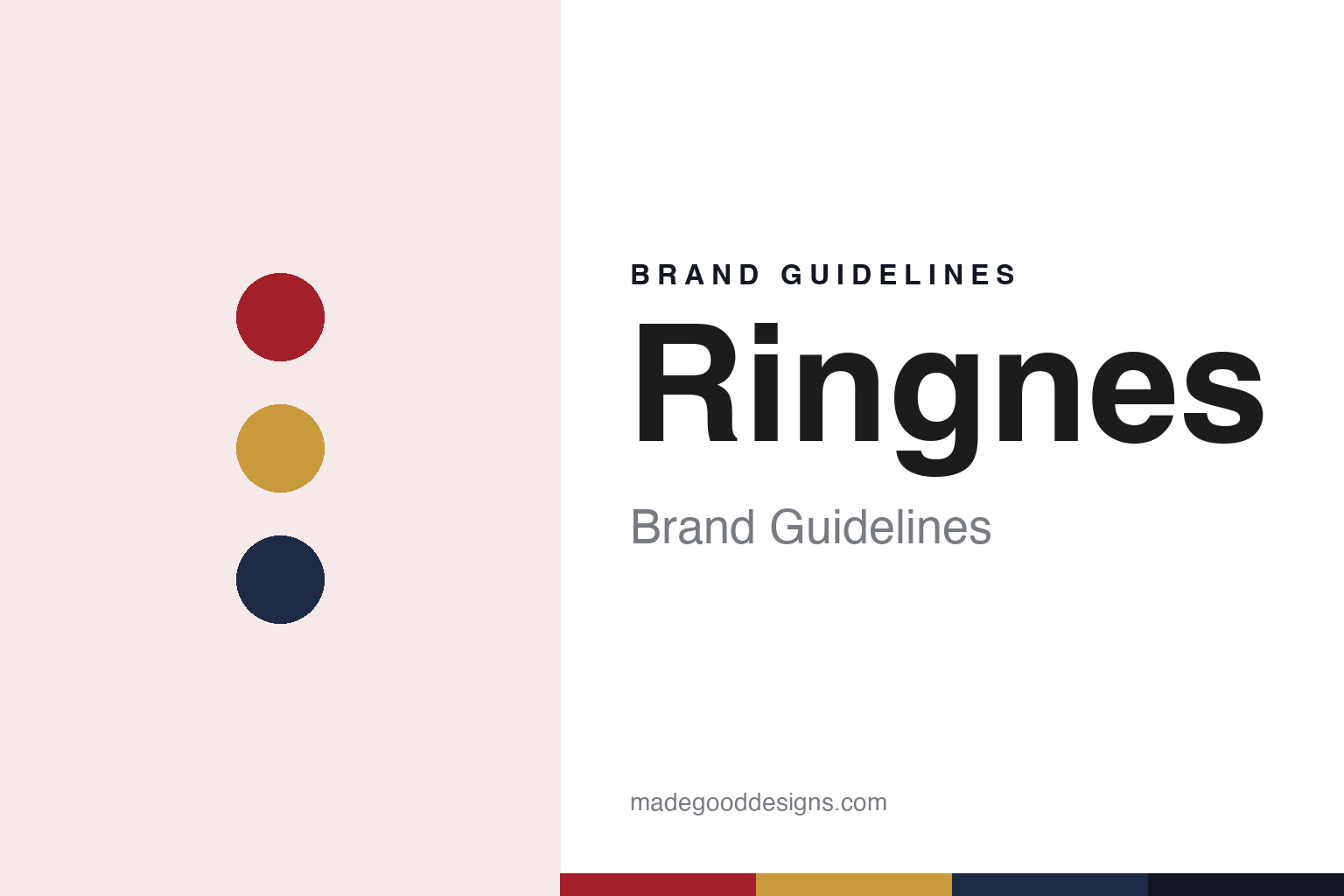
Ringnes Brand Guidelines
The Oslo brewery of the Ringnes brothers, Axel Heiberg and the Fram.
Aa
Two constants: a red, malt-gold and navy palette and a brewery serif register. Abstract homage — not a Ringnes product or mark; no can, label or logo is reproduced.
Ringnes & Co
Two brothers from Krødsherad and a financier.
Ringnes is named after a farm. The brothers Amund and Ellef Ringnes grew up on the Ringnes farm in Krødsherad and moved to the capital, then called Christiania, in 1860, Norwegian Wikipedia says. Ellef found work as a clerk and later as a travelling salesman for Christiania Bryggeri; Amund worked at the Akers mekaniske verksted engineering works before starting as an apprentice brewer at Christiania Bryggeri in 1865.
In 1876 the brothers set up a partnership, Ringnes & Co, with Axel Heiberg as its financial backer. English Wikipedia describes Amund as the brewer and Ellef as the administrator and salesman. The company says Amund brewed the first beer in the new brewery on 28 November 1877. The site was on Thorvald Meyers gate in Grünerløkka; Norwegian Wikipedia explains the choice by family ties, since Heiberg was the son-in-law of the businessman Thorvald Meyer, who owned much of the land there.
The partnership became a limited company, Ringnes Bryggeri, in 1899. The company says its brewery was the first in Norway, and probably the second in the world, to develop and cultivate its own pure strain of yeast; that is its own account. Norwegian Wikipedia records that the brewery modernised its plant and transport between the wars but kept its well-known dray horses on the streets of Oslo until 1952.
Two company histories by Mentz Schulerud, published by Ringnes for its 100th anniversary in 1976 and, with Øystein Øystå, for its 125th in 2002, are the main book-length sources; Norwegian Wikipedia cites the first for sales of about 101,000 hectolitres in 1946 and 384,000 in 1975.
Colour
Polar sponsors with islands to their names.
The early brewery’s best-known act of publicity had nothing to do with beer. The Ringnes brothers and Axel Heiberg were among the backers of Fridtjof Nansen’s and Otto Sverdrup’s voyages in the polar ship Fram; the company says the brothers were central among those who made the Fram expeditions possible, and English Wikipedia says the company helped fund the ship’s construction. Norwegian Wikipedia notes that the expeditions brought the firm a great deal of attention.
The result is unusual for a drinks brand: its founders’ names are on the map. During his exploration of the Canadian high Arctic in 1900, Sverdrup named three large islands after his sponsors, Axel Heiberg Island, Amund Ringnes Island and Ellef Ringnes Island, English Wikipedia says.
The brewery stayed in the family for a century. Norwegian Wikipedia records that it was led from 1901 by Harald Sigvart Maartmann, as managing director, and from 1920 by Knud Maartmann Ringnes. During the Second World War, it says, the brewery’s large malt store let it keep producing under rationing, when malt was impossible to obtain.
The original site is now part of the brand’s story rather than its production. In 2001 the last bottle of Ringnes beer left the Thorvald Meyers gate brewery, where beer had been made since 1877, Norwegian Wikipedia says, as production moved to a new plant outside the city. In 2018, the company says, it opened Ringnes Brygghus, a beer-culture venue with tours, on Grünerløkka at the original brewery location; its head office is still in Oslo.
Ringnes makes soft drinks and water as well as beer. Its portfolio, the company says, runs to about forty brands, from regional beers such as E.C. Dahls to the orange soda Solo, Pepsi Max, Carlsberg and Tuborg, and its own beers include Ringnes Pilsner.
Typography
Design and documentation.
The seven brands in this group all make food or drink, and all of them come from Switzerland or Norway: Villars, Maestrani, Ramseier, Appenzeller Alpenbitter, Elmer Citro, Ringnes and Tine. Food and drink brands from these two countries in general sit at many different points in the trade, from family firms that still carry a founder’s surname to co-operatives and names that now belong to much larger groups, and a single brand can be sold everywhere from a village shop to a supermarket shelf.
A food or drink brand’s identity is usually carried less by a single product than by a pack, a name and the taste it promises, because the company behind the name may have changed hands, moved its production or grown far beyond the town where it started. That makes the questions behind each name worth asking plainly: who started it, who owns it now, and where its products are actually made and packed.
Each guide separates what independent sources record from what the company says about itself — its founding story, its owners over time, where its products are made and how its packaging has changed — and marks plainly what rests only on the company’s own word.
Aa
A brewery serif — a name that is also a farm and an island. (Specimen set in Playfair Display, a serif STAND-IN; NOT the Ringnes logo.)
Ringnes
From Nora and Orkla to Carlsberg.
The family era ended in 1978, when Ringnes merged with De sammensluttede Bryggerier, itself formed from the Frydenlund and Schous breweries, under Nora Industrier, English and Norwegian Wikipedia say. Nora went on to buy regional breweries, including Arendals in 1980, E.C. Dahls of Trondheim in 1987 and Tou of Stavanger in 1990, and the Farris mineral-water business joined the group. The company dates the creation of Ringnes AS, as Nora’s drinks division, to 1988.
Nora merged with the Norwegian conglomerate Orkla in 1991, English Wikipedia says. The company’s timeline continues: in 1995 Ringnes merged with the Swedish brewer Pripps to form Pripps Ringnes; in 1997 Orkla became its sole owner; and in 2000 it was combined with Carlsberg’s brewing business in Carlsberg Breweries, in which Orkla held 40 per cent. In February 2004 Carlsberg agreed to buy Orkla’s stake, NRK reported, taking Ringnes, Farris, Solo and E.C. Dahls with it; Orkla’s chief executive, Finn Jebsen, said the sale was made “with a heavy heart,” while a union representative called it a disaster. Ringnes has been wholly owned by the Carlsberg Group since.
Production has been concentrated. Norwegian Wikipedia says work on the Gjelleråsen brewery in Nittedal, outside Oslo, began in 1993 and was finished in 2000; the Bodø brewery closed in 2000 and Tou’s in Stavanger in 2003, and in 2009 Ringnes sold the Arendal brewery to local owners while keeping the Arendals Pilsner brand, Nettavisen reported. Today the company names four production sites: Gjelleråsen, E.C. Dahls in Trondheim, and the Imsdal and Farris bottling plants.
For a design guide, Ringnes shows how a brewery can carry its founders, its street and even an Arctic map in its name after a century and a half and several owners. Compare Freia, another Oslo food name now owned abroad, and Tine, the Norwegian dairy cooperative. For this guide we use a deep red, a malt gold and a navy with a serif, an unofficial interpretation; no product or logo is reproduced.
Explore & save
Keep Ringnes’s identity on hand — save it to a board in the Made Good inspiration library.
Ringnes identity set
Pin the Ringnes red, malt-gold and navy palette and the brewery serif register to your own board.