Mills Brand Guidelines
The Oslo mayonnaise house still owned by the Heje family.
Aa
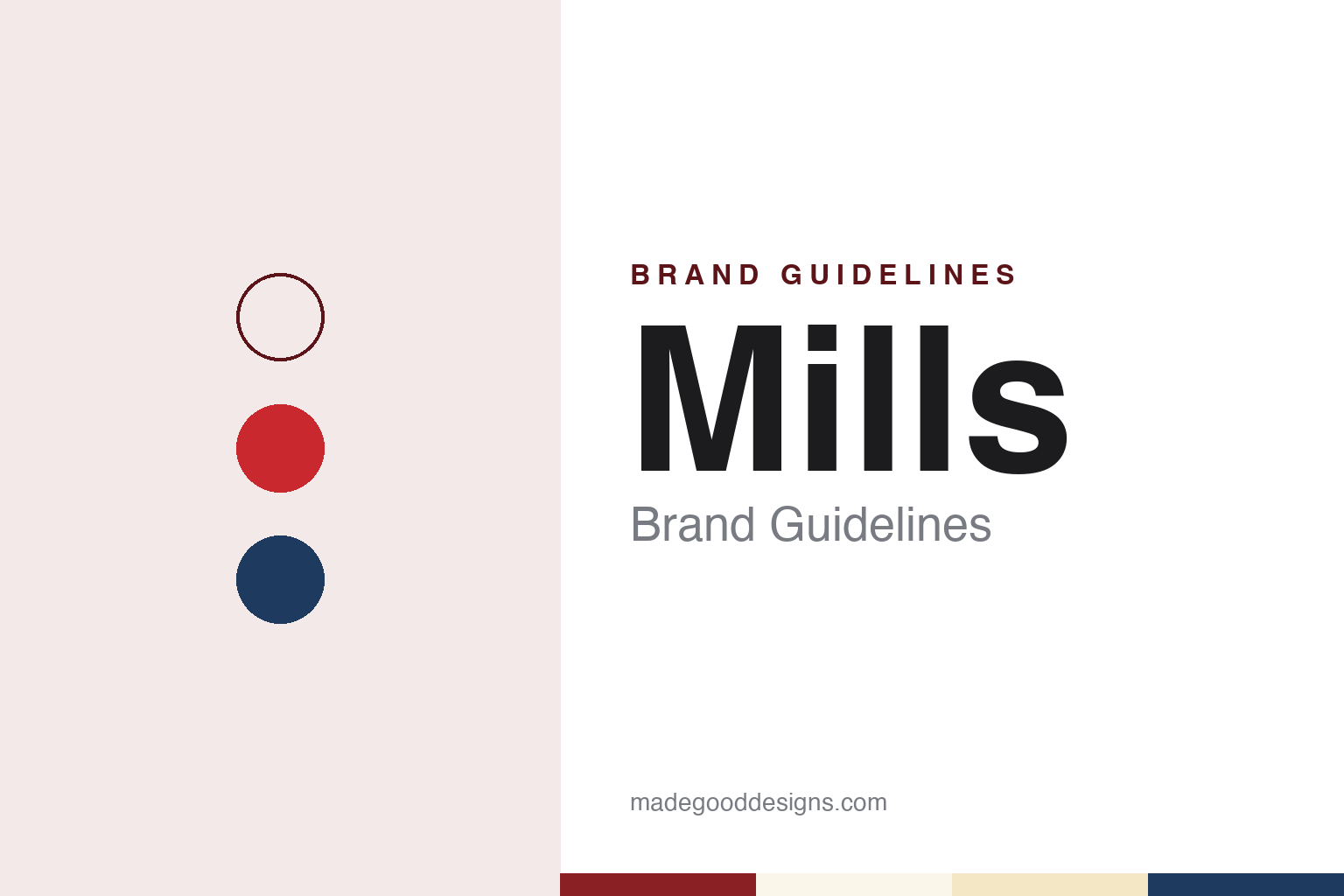
Two constants: a Mills red, mayonnaise cream and fjord blue palette and a warm display serif register. Abstract homage — not a Mills product or mark; no jar, tube, logo or label is reproduced.
A margarine works on Grünerløkka
A farmer’s son from Hallingdal, a soap factory and a margarine called Melange.
Mills is one of the most familiar names in a Norwegian fridge, but the company behind it began with margarine. In 1885, according to the history published by its parent group Agra, Knut K. Heje, the heir to a farm at Flå in Hallingdal, founded A/S Agra Margarinfabrik on Grünerløkka in Oslo. Mills’ own history adds that the works began in a disused soap factory, and that Heje founded it together with an engineer, J. A. Mørch. Norwegian Wikipedia gives the same founding story, citing Agra.
The first brand to last was a margarine. Agra launched Melange in 1919, and the company calls it one of Norway’s oldest and best-known brand names; Mills still sells it more than a century later.
The Mills name came later and through a joint venture. In 1936, Agra says, it played a leading role in founding A/S Margarincentralen. After the Second World War, as Norwegians grew better off and wanted new foods, Margarincentralen began producing them under the Mills name, and Agra says those Mills products now account for the largest share of the group’s revenue. The company dates itself to the 1885 founding, and its history page carries the line “Matglede helt siden 1885,” roughly “the joy of food since 1885.”
Colour
Mayonnaise under rationing, caviar in a tube and a salad maker from Drammen.
The product that made the name was mayonnaise. Mills says it launched Mills majones in 1951, at a time when food in Norway was still subject to ration cards, and that it was an immediate success. A year later, in 1952, came Mills kaviar, a cod-roe spread; the company says it won Norwegian customers with fresh ingredients, modern production and “elegant packaging,” even though cod roe had been one of the most-eaten foods during the war years. Today the mayonnaise range runs from Ekte Majones to lighter and flavoured versions, and the company’s recipe pages use it in everything from burgers to chocolate cake.
Other names joined over the following decades. Mills says it launched Soft Flora, a margarine that stays spreadable straight from the fridge, in 1966. Delikat, a maker of salads and spreads, started in Skomakergaten in Drammen in 1931, and A/S Delikat Fabrikker was bought in 1970, both Agra and Mills say; its best-known products then, as now, were shrimp salad and Italian salad, which the company says were decorated by hand with ingredients on top. Vita hjertego’, a range made from plant oils, followed in 1997, and Plantego’, a line of plant-based and vegan products, in 2019, with its first spreads made at the Drammen factory.
Mills lists seven brands today: Mills, Delikat, Melange, Soft Flora, Vita hjertego’, Olivero and Plantego’. The company says most of its products are made at its factories in Fredrikstad and Drammen, while its head office remains on the original Grünerløkka site. When Agra and Mills moved into new offices beside Sofienberg Park in 2016, Agra says, the old factory building was turned into offices and a food centre and its production was moved to the Mills factory in Fredrikstad.
Typography
Design and documentation.
The seven brands in this group all make food or drink, and they come from Finland and Norway: Hartwall, Koff, Mills, Solo, Olvi, Lapin Kulta and Atria. Food and drink brands in general sit at many different points in the trade, from family firms that still carry a founder’s surname to names that now belong to much larger groups, and a single brand can be sold everywhere from a corner kiosk to a supermarket aisle.
A food or drink brand’s identity is usually carried less by a single product than by a pack, a name and the meal or drink it promises, because the company behind the name may have changed hands, moved its production or grown far beyond the town where it started. That makes the questions behind each name worth asking plainly: who started it, who owns it now, and where its products are actually made and packed.
Each guide separates what independent sources record from what the company says about itself — its founding story, its owners over time, where its products are made and how its packaging has changed — and marks plainly what rests only on the company’s own word.
Aa
A warm display serif for a brand that has dated itself to 1885. (Specimen set in DM Serif Display, a serif STAND-IN; NOT the Mills logo.)
Mills
A cartel of margarine makers, a buy-out and a family firm again.
Mills reached its present shape through a long consolidation. In 1970, Agra says, Margarincentralen became Forenede Margarinfabrikker, or Forma, after a merger. Agra then owned only 19 per cent of Forma and, like the other shareholders, made only margarine and Mills products for it. Agra says the arrangement left Forma with an awkward ownership structure and too many production sites, and over the following years it bought out the other shareholders. The last step was the purchase of Mustad Industrier’s stake in 1995, which gave Agra full control.
Agra used that control to merge sales, marketing and production into a single new company, Mills DA, in 1997, and Delikat was merged into Mills in 2002, the group says. One outside shareholder remained: at Agra’s 120th anniversary in 2005, it says, Unilever still held 34 per cent of the shares. In 2015 those shares were bought back, and Agra describes itself as once again a wholly Norwegian, family-owned company. Mills says the Heje family still owns it, and in 2020 Knut G. Heje stepped down as group chief executive after 42 years to become chairman, with Knut K. Heje moving up from managing director of Mills to run the group, Agra says.
Agra has also grown outside Norway. Through Delikat it bought the Swedish salad makers Rubin Partysallad in 1994 and Rydbergs in 1995, and it added Graasten Salater in Denmark in 2003 and Stryhns, the Danish liver-pâté maker, in 2008, according to its own timeline. The group now presents itself as three companies, Mills in Norway, Foodmark in Sweden and Stryhns Gruppen in Denmark, with factories in Scandinavia and Poland.
For a design guide, Mills shows how a margarine works can become a household name through mayonnaise, caviar and salads, while keeping one family and one Oslo address. Compare Hellmann’s, the mayonnaise brand of Unilever, Mills’ former shareholder, and Solo, Norway’s orange soft drink. For this guide we use a Mills red, a mayonnaise cream and a fjord blue with a serif, an unofficial interpretation; no product or logo is reproduced.
Explore & save
Keep Mills’s identity on hand — save it to a board in the Made Good inspiration library.
Mills identity set
Pin the Mills red, mayonnaise cream and fjord blue palette and the warm display serif register to your own board.