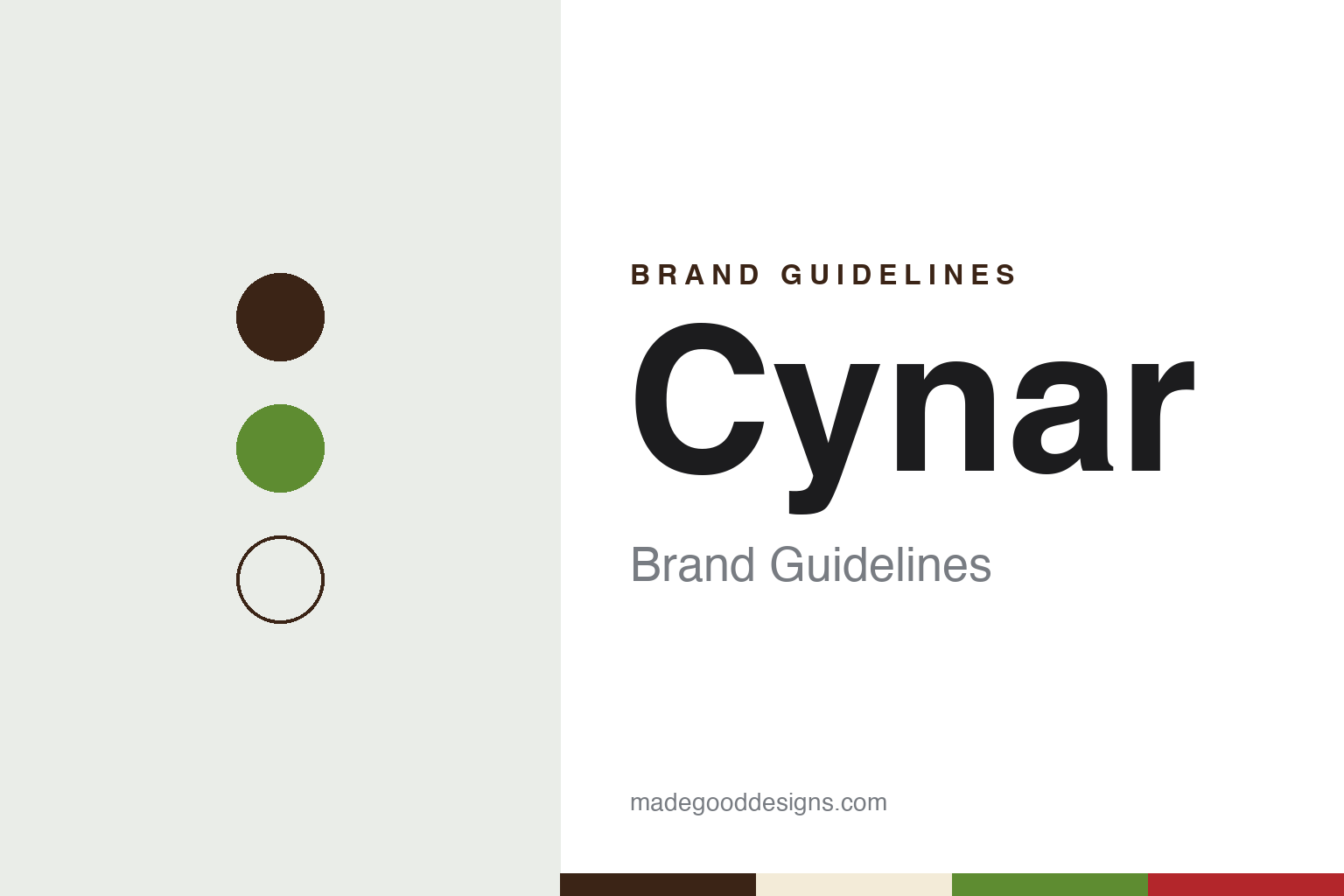
Cynar Brand Guidelines
The Padua artichoke amaro and its Carosello slogan.
Aa
Two constants: an artichoke green, amaro brown and cream palette and a classic bottle serif register. Abstract homage — not a Cynar product or mark; no bottle, label or logo is reproduced.
Pezziol of Padua
A family firm, a distiller and an artichoke.
Cynar is an Italian amaro made with artichoke leaves, and it was born in Padua. Its maker was G.B. Pezziol, a Padua company already known for Vov. Italian Wikipedia says Angelo Dalle Molle persuaded his family to buy the struggling Pezziol business in 1935, when it already owned well-known spirits such as Vov; the Cynar entry names the owners as the brothers Amedeo, Angelo and Mario Dalle Molle.
The recipe came from inside the firm. Il Sole 24 Ore reported in March 2025 that the Pezziol owners challenged their staff to come up with a popular new aperitif, and credited the formula, dated 1948, to Rino Dondi Pinton, a distiller at Pezziol who had trained at the Gran Bar Pezziol beside Padua’s Caffè Pedrocchi from 1938 and who later became production director for Angelo Dalle Molle’s companies. The paper describes the recipe as artichoke leaves with 13 other herbs and plants; English Wikipedia, citing Campari, describes 13 herbs and plants, predominantly artichoke.
The name came next. Italian Wikipedia, citing the Corriere della Sera in 2018, says the first version was called CaB1, that it was renamed Cynar at the end of 1949 after Cynara scolymus, the botanical name of the artichoke, and that it went on sale in 1952 with the label that made it famous. Sources differ on the launch year: English Wikipedia also gives 1952, while Italian Wikipedia’s entry on Angelo Dalle Molle gives 1950, and the brand’s own Italian website calls Cynar a vintage icon “dal 1950,” since 1950. The Dalle Molle entry says two million bottles were sold in the first year and more than 40 million a year by the early 1970s.
Colour
Calindri at the crossroads.
Cynar’s fame was made on television. Italian Wikipedia ties the growth of its sales between 1957 and 1976 to heavier advertising, above all the spots it ran in Carosello, the RAI programme that framed short sketches around commercials. English Wikipedia says Cynar became popular in the early 1960s through those films. The first series starred the actor Ferruccio De Ceresa; from 1966 the role passed to Ernesto Calindri.
The best-remembered sketch is simple. Calindri sits at a small table in the middle of a roundabout, which Italian Wikipedia identifies as la Stanga in Padua, calmly sips a glass of Cynar while the traffic swirls around him, and delivers the line “Cynar contro il logorio della vita moderna,” Cynar against the wear and tear of modern life. English Wikipedia says that towards the end of the 1970s the setting moved from the busy city to a field of artichokes, and that Calindri’s partnership with the brand lasted until 1984. The Corriere della Sera returned to the line in 2018 in a feature on drinks slogans that tracked how the country changed.
The slogan outlived the campaign. In the 1990s, Italian Wikipedia says, the brand hired the actor Alberto Lionello and the showgirl Natalia Estrada, with new spots set to music by Enzo Jannacci. In September 2007 it revived the old line ironically with the band Elio e le Storie Tese, stuck at a busy junction until a bottle of Cynar turns into an artichoke-shaped spaceship; in the same spot a newspaper page shows Calindri’s photograph and his slogan. The sketch had already become a film reference: in Maurizio Nichetti’s Ladri di saponette, a moped knocks over Calindri’s table.
Typography
Design and documentation.
The seven brands in this group are all Italian amaro and liqueur names: Fernet-Branca, Averna, Ramazzotti, Montenegro, Cynar, Strega and Galliano. Italian amaro and liqueur brands in general sit at many different points in the trade, from family firms that still carry a founder’s name to names that now belong to much larger drinks groups, and a single brand can be sold everywhere from a neighbourhood bar to a supermarket shelf.
A drinks brand’s identity is usually carried less by a single product than by a bottle, a label, a name and the ritual it promises, because the company behind the name may have changed hands, moved its production or grown far beyond the town where it started. That makes the questions behind each name worth asking plainly: who started it, who owns it now, and where its drinks are actually made and bottled.
Each guide separates what independent sources record from what the company says about itself — its founding story, its owners over time, where its drinks are made and how its bottles and labels have changed — and marks plainly what rests only on the company’s own word.
Aa
A classic bottle serif for an amaro with a mid-century label. (Specimen set in Playfair Display, a serif STAND-IN; NOT the Cynar logo.)
Cynar
From the Dalle Molles to Campari.
The Dalle Molle family did not keep Cynar for good. Italian Wikipedia says Angelo Dalle Molle sold his shares in the company in 1973, without naming the buyer. English Wikipedia, citing the Corriere della Sera archive, says that in 1995 the Campari group acquired the Italian branch of the Dutch group BolsWessanen, which distributed brands including Crodino, Cynar and Lemonsoda, and that Cynar has been made and distributed by Campari ever since. Campari later added another amaro, the Sicilian Averna, which it bought in 2014, Reuters reported.
The range is small. The standard Cynar is a dark brown, bittersweet amaro at 16.5% alcohol, and a stronger Cynar 70 Proof, at 35%, was covered by Forbes in 2015. Italian Wikipedia, citing Campari, names Brazil, Italy and Switzerland as the main markets, and English Wikipedia says Cynar is also produced in Brazil and Argentina; in Brazil it goes into the rabo-de-galo, with cachaça and sweet vermouth. Today the brand’s Italian website promotes the Cynar Spritz and describes Cynar as official sponsor of Venezia FC. For the lettering on the bottle, see our separate guide to the Cynar font.
For a design guide, Cynar shows how one character and one line can carry a brand for decades: an actor at a table in traffic, and a slogan the brand itself revived in 2007. Compare Averna, its Campari stablemate, and Amaro Montenegro, another Italian amaro. For this guide we use artichoke green, amaro brown and cream with a serif, an unofficial interpretation; no product or logo is reproduced.
Explore & save
Keep Cynar’s identity on hand — save it to a board in the Made Good inspiration library.
Cynar identity set
Pin the Cynar artichoke green, amaro brown and cream palette and the classic bottle serif register to your own board.