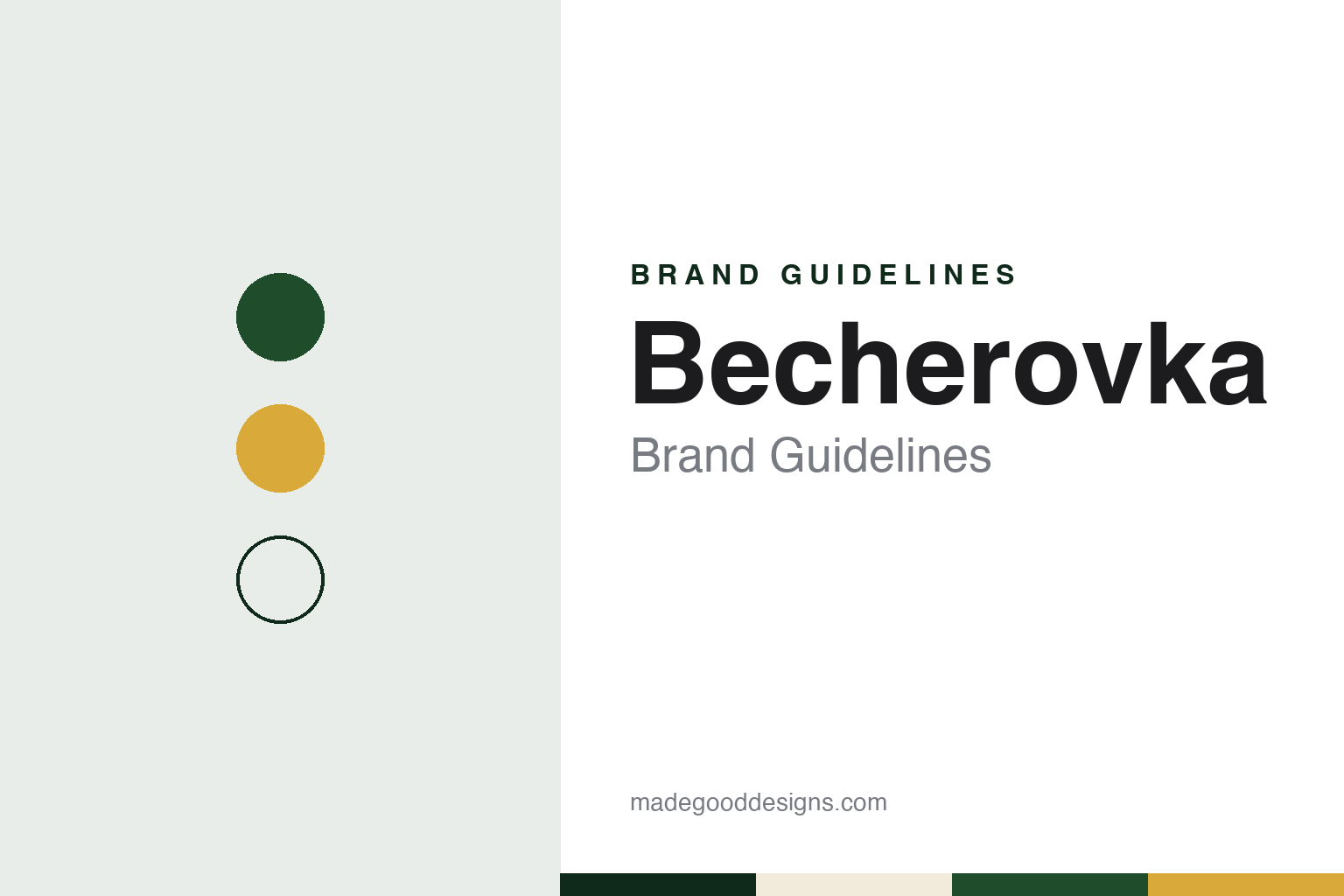
Becherovka Brand Guidelines
The 1807 Karlovy Vary herbal liqueur in the flat green bottle.
Aa
Two constants: a bottle green, herbal gold and spa-town cream palette and an old Bohemian display serif register. Abstract homage — not a Becherovka product or mark; no bottle, label or logo is reproduced.
A recipe from a spa town
A merchant, a doctor’s recipe and two years of trials.
Becherovka is a bittersweet herbal liqueur made in Karlovy Vary, the Bohemian spa town once known as Carlsbad, by the company Jan Becher – Karlovarská Becherovka. Its makers call it the oldest alcohol brand in the Czech Republic and say it has been made continuously since 1807. Under its full name, Becherovka Original, it is bottled at 38% ABV, according to English and Czech Wikipedia.
The story begins with Josef Vitus Becher, a Carlsbad merchant who traded in spices and colonial goods. English Wikipedia, citing the Czech news site Aktuálně.cz (2018), says his shop was known as the House of the Three Larks. The company says that in 1805 Becher received a recipe written by a doctor, Christian Frobrig, and spent nearly two years adjusting it before the liqueur went on sale in 1807. Czech Wikipedia dates Frobrig’s visit to 1806; both versions agree on the 1807 launch.
The first name on the bottle was not Becherovka. Czech and English Wikipedia say the liqueur was sold at first as English Bitter, and later under names including Karlsbader Becherbitter. Czech Wikipedia says the name Becherovka was used on the Czech market from 1922. Today the company describes a recipe of roughly twenty herbs and spices, some brought from far-off countries and some from around Karlovy Vary, mixed with Karlovy Vary water, spirit and sugar. The exact formula, it says, is secret and known to only two people, who mix the herbs in a room still called the Drogikamr, as English Wikipedia also notes, citing the company.
In its home town, the company says, the liqueur earned the nickname “the thirteenth Karlovy Vary spring”.
Colour
A family firm, a flat bottle and exports across Europe.
The business took its lasting shape under Josef’s son, Johann Nepomuk Becher, known in Czech as Jan. English Wikipedia says he took over the still-house in 1838. The company calls him the true founder of the firm: he took over his father’s shop and liqueur making, developed the business for some forty years, and his signature still appears on every bottle. In 1867, the company says, he moved the growing production to a new factory at Steinberky, which gave the liqueur a direct railway link to other countries. That building is now the brand’s visitor centre, The Home of Becherovka.
The pack that defines the brand came from inside the family. The company says that in 1866 Jan Becher’s brother-in-law, Karel Laube, proposed the flat bottle shape that Becherovka still uses, and that in 1907 the glass changed from clear flint to dark green. Czech Wikipedia gives the same 1866 and 1907 dates.
Exports started early. The company says the liqueur first went abroad in 1834, to Szczecin, followed by Vienna and Munich a year later and Paris in 1838; during the First World War it was sold in Spain, Italy, Turkey and Egypt, and after the end of Prohibition it reached the United States. Czech Wikipedia, citing the financial site Peníze.cz (2006), says the firm was named a supplier to the imperial court in 1904.
The family era ended with the Second World War. After 1945, Czech Wikipedia says, the German-speaking Becher family was expelled from Czechoslovakia and the liqueur works, with its recipe, passed into state administration. In 1967, at Expo 67 in Montreal, the company says, it presented the BeTon, Becherovka with tonic, as a toast to Czechoslovak–Canadian friendship. Beton means concrete in Czech.
Typography
Design and documentation.
The seven brands in this group are all liqueur and aperitif brands: Baileys, Kahlúa, Disaronno, Martini, Cinzano, Molinari and Becherovka. Liqueur and aperitif brands in general sit at many different points in the trade, from family firms that still carry a founder’s name to names that now belong to much larger drinks groups, and a single brand can be sold everywhere from a corner shop to a hotel bar.
A liqueur or aperitif brand’s identity is usually carried less by a single recipe than by a bottle, a label, a name and the drink or occasion it promises, because the company behind the name may have changed hands, moved its production or grown far beyond the place where it started. That makes the questions behind each name worth asking plainly: who started it, who owns it now, and where its drinks are actually made and bottled.
Each guide separates what independent sources record from what the company says about itself — its founding story, its owners over time, where its drinks are made and how its bottles and labels have changed — and marks plainly what rests only on the company’s own word.
Aa
An old Bohemian display serif for a liqueur that has kept its flat green bottle since the early twentieth century. (Specimen set in Playfair Display, a serif STAND-IN; NOT the Becherovka logo.)
Becherovka
From state enterprise to two foreign owners.
After the fall of communism the brand returned to private hands in stages. Czech Wikipedia says the joint-stock company Jan Becher – Karlovarská Becherovka was formed in 1994 from the former state enterprise, and that in 1997 the Czech government chose a consortium part-owned by Pernod Ricard to privatise it; the French group later bought out its partners, and Becherovka became part of Pernod Ricard in 2001. Under that owner, the company says, a new factory was built in the Bohatice district of Karlovy Vary in 2010, in under a year, raising capacity by 40%; it says it makes almost eight million litres a year and exports more than half.
The labels have changed too. In 2017, the Czech trade site MediaGuru reported, a limited edition of half-litre bottles revealed four of the secret ingredients, among them yarrow, clove and cinnamon, through drawn motifs and Latin names on the labels, with the Czech name and the country of origin appearing once the bottle was frozen. In 2018, the company says, it introduced a new bottle design built around the cryptogram, which it describes as the Becher family crest and a symbol that has accompanied the brand from the start.
Ownership changed again in the mid-2020s. Poland’s Maspex, the Wadowice food and drink group, lists the purchase of the company and brand among its 2023 acquisitions. The Czech news agency ČTK, in a report carried by Forbes Česko on 30 April 2024, said the transfer from Pernod Ricard had been completed that day, that Maspex would be the owner from 1 May 2024, and that the deal included the production plant and warehouse in Karlovy Vary. Maspex said at the time that Becherovka was the number two brand among herbal liqueurs in the Czech Republic and Slovakia.
For a design guide, Becherovka shows how one family decision — a flat bottle proposed in 1866 and cast in green glass from 1907 — can carry a brand through changes of country, regime and owner. Compare Unicum, the Zwack family’s round-bottled Budapest bitter, and Tymbark, the Polish juice brand from the same Maspex stable. For this guide we use a bottle green, a herbal gold and a spa-town cream with a serif, an unofficial interpretation; no product or logo is reproduced.
Explore & save
Keep Becherovka’s identity on hand — save it to a board in the Made Good inspiration library.
Becherovka identity set
Pin the Becherovka bottle green, herbal gold and spa-town cream palette and the old Bohemian display serif register to your own board.