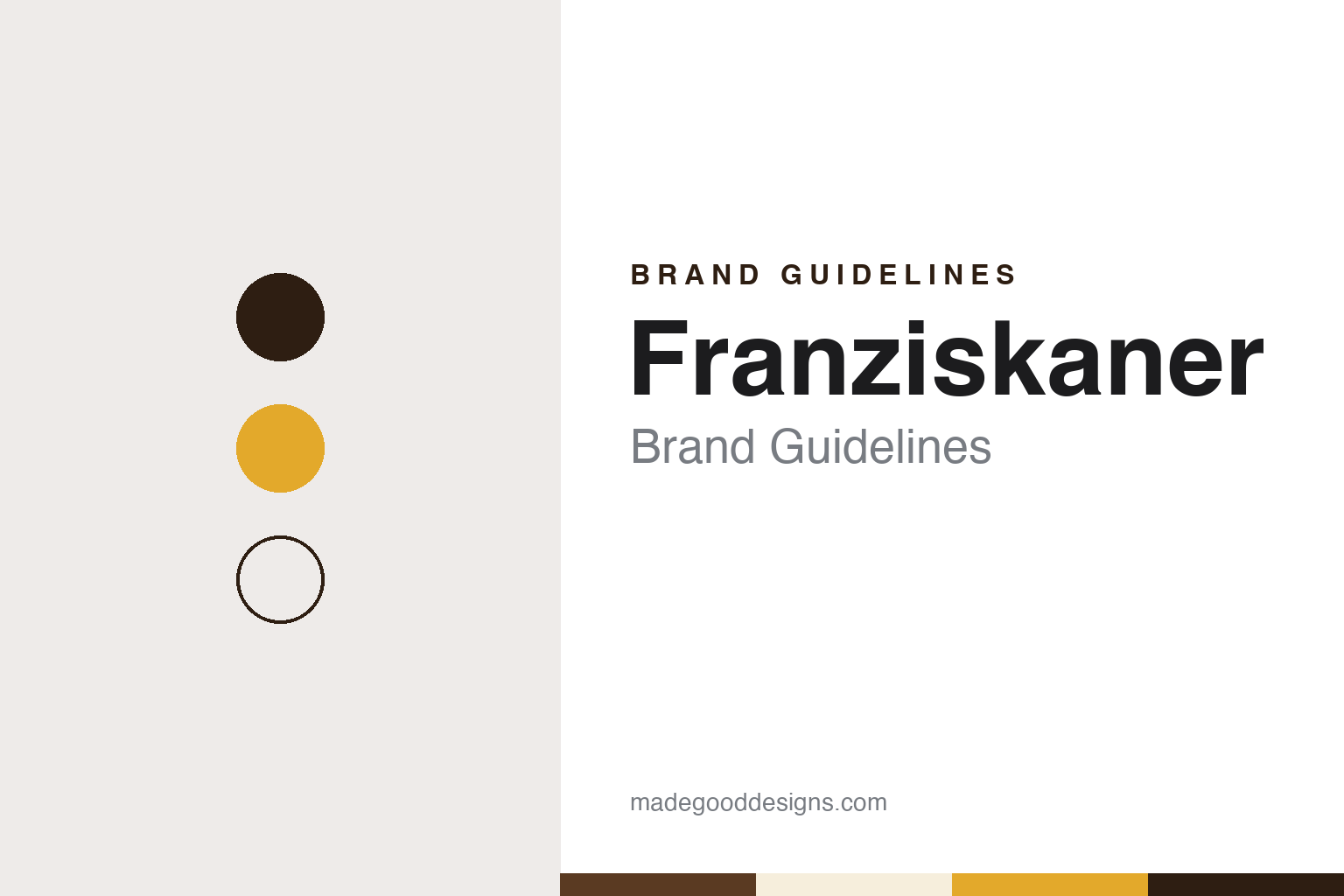
Franziskaner Brand Guidelines
The Munich wheat beer with Ludwig Hohlwein’s friar.
Aa
Two constants: a habit brown, wheat gold and foam cream palette and a humanist serif register. Abstract homage — not a Franziskaner product or mark; no label, logo or illustration is reproduced.
The brewhouse by the Franciscans
A 1363 brewing site named after its neighbours.
Franziskaner takes its name from a place, not a person. The Munich historian Helmuth Stahleder, cited by German Wikipedia, records a brewing site founded by the brewer Seidel Vaterstetter and first mentioned in 1363 as the “Bräustatt bey den Franziskanern,” the brewhouse by the Franciscans, near the Munich Residenz. The name came from the Franciscan friary that stood almost opposite, and the brewery kept it after it left the old town. German Wikipedia calls it the oldest burgher brewery in Munich; the company says its roots can be traced back to 1363.
In 1841 the brewery moved out to the Lilienberg, a rise in the eastern suburb of Au, the company says. The family that would shape the brand arrived soon after. Joseph Sedlmayr, a son of the Spaten brewer Gabriel Sedlmayr the Elder, had bought Munich’s Leist brewery in 1842; in 1858 he became a partner in Franziskaner alongside August Deiglmayr, and in 1861 he became its sole owner. In 1865 brewing at the Leist site on Sendlinger Straße stopped, and the combined Franziskaner-Leist business brewed only in Au, according to the company.
The company says that in 1872 the Franziskaner-Leist brewery first poured an amber, Vienna-style Ur-Märzen in the Schottenhamel tent at the Oktoberfest. English Wikipedia, citing Getränke News and The Mercury News, credits that beer to Joseph Sedlmayr.
Colour
A friar, a poster artist and a wheat beer.
The friar arrived long before the wheat beer. In 1909, when Franziskaner became a family joint-stock company under Joseph Sedlmayr’s son Gabriel von Sedlmayr, a friar was used as the brand’s emblem for the first time, the company says. In 1922 Franziskaner-Leist and the Sedlmayr family’s other brewery, Spaten, merged into one company, the Gabriel und Joseph Sedlmayr Spaten-Franziskaner-Leistbräu AG; German Wikipedia says the aim was to weather the economic crises of the 1920s together.
The image the brand still uses came in the mid-1930s. The Munich artist Ludwig Hohlwein drew a portrait of a cellarer, the friar in charge of a monastery’s cellars and stores. The company dates the design to 1935 and calls it the brand image that is still valid today; German Wikipedia gives 1934/1935. Getränke News wrote in 2020 that Hohlwein gave the brand “a face” in 1935 and that the cellarer stands for the order’s standards for its beer. Hohlwein was not the first notable artist to work for the brewery: German Wikipedia illustrates a Franziskaner-Leist-Bräu poster of about 1900 by the graphic artist Otto Hupp, who also designed the Spaten logo.
Wheat beer came much later. The brewery first brewed a Weissbier in 1964, sold as “Spaten Champagner Weissbier”; the clear version was renamed Club-Weiße in 1968, and in 1974 the beer went on sale as Franziskaner Hefe-Weissbier, the company says. English Wikipedia adds that from then on all Franziskaner beer was wheat-based. Distribution beyond Bavaria began in 1984. In the 2002/2003 brewing year Franziskaner passed one million hectolitres for the first time, and German Wikipedia, citing the company, describes it as Germany’s third-largest wheat beer brand at that point.
Typography
Design and documentation.
The seven brands in this group are all beer names from Germany, Belgium and the United States: Franziskaner, Spaten, Löwenbräu, Leffe, Hoegaarden, Westmalle and Yuengling. German, Belgian and American beer brands in general sit at many different points in the trade, from family firms that still carry a founder’s name to names that now belong to much larger brewing groups, and a single brand can be poured everywhere from a local bar to a supermarket shelf.
A beer brand’s identity is usually carried less by a single product than by a label, a glass, a name and the place it claims as home, because the company behind the name may have changed hands, moved its brewing or grown far beyond the town where it started. That makes the questions behind each name worth asking plainly: who started it, who owns it now, and where its beer is actually brewed and packed.
Each guide separates what independent sources record from what the company says about itself — its founding story, its owners over time, where its beer is brewed and how its labels and packaging have changed — and marks plainly what rests only on the company’s own word.
Aa
A humanist serif for a brand built on a 1930s illustration. (Specimen set in Alegreya, a serif STAND-IN; NOT the Franziskaner logo.)
Franziskaner
Interbrew, InBev and a museum brewhouse.
The Sedlmayr group grew before it was sold. In 1997 Spaten-Franziskaner combined with Löwenbräu to form the Spaten-Löwenbräu-Gruppe, and in 2003 the group was sold to the Belgian brewer Interbrew, which became InBev and later AB InBev, Getränke News reported in 2020. German Wikipedia gives 1 October 2004 as the date the group joined InBev; the company dates the link to 2005. Franziskaner is now a brand of Spaten-Franziskaner-Bräu GmbH in Munich. In October 2021 Bloomberg reported that AB InBev was exploring a sale of German brands including Franziskaner and Spaten; in April 2026 the Abendzeitung still described the brewery as part of AB InBev.
Where the beer is made has changed within Munich. In 2006 the historic Spaten brewhouse on Marsstraße, where Franziskaner had also been brewed, was closed for lack of use and turned into a visitor museum; Bayerischer Rundfunk reported in 2016 that Franziskaner was then brewed in Löwenbräu’s remaining brewhouse on Nymphenburger Straße. The Abendzeitung wrote in 2026 that Spaten, Löwenbräu and Franziskaner are all brewed at the Marsstraße site. The Süddeutsche Zeitung and Die Welt reported in 2022 that Franziskaner and Spaten were also being brewed in Russia under licence.
Advertising has kept the friar at the centre. The company says a 2005 repositioning brought the line “Kenner schätzen Franziskaner Weissbier” (connoisseurs appreciate Franziskaner Weissbier), followed by “Zeit für das Besondere” (time for something special); German Wikipedia says the print and television campaigns put the friar forward as the embodiment of Bavarian brewing tradition. Getränke News reported a new label design in 2009, and the company dates the vintage Franziskaner Royal to 2011. The company also says its alcohol-free wheat beer won gold in its category at the World Beer Awards in 2015, and The Grocer reported in January 2017 that AB InBev was bringing that beer to the United Kingdom.
For a design guide, Franziskaner shows how one commissioned illustration can carry a brand for about ninety years. Compare its sister brands Spaten and Löwenbräu. For this guide we use habit brown, wheat gold and foam cream with a humanist serif, an unofficial interpretation; no product or logo is reproduced.
Explore & save
Keep Franziskaner’s identity on hand — save it to a board in the Made Good inspiration library.
Franziskaner identity set
Pin the Franziskaner habit brown, wheat gold and foam cream palette and the humanist serif register to your own board.