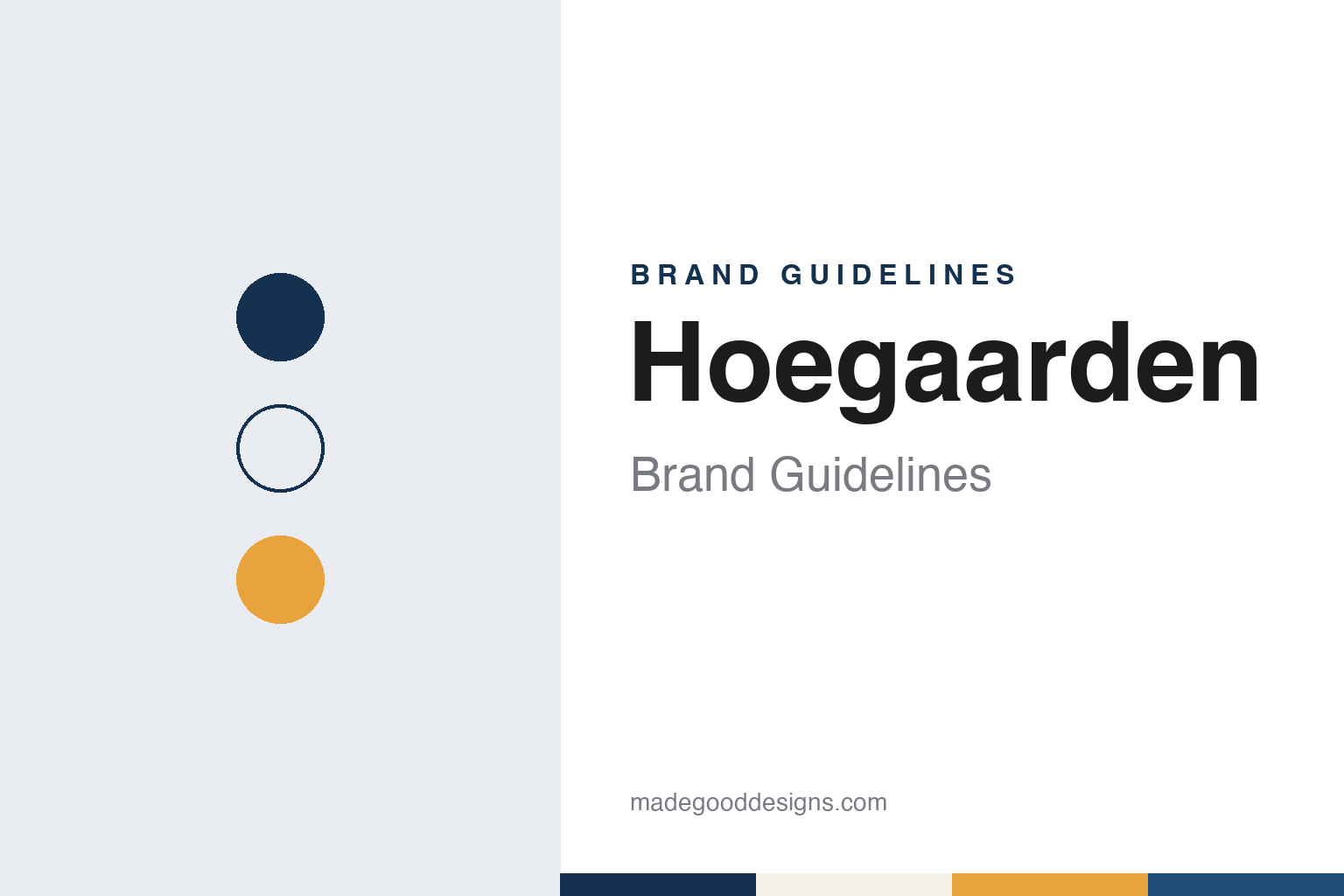
Hoegaarden Brand Guidelines
The milkman’s revival of Belgian witbier.
Aa
Two constants: a wheat white, village blue and orange-peel palette and a classical serif register. Abstract homage — not a Hoegaarden product or mark; no bottle, glass or logo is reproduced.
A village without its beer
A dead style, a milkman and a copper boiler.
Hoegaarden is named after a village in Flemish Brabant, east of Leuven, that was known for its cloudy wheat beer long before the brand existed. The brand’s own history says local monks hit on a wheat-beer recipe with orange peel and coriander around 1445, and that by 1726 the village had 36 breweries. English Wikipedia, citing the newspaper Het Nieuwsblad in 2005, says Hoegaarden still had thirteen breweries and nine distilleries in the nineteenth century. The tradition ran out in 1957, when Tomsin, the last wheat-beer brewery in the village, closed.
The revival came from a neighbour. Pierre Celis, born in Hoegaarden in 1925, grew up on the same street as Tomsin and worked there from an early age, he told the American beer writer David Cook in a 2003 interview that Cook published in 2005 and again on his blog Belgian Beer and Travel in April 2011. Celis had become a milkman. In the early 1960s, he said, friends joked that he should make another frothy white drink: beer. He began test brews in 1965 with a copper vessel, using the Tomsin recipe as he remembered it, and the brand’s own history describes the same start in his milk shed. With equipment bought from an abandoned brewery in Heusden-Zolder, according to English Wikipedia, he opened Brouwerij Celis in March 1966; Cook gives the official opening as 16 March, and both English and Dutch Wikipedia date the brewery to 1966. Dutch Wikipedia says the beer was at first sold as Oud Hoegaards.
The ingredients were the old ones: water, yeast, unmalted wheat, malted barley, hops, coriander and dried Curaçao orange peel, English and Dutch Wikipedia say. The beer is top-fermented, unfiltered and refermented in the bottle, which gives it its haze, and the regular witbier is 4.9% alcohol, Dutch Wikipedia says. Celis told Cook that the first year produced 350 hectolitres, and that in 1968 he began bottling a beer he had at first sold only in kegs.
Colour
A borrowed glass, a printer’s label and a fire.
Much of Hoegaarden’s look began as Celis’s own improvisation, by his account. The first bottles of 1968 carried simple labels from a local printer, with the letters “HW” in black and red, he told Cook. The chunky, faceted glass that is now inseparable from the beer was, Celis said, his own creation, patterned on an old glass he had seen at the Bokrijk open-air museum, where the old Tomsin brewing equipment had ended up. He was also a showman: he had more than a million mock identity cards printed, issued by “The Beer Kingdom of Hoegaarden” and styled on Belgian driving licences of the day, Cook reported.
The business grew quickly. Celis bought a water and soft-drinks plant in the village called De Kluis and opened it as a brewery on 19 July 1979, he told Cook; Dutch Wikipedia describes the site as a former lemonade factory known as Hougardia. The brand’s history says the brewery made more than 75,000 hectolitres a year by 1985, and Celis said Hoegaarden had been imported into the United States, mainly for Texas, since 1975. English Wikipedia lists a stronger Grand Cru and a dark, spiced ale, Verboden Vrucht (Forbidden Fruit), among the beers that grew up beside the white.
In 1985 a fire destroyed much of De Kluis. Celis told Cook the brewery was badly under-insured, and that Stella Artois offered to invest in return for 45% of the shares. In 1988 Artois merged with Piedboeuf to form Interbrew, and Celis said the bankers then wanted cheaper ingredients; in 1990, aged 65, he sold the rest of his shares to Interbrew. He went on to found the Celis Brewery in Austin, Texas, run by his daughter Christine, which was later sold to Miller and closed, English Wikipedia says. Celis died in April 2011, aged 86, and The Washington Post published a remembrance of him that month.
Typography
Design and documentation.
The seven brands in this group are all beer names from Germany, Belgium and the United States: Franziskaner, Spaten, Löwenbräu, Leffe, Hoegaarden, Westmalle and Yuengling. German, Belgian and American beer brands in general sit at many different points in the trade, from family firms that still carry a founder’s name to names that now belong to much larger brewing groups, and a single brand can be poured everywhere from a local bar to a supermarket shelf.
A beer brand’s identity is usually carried less by a single product than by a label, a glass, a name and the place it claims as home, because the company behind the name may have changed hands, moved its brewing or grown far beyond the town where it started. That makes the questions behind each name worth asking plainly: who started it, who owns it now, and where its beer is actually brewed and packed.
Each guide separates what independent sources record from what the company says about itself — its founding story, its owners over time, where its beer is brewed and how its labels and packaging have changed — and marks plainly what rests only on the company’s own word.
Aa
A classical serif for a village beer with a long memory. (Specimen set in Libre Baskerville, a serif STAND-IN; NOT the Hoegaarden logo.)
Hoegaarden
A global brand that stayed in its village.
Interbrew merged with Brazil’s AmBev in 2004 to form InBev, which became Anheuser-Busch InBev after buying Anheuser-Busch in 2008. In November 2005 InBev announced that it would close the Hoegaarden brewery and move production to its larger brewery in Jupille, near Liège, English Wikipedia says. The plan met protests in the village. Dutch Wikipedia says brewers in Jupille struggled to match the beer, that in May 2007 some large Belgian and Dutch supermarkets ran out of Hoegaarden, and that on 10 September 2007 the company decided the beer would be brewed in Hoegaarden for good.
The brewery in the village still makes the beer, though not all of it. Dutch Wikipedia, citing De Standaard in May 2018, says about 1.3 million hectolitres a year were brewed in Hoegaarden, with only 8% going to the Belgian market and 15% to China, and that some of the witbier was by then also brewed in China; De Tijd reported the same year on plans to brew part of it in Vietnam. The brand says Hoegaarden accounts for nine out of ten wheat beers sold in Belgium. Its range has spread from the original white into flavoured and lower-strength beers such as Rosée, launched in 2007, and Citron, in 2008, plus radler versions, Dutch and English Wikipedia say.
Celis’s own place in the story was settled at home. The village made him an honorary citizen on 17 December 2005, Dutch Wikipedia says. His daughter regained the Celis name in 2012, De Standaard reported, and Celis beer has been brewed in Austin again since 2017. The brand’s website still tells the story of the milkman who “took the bull by the horns”, while separately crediting the monks of 1445 with the recipe.
For a design guide, Hoegaarden shows how a cloudy village beer, a borrowed museum glass and a founder’s story can carry a brand through two changes of owner. Read our note on the Hoegaarden font, and compare Jupiler, the AB InBev pils from the brewery that tried to take Hoegaarden’s production, and Leffe, another Belgian beer in the same group. For this guide we use a wheat white, a village blue and an orange-peel accent with a classical serif, an unofficial interpretation; no product or logo is reproduced.
Explore & save
Keep Hoegaarden’s identity on hand — save it to a board in the Made Good inspiration library.
Hoegaarden identity set
Pin the Hoegaarden wheat white, village blue and orange-peel palette and the classical serif register to your own board.