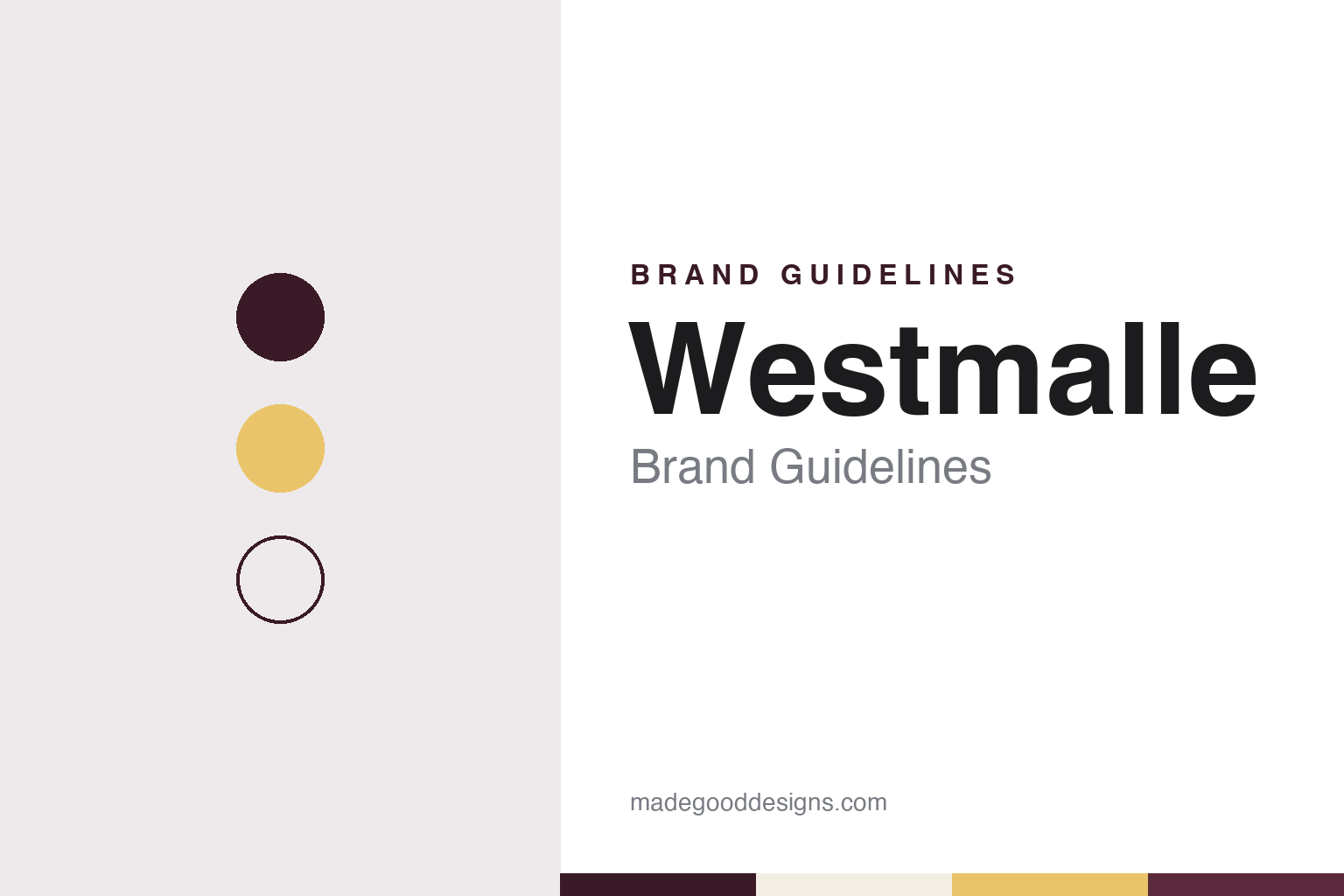
Westmalle Brand Guidelines
The Trappist abbey that named the dubbel and tripel.
Aa
Two constants: a dubbel plum, tripel gold and cloister stone palette and an old-style serif register. Abstract homage — not a Westmalle product or mark; no bottle, label or logo is reproduced.
Beer for the monks’ table
A priory in a farmhouse and a brewery in 1836.
Westmalle is brewed inside the Trappist abbey of Westmalle, formally the Abbey of Our Lady of the Sacred Heart, in the village of Westmalle in Belgium’s Antwerp province. The community is older than the beer. English Wikipedia says a group of Trappist monks who had fled revolutionary France, and who were travelling to Canada, were invited to stay by the bishop of Antwerp; on 6 June 1794 they founded a priory in a farmhouse called Nooit Rust, “never rest”. French troops drove them out within weeks, and they returned only in 1802 and again in 1814.
On 22 April 1836 the priory was raised to an abbey. The Trappist rule followed at Westmalle let monks drink the local beverage with their meals, and in Flanders that was beer, so rather than buy it they decided to brew it, English Wikipedia says. The first abbot, Martinus Dom, built a small brewery. Citing the Belgian beer writer Jef van den Steen, English Wikipedia says the first beer was brewed on 1 August 1836 and first served on 10 December 1836, and describes it as light in alcohol and rather sweet; the first brewers were Father Bonaventura Hermans and Albericus Kemps.
For two decades the beer stayed in the abbey. In 1856 the monks added a second, strong brown beer, and began selling locally, Dutch and English Wikipedia say; the oldest registered sale dates from 1 January 1861. English Wikipedia says the brewery was enlarged and rebuilt in 1865, following the example of the Trappists at Forges, near Chimay, that sales to traders began in 1921, and that a complete new brewery was built in 1933. The abbey says it still brews at the pace of monastic life: work in the brewing room starts only after the monks’ first prayer of the morning in church.
Colour
Two beers that became styles, and a label with rules.
Westmalle’s place in brewing history rests on two words. The strong brown beer of 1856 is regarded as the first dubbel, English Wikipedia says, and Westmalle Dubbel was imitated by other breweries, Trappist and commercial, until it became a style. The present Dubbel, at 7%, comes from a recipe first brewed in 1926. In 1934 the brewery added a strong golden ale of 9.5%, the Tripel. The British beer writer Michael Jackson credited Westmalle Tripel as the first golden strong pale ale to use the name, and English Wikipedia calls it the foundation of the tripel style, now brewed by secular breweries as well as abbeys.
The range has stayed small. Besides Dubbel and Tripel, the brewery makes Westmalle Extra, a lighter beer that was the monks’ own everyday drink; English Wikipedia, citing a retailer’s 2010 announcement, says it became commercially available through some outlets that year. In March 2025 the abbey added Westmalle Duo, a blend of Tripel and Extra at 7.2%, sold only on draught in a limited number of cafés. The abbey says it uses five raw materials, including water drawn from 60 metres down in the deep Diestian layer and its own Westmalle yeast, that it neither pasteurises nor adds stabilisers, and that bottles are refermented within the abbey walls for two to three weeks before they leave. Its bottling plant fills 45,000 bottles an hour, it says.
Westmalle is also one of the founders of the label that defines Trappist beer. In 1997 eight Trappist abbeys, Westmalle among them, set up the International Trappist Association to stop commercial companies from using the Trappist name, English Wikipedia says. The association awards an Authentic Trappist Product logo, and Westmalle says its beer carries it because it meets three rules: it is brewed within the abbey walls, production and business policy are supervised by Trappist monks, and the proceeds go to the community’s needs, to reinvestment, to support within the order and to charity.
Typography
Design and documentation.
The seven brands in this group are all beer names from Germany, Belgium and the United States: Franziskaner, Spaten, Löwenbräu, Leffe, Hoegaarden, Westmalle and Yuengling. German, Belgian and American beer brands in general sit at many different points in the trade, from family firms that still carry a founder’s name to names that now belong to much larger brewing groups, and a single brand can be poured everywhere from a local bar to a supermarket shelf.
A beer brand’s identity is usually carried less by a single product than by a label, a glass, a name and the place it claims as home, because the company behind the name may have changed hands, moved its brewing or grown far beyond the town where it started. That makes the questions behind each name worth asking plainly: who started it, who owns it now, and where its beer is actually brewed and packed.
Each guide separates what independent sources record from what the company says about itself — its founding story, its owners over time, where its beer is brewed and how its labels and packaging have changed — and marks plainly what rests only on the company’s own word.
Aa
An old-style serif for an abbey that has brewed since 1836. (Specimen set in Cormorant Garamond, a serif STAND-IN; NOT the Westmalle logo.)
Westmalle
Monks in charge, lay brewers at work.
Unlike most beer brands, Westmalle has no outside owner: the brewery belongs to the abbey, and the company says the monks set its policy and oversee how it is carried out. Most of the work is done by lay staff. In 2009 the Toronto Star reported that the brewery had 22 monks and 40 outside workers, and English Wikipedia puts the brewery’s output at 120,000 hectolitres in 2004. The abbey says the income lets the community live and reinvest in the brewery, and that surplus profits are shared with other Cistercian abbeys and given to charitable causes. The abbey also keeps a dairy herd and sells Trappist cheese aged for two, six and twelve months; it says the brewery’s spent grain is fed to its cows.
Westmalle’s reach inside the order has extended beyond its own walls. In the nineteenth century it founded other monasteries, including the abbey at Achel, English Wikipedia says. When the last monk left Achel, Westmalle took over its beer production, the Flemish broadcaster VRT reported in January 2021; Achel lost its Authentic Trappist Product label that year and its Trappist recognition in January 2023, after the abbey was sold to a private buyer, Gazet van Antwerpen reported.
The beers are told apart by colour. English Wikipedia describes the Dubbel as wearing a purple label and the Tripel a yellow one, with a blue label for the Extra, and Dutch Wikipedia distinguishes the beers by the colour of their crown caps. The abbey also runs a café, Café Trappisten, and opens the brewery to visitors on set days.
For a design guide, Westmalle shows how an abbey can define two beer styles while keeping its range, its ownership and its labels deliberately small. Compare Chimay, the Trappist brewery whose abbey Westmalle followed when it rebuilt in 1865, and Leffe, a Belgian abbey beer made by a commercial brewer. For this guide we use a dubbel plum, a tripel gold and a cloister stone with an old-style serif, an unofficial interpretation; no product or logo is reproduced.
Explore & save
Keep Westmalle’s identity on hand — save it to a board in the Made Good inspiration library.
Westmalle identity set
Pin the Westmalle dubbel plum, tripel gold and cloister stone palette and the old-style serif register to your own board.