Lemonsoda Brand Guidelines
The 1940s Milan lemon soda that became a Danish-owned brand.
Aa
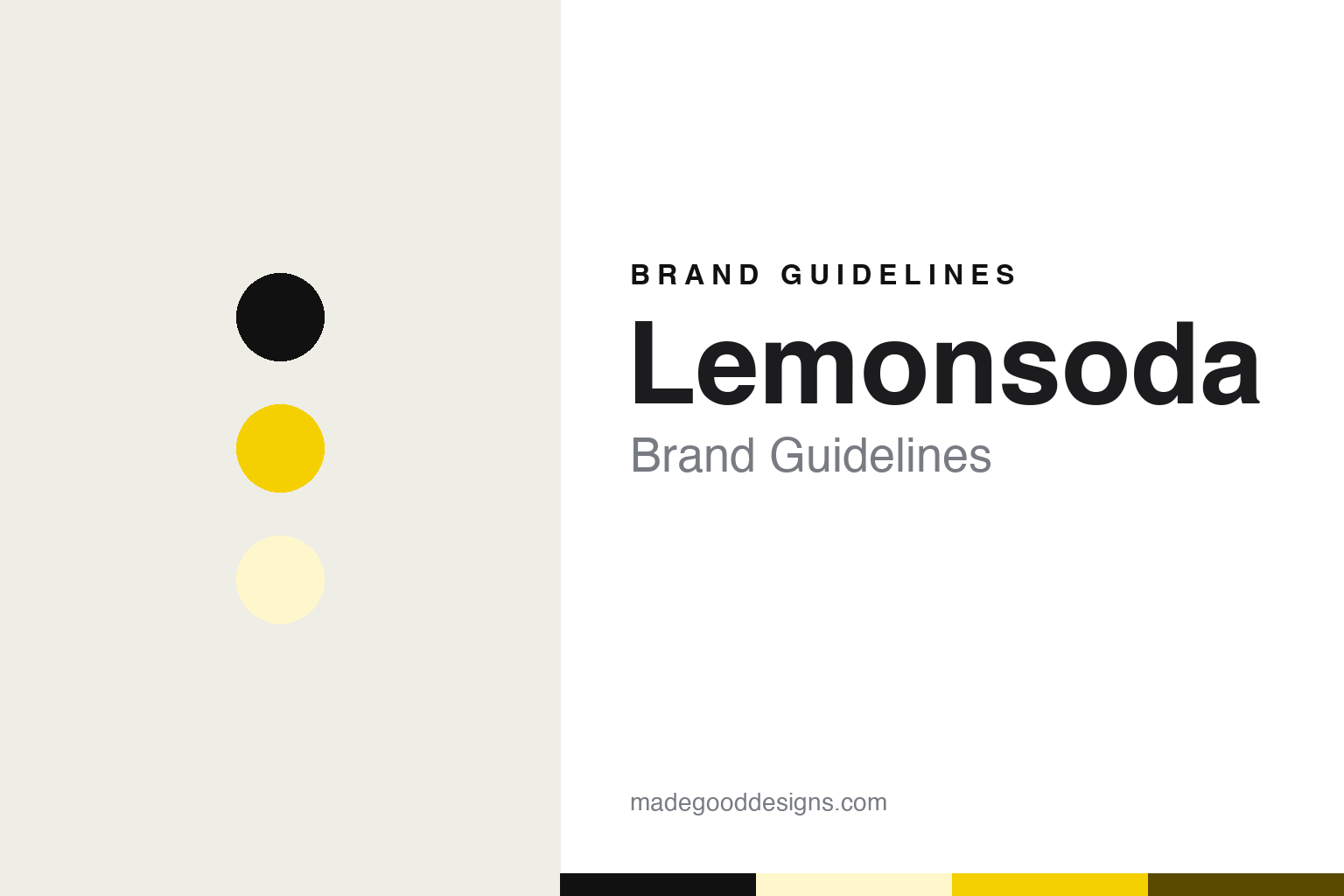
Two constants: a can black, lemon yellow and citrus olive palette and a bold grotesque sans register. Abstract homage — not a Lemonsoda product or mark; no can, bottle or logo is reproduced.
S.A.G.A. of Milan
A Milan water company and a lemon soda.
Lemonsoda is an Italian carbonated lemon drink, and its story starts in Milan in the 1940s. Italian Wikipedia says it was created by S.A.G.A. — the Società Acque Gasate e Affini, a Milan company owned by Ettore Casella that also held the Levissima mineral-water brand — and that an orange version, Oransoda, followed soon after. English Wikipedia also credits the 1940s and the Milan company Saga. A grapefruit soda, Pelmosoda, joined the family later.
The family then went separate ways. Italian Wikipedia says the Levissima waters passed to the Italian food group Crippa & Berger, while Lemonsoda and Oransoda were bought in 1986 by the Dutch group Bols Wessanen.
Bols Wessanen already owned Terme di Crodo, the mineral-water and soft-drink company of Crodo, a spa town in Piedmont’s Ossola valley. It had bought that company from Piero Ginocchi in 1983 and folded the two sodas into it, according to a 2020 report in La Stampa cited by Italian Wikipedia. That put Lemonsoda in the same house as Crodino, the non-alcoholic aperitif Terme di Crodo had launched in 1965, and tied the soda to Crodo and its springs, a link the brand still uses today.
Colour
Campari years and a run of new sodas.
In the mid-1990s the whole Crodo business moved to Gruppo Campari. Campari said in 2017 that the Lemonsoda business “entered Gruppo Campari in 1995 via the Group’s first acquisition,” as part of a larger portfolio that also included Crodino. Italian Wikipedia’s Lemonsoda and Crodino articles, citing La Repubblica from November 1994 and Corriere della Sera from January 1995, place the purchase of Bols Wessanen’s Italian activities at the turn of 1994 and 1995.
Under Campari the range grew. Italian Wikipedia dates Tonicsoda, a tonic water and the first product of the line created under Campari, to 2004, where English Wikipedia says 2005; Lemonsoda Zero, without sugar, and Mojitosoda, a non-alcoholic mojito-style drink made with lemon juice and mint flavouring, to 2010; and a summer Piñacolada Soda to 2013. In 2016, the trade magazine Mark Up reported, Campari gathered its soft drinks under a single umbrella name, Freedea, which the trade site Media Key described as a name for the historic Lemonsoda line.
The packs work as a colour code. Italian Wikipedia describes each soda pairing black with a colour of its own: yellow for Lemonsoda, orange for Oransoda, pink for Pelmosoda, grey for Tonicsoda, green for Mojitosoda and gold for Piñacolada Soda. From 2013, it says, special-edition cans carried characters from Japanese anime series including Naruto, Captain Tsubasa — known in Italy as Holly & Benji — and One Piece; an archived 2013 Lemonsoda web page promoted the Naruto edition. Italian Wikipedia also dates Lemonsoda’s sponsorship of the Lecce football club and the Brunico ice-hockey team to the 1983–84 season, while English Wikipedia places a Lecce sponsorship in 2003–04.
Typography
Design and documentation.
The seven brands in this group are all soft drink and water names from Spain and Italy: La Casera, Trina, Font Vella, Bezoya, Aquarius, Lemonsoda and Levissima. Spanish and Italian soft drink and water brands in general sit at many different points in the trade, from family firms that still carry a founder’s name to names that now belong to much larger food and drink groups, and a single brand can be sold everywhere from a corner bar to a supermarket shelf.
A soft drink or water brand’s identity is usually carried less by a single product than by a bottle, a label, a name and the drink it promises, because the company behind the name may have changed hands, moved its bottling or grown far beyond the place where it started. That makes the questions behind each name worth asking plainly: who started it, who owns it now, and where its drinks are actually made and bottled.
Each guide separates what independent sources record from what the company says about itself — its founding story, its owners over time, where its drinks are made and how its packaging has changed — and marks plainly what rests only on the company’s own word.
Aa
A bold grotesque sans for a soda sold on a colour code. (Specimen set in Archivo, a sans STAND-IN; NOT the Lemonsoda logo.)
Lemonsoda
A Danish owner and the Crodo springs.
On 4 October 2017 Campari announced that it would sell the Lemonsoda business to Royal Unibrew, the Danish beer and soft-drink group listed on Nasdaq Nordic. The sale covered Lemonsoda, Oransoda, Pelmosoda and Mojito Soda, grouped under Freedea, and the Crodo brands — but not Crodino, which Campari kept as a core aperitif. It also included the manufacturing and bottling plant at Crodo with its springs, and under a multi-year agreement Royal Unibrew would go on making some Campari products there. Campari called Lemonsoda the leader of Italy’s lemon-soda segment and said Italy was the brands’ core market. Royal Unibrew’s chief executive, Hans Savonije, said Lemonsoda would join Ceres Strong Ale as a second must-stock product in its Italian portfolio.
Royal Unibrew still lists Lemonsoda among its brands in 2026. The Lemonsoda website, run by Terme di Crodo S.r.l. of Milan, calls the drink “the original Italian lemonade” and says the range is made with Italian fruit and sparkling mineral water from the Crodo springs. Its current line-up includes Lemonsoda Zero, Oransoda, Lemonsoda Mojito, Lemonsoda Twist and a Lemonsoda Chinotto, alongside Lemonsoda Energy, an energy-drink line Italian Wikipedia dates to 2021.
The plant at Crodo remains the brand’s base. When Il Post reported in October 2023 that Crodino’s production would leave Crodo for Campari’s plant at Novi Ligure once the bottling contract ended, it noted that Royal Unibrew had bought the Crodo production and bottling site, its spring and the Lemonsoda drinks in 2017. Royal Unibrew said the plant would keep making its own soft drinks and energy drinks, which already made up most of its output, and that there would be no job losses.
For a design guide, Lemonsoda shows a simple system — black plus one fruit colour per flavour, as Italian Wikipedia describes the packs — applied across a whole family of sodas. Compare Crodino, its former stablemate from Crodo, and Faxe Kondi, Royal Unibrew’s Danish lemon-lime soda. For this guide we use can black, lemon yellow and citrus olive with a bold grotesque sans, an unofficial interpretation; no product or logo is reproduced.
Explore & save
Keep Lemonsoda’s identity on hand — save it to a board in the Made Good inspiration library.
Lemonsoda identity set
Pin the Lemonsoda can black, lemon yellow and citrus olive palette and the bold grotesque sans register to your own board.