Levissima Brand Guidelines
The Valtellina mineral water with a mountain on the label.
Aa
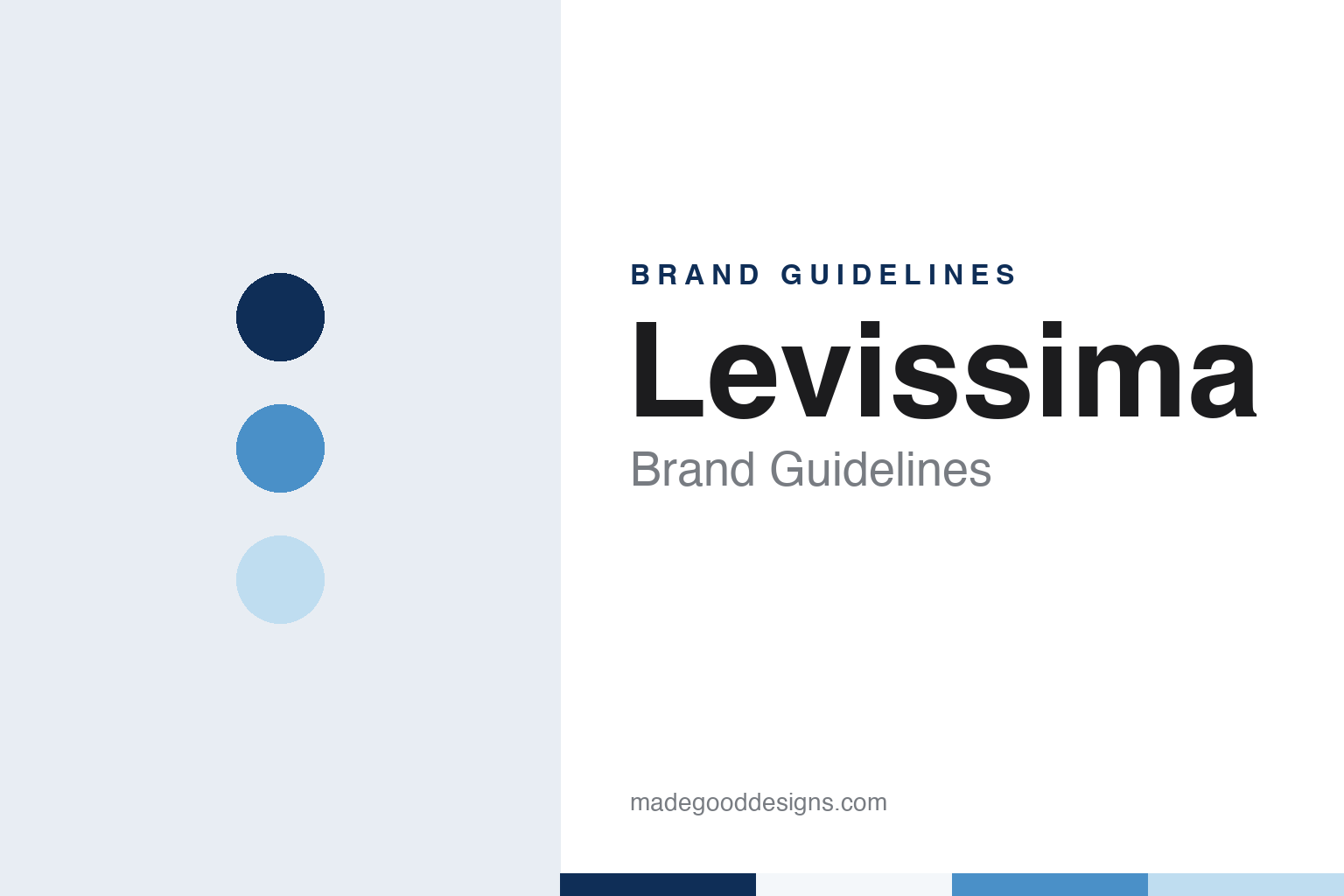
Two constants: an alpine navy, glacier blue and ice palette and a clean geometric sans register. Abstract homage — not a Levissima product or mark; no bottle, label or logo is reproduced.
A hotel, an aqueduct and a bishop
A village in the Alta Valtellina and a word in Latin.
Levissima comes from Cepina, a village in the municipality of Valdisotto, in the province of Sondrio, high in the Valtellina valley of northern Lombardy. The company’s own history, published by the Sanpellegrino group for the brand’s 80th anniversary in April 2016 and followed by Italian Wikipedia, says that in the early 1900s the people of Cepina built an aqueduct to bring the area’s plentiful water into the centre of the village. The owner of the Hotel Cepina, Gasparre Piccagnoni, began serving the water to his guests and later had it analysed.
In 1936, the company says, Piccagnoni obtained the concession to use the spring as a natural mineral water and officially began bottling it under the Levissima name. The bottling has stayed in the same place: the Sanpellegrino group still describes the plant at Cepina, in Valdisotto, as Levissima’s home, and it held its 90th-anniversary celebrations there in June 2026.
The name has a story of its own, which the company tells as a legend. Monsignor Alessandro Macchi, the bishop of Como, is said to have tasted the village water during a stop at the parish of Cepina and called it “levissima” — from the Latin levis, “light,” so roughly “very light.” Italian Wikipedia repeats the account, citing the same company pages. The company places the source high in the central Alps, close to the Stelvio National Park, in the old county of Bormio, and says the water comes from melting glaciers and winter snow that seep down through cracks in the crystalline rock below.
Colour
A Milan soft-drink firm, a coffee family and a short-lived water group.
Between Piccagnoni and Nestlé, Levissima passed through several Italian owners. Italian Wikipedia’s article on Lemonsoda says the lemon soda was created in the 1940s by the Milan company S.A.G.A. (Società Acque Gasate e Affini), owned by Ettore Casella, which already held the Fonti Levissima mineral-water brand. Casella also used the name in sport: English Wikipedia, citing a 2011 article on the LegaBasket site, says he put “another of his brands, Fonte Levissima” on the shirts of the Cantù basketball club, which played as Fonte Levissima Cantù from 1958 to 1965.
Fonti Levissima was later bought by Crippa & Berger, the company of the Berger family, best known in Italy for distributing Hag decaffeinated coffee, according to Italian Wikipedia, which counts Levissima among the family’s waters alongside names such as Fiuggi, Ferrarelle and Uliveto. Italian Wikipedia’s article on the businessman Giulio Malgara says that in 1992 the food group Garma, which he had founded with Raul Gardini, took over Levissima, Recoaro, Pejo and Fonti Tigullio from Crippa & Berger and Giuseppe Ciarrapico, and that in 1993 Malgara sold that business to the Mentasti family’s Sanpellegrino group.
That fits the company’s own date: the Sanpellegrino group says Levissima joined it in 1993. Sanpellegrino, founded in 1899 at San Pellegrino Terme, near Bergamo, came under Nestlé, which took full control of it in 1997, according to the Treccani encyclopedia; Italian Wikipedia, citing the Corriere della Sera, dates the final step to 1999. Today Levissima sits beside S.Pellegrino and Acqua Panna as one of the group’s mineral waters.
Typography
Design and documentation.
The seven brands in this group are all soft drink and water names from Spain and Italy: La Casera, Trina, Font Vella, Bezoya, Aquarius, Lemonsoda and Levissima. Spanish and Italian soft drink and water brands in general sit at many different points in the trade, from family firms that still carry a founder’s name to names that now belong to much larger food and drink groups, and a single brand can be sold everywhere from a corner bar to a supermarket shelf.
A soft drink or water brand’s identity is usually carried less by a single product than by a bottle, a label, a name and the drink it promises, because the company behind the name may have changed hands, moved its bottling or grown far beyond the place where it started. That makes the questions behind each name worth asking plainly: who started it, who owns it now, and where its drinks are actually made and bottled.
Each guide separates what independent sources record from what the company says about itself — its founding story, its owners over time, where its drinks are made and how its packaging has changed — and marks plainly what rests only on the company’s own word.
Aa
A clean geometric sans for a water named after the word “light.” (Specimen set in Montserrat, a sans STAND-IN; NOT the Levissima logo.)
Levissima
A peak on the label, a climber in the advertising and glaciers in the story.
Levissima’s identity leans on the mountains it comes from. In 2016 the company described a mountain peak that had stood against a blue sky on the bottle’s label for 80 years, and recalled its best-known advertising: the climber Reinhold Messner, framed by snowy summits in the 1990s, exclaiming “Altissima, purissima, Levissima” — “very high, very pure, Levissima.” Italian Wikipedia gives the same line as the brand’s slogan.
The glaciers have become part of the brand story too. Since 2007, the company says, Levissima has worked with the glaciology department of the University of Milan to collect data on Alpine glaciers; the first step was an automatic weather station on the Dosdè–Cima Piazzi glacier, where, the company says, a white geotextile was laid over the ice for the first time in Italy to shield it from summer heat. From 2016 to 2018 a three-year project, “Levissima Spedizione Ghiacciai,” used a NASA satellite and a drone to monitor Italian glaciers, after the publication of a new inventory of Italy’s glaciers with the Ev-K2-CNR committee, Italian Wikipedia says, citing the company. A “Levissima Snow Recycling” campaign asked skiers in Lombardy, Veneto and the Aosta Valley to recycle plastic bottles.
Packaging and sport have carried the rest. The company says Levissima was the first on the market with a PET bottle made 30% from sugar-cane-based plastic, and in 2016 it launched #La75, a smaller “mobile bottle” with a sport cap, under an “Everyday Climbers” campaign. Its sponsorships, by the company’s account, have run from a Levissima Golf Cup in 1997 to football, as an official partner of AC Milan from 2011 and later official water of Juventus, and to the Internazionali BNL d’Italia tennis tournament. In 2026 the company described the Cepina plant as covering more than 100,000 square metres, with 225 employees and seven PET bottling lines, and said that about 40% of its output leaves by rail.
For a design guide, Levissima shows how a village spring, a bishop’s Latin word and a mountain peak on the label can carry one mineral water for 90 years. Compare San Pellegrino, the group’s sparkling water from near Bergamo, and Lemonsoda, the lemon soda created by Levissima’s Milan owner of the 1940s. For this guide we use alpine navy, a glacier blue and an icy pale blue with a geometric sans, an unofficial interpretation; no product or logo is reproduced.
Explore & save
Keep Levissima’s identity on hand — save it to a board in the Made Good inspiration library.
Levissima identity set
Pin the Levissima alpine navy, glacier blue and ice palette and the clean geometric sans register to your own board.