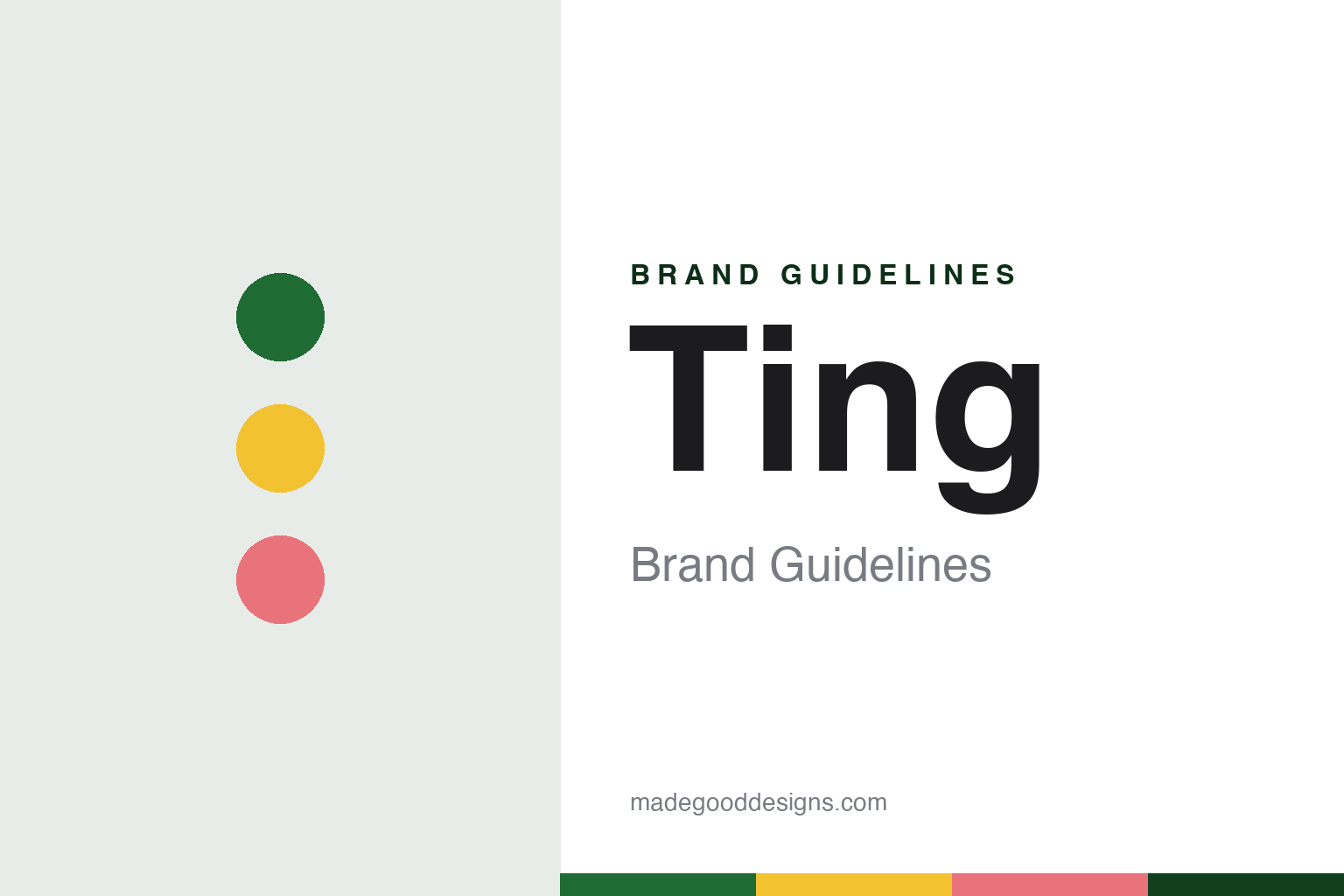
Ting Brand Guidelines
Jamaica’s grapefruit soda in the green bottle.
Aa
Two constants: a Ting green, yellow and grapefruit pink palette and a bold sans register. Abstract homage — not a Ting product or mark; no bottle, can or logo is reproduced.
Kingston
A grapefruit soda from the Red Stripe brewer.
Ting is a sparkling grapefruit drink from Jamaica. It was launched in 1976 by Desnoes & Geddes, the Kingston brewer of Red Stripe. English Wikipedia dates its introduction to November that year, and the International Directory of Company Histories records that it first went on sale as Ting Grapefruit Crush. The same reference says the name is Jamaican dialect for “thing,” and that the drink was made with locally sourced grapefruit.
Desnoes & Geddes made soft drinks long before it made Ting. English Wikipedia says Eugene Peter Desnoes and Thomas Hargreaves Geddes combined their two shops into one business in 1918, first producing soft drinks and distributing imported alcohol, and later opened the Surrey Brewery in Kingston. The company history adds that D&G became the Pepsi-Cola bottler for Jamaica in 1947 and began brewing Heineken under licence in 1973, three years before Ting arrived.
Ting travelled with the Jamaican diaspora. The company history says it was soon exported to more than 20 countries, beginning with Barbados; that D&G began shipping it in 1985 to American cities with large Caribbean populations; and that Ting and Old Jamaica Ginger Beer were introduced to the United Kingdom in 1988, where both sold well from the start. The American launch was harder: Kraft General Foods, the owner of the Tang drink mix, sued D&G for trademark infringement, the Associated Press reported, according to the same reference.
By the brand’s twenty-fifth year it was a fixture. The Gleaner ran a report on Ting’s silver anniversary in November 2001.
Colour
Green glass and a green-and-yellow can.
Ting’s look rests on colour. English Wikipedia describes it as sold in a green glass bottle, a green plastic bottle or a green and yellow can, and notes that, like Orangina, the drink carries a little sediment of grapefruit pulp. English Wikipedia says the drink is flavoured with Jamaican grapefruit juice made from concentrate, and that the family now includes Pink Ting, an orange version, a diet version and a ginger beer under the same name.
In Jamaica the drink is bound up with rum. Writing in Punch in August 2018, Drew Lazor described Wray & Ting, rum mixed with the soda, as the unofficial drink of Jamaica, and called Ting a soft drink made from a concentrate of Caribbean grapefruit. He wrote that Pepsi’s takeover in 1999 had given the brand a far wider profile and distribution.
The brand’s British website leans into the same idea. It presents Ting as a mixer for cocktails such as the Paloma, calls it “a lightly sparkling, citrusy cocktail chameleon,” and says it is made with real grapefruit juice. An earlier version of the site, archived in 2018, spoke of “a dash of glorious Jamaican sunshine.” Its current slogans include “Add some zing with Ting!”
Ting should not be confused with Tang, the powdered drink mix, from which English Wikipedia separately distinguishes it.
Typography
Design and documentation.
The seven brands in this group are all milk, chocolate and fruit drink names: Milo, Nido, La Lechera, Cacaolat, Granini, Ting and Bigga. Milk, chocolate and fruit drink brands in general sit at many different points in the trade, from family firms that still carry a founder’s name to names that now belong to much larger food and drink groups, and a single brand can be sold everywhere from a corner shop to a supermarket shelf.
A drink brand’s identity is usually carried less by a single product than by a pack, a name and the taste or moment it promises, because the company behind the name may have changed hands, moved its production or grown far beyond the place where it started. That makes the questions behind each name worth asking plainly: who started it, who owns it now, and where its drinks are actually made and packed.
Each guide separates what independent sources record from what the company says about itself — its founding story, its owners over time, where its products are made and how its packaging has changed — and marks plainly what rests only on the company’s own word.
Aa
A bold sans — a loud, cheerful register for a soda. (Specimen set in Rubik, a sans STAND-IN; NOT the Ting logo.)
Ting
A brewer’s brand, a bottler’s product.
Ting’s ownership has followed the fortunes of the company that created it. Guinness took control of Desnoes & Geddes in 1993, and in 1999 D&G sold its soft-drink operations to the Pepsi-Cola (Jamaica) Bottling Company so that it could concentrate on brewing, the International Directory of Company Histories says; in February 2001 D&G changed its name to Red Stripe Limited. Diageo, the owner of Guinness, held a controlling stake in D&G until October 2015, when Heineken bought it, Bloomberg reported.
Where the brand itself sits has been reported in two ways. The Gleaner reported in May 2012 that Pepsi Jamaica produced D&G soft drinks, Ting among them, under licence from Desnoes & Geddes, trading as Red Stripe Jamaica, which it said kept full ownership of the brand. A Gleaner report of December 2016 said instead that the purchase of D&G’s soft-drink business by Pepsi Americas, which led to Pepsi-Cola Jamaica opening in December 1999, had included Ting.
Both reports agree on who makes it. The 2012 report described Pepsi Jamaica’s plant on Spanish Town Road in Kingston, named grapefruit concentrate for Ting as a major input, and said the Central American bottler Cabcorp had acquired PepsiAmericas, and with it Pepsi Jamaica, in 2009. A Gleaner report of August 2018 described Pepsi-Cola Jamaica Bottling as owned by Cabcorp, which holds rights to make and distribute PepsiCo products in the region.
Outside the Caribbean, Ting is made under licence. English Wikipedia says it is produced in the United Kingdom by Refresco, and the brand’s British website names Refresco as its distributor there. English Wikipedia also says the drink is distributed across the Caribbean, the United States and Canada.
For a design guide, Ting shows how a small brand can be carried by colour alone, a green bottle and a green-and-yellow can, through fifty years and several changes in the ownership of the business that makes it. Compare Red Stripe, the lager from the same Kingston brewer, and Grace, GraceKennedy’s Jamaican food brand. For this guide we use bottle green, can yellow and grapefruit pink with a bold sans, an unofficial interpretation; no product or logo is reproduced.
Explore & save
Keep Ting’s identity on hand — save it to a board in the Made Good inspiration library.
Ting identity set
Pin the Ting green, yellow and grapefruit pink palette and the bold sans register to your own board.