Bavaria Brand Guidelines
The Swinkels family’s Lieshout lager and its 0.0.
Aa
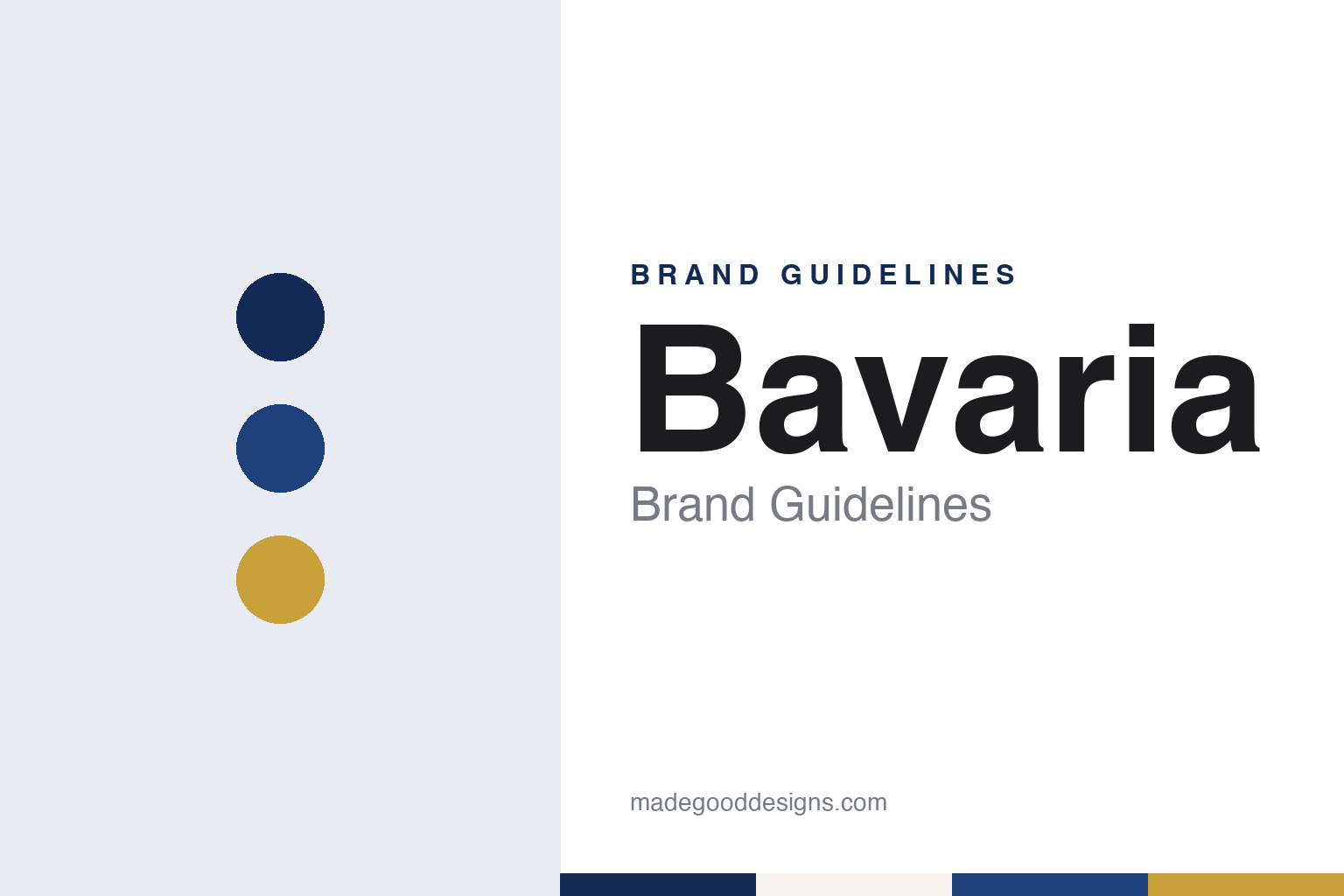
Two constants: a Lieshout blue, malt gold and lager white palette and a sturdy brewery sans register. Abstract homage — not a Bavaria product or mark; no bottle, can, label or logo is reproduced.
A brewery on the Kerkdijk
A village brewery, three generations of women and a borrowed name.
Bavaria is a Dutch beer brand brewed in Lieshout, a village in North Brabant, by Royal Swinkels, a company the Swinkels family has owned for seven generations, English Wikipedia says. Its roots run back further than its name. Dutch Wikipedia, citing the company’s own 2008 history by Antoon Swinkels and Peter Zwaal, says the oldest known documents date from 1680, when Dirk Vereijken owned a brewery on the Kerkdijk in Lieshout; a gauging of 1691 put its kettle at about 20 hectolitres, the largest in the village.
The brewery passed down the female line three times before it reached the family that still owns it. Dutch Wikipedia says Vereijken’s son-in-law Hendrik van Moorsel carried it on, that it went to his daughter Helena van Moorsel in 1720, and that her daughter Brigitta Moorrees married Ambrosius Swinkels in 1764. From 1773 Ambrosius ran the brewery, and it has stayed with the Swinkels family ever since. For decades the company dated itself to 1719, a year taken from a 1938 booklet by the Helmond municipal archivist Jac. Heeren; Dutch Wikipedia says the 2008 history corrected the date to 1680. The Royal title granted in 2019 still marked a 300th anniversary, NU.nl reported.
For most of its history it was a village brewery. In 1890 Jan Swinkels, of the fourth generation, named it De Kerkdijk and began selling beer in nearby Helmond, the Dutch and English Wikipedias say. The name that stuck came in 1925. On 15 April that year, Dutch Wikipedia says, a new brewery built for bottom-fermented pilsener was completed, and Jan sold the business the same day to his sons Frans, Piet and Jan, who formed the firm Gebroeders Swinkels. They chose Bavaria — Latin and English for Beieren — as their trade name, because pilsener-style lager was then often called “Beiersch bier,” Bavarian beer. The Dutch Wikipedia article on the beer itself dates the brothers’ firm to 1924.
Colour
Lager, malt and an early 0.0.
The name travelled with the beer. Dutch Wikipedia says that in 1930 the brothers set up NV Beiersch-Bierbrouwerij Bavaria, reached Amsterdam and Rotterdam in 1933 and Utrecht and The Hague a year later, and opened their own malt house in 1940; English Wikipedia adds a bottling plant in 1933. In 1955 the firm began making soft drinks under the name 3ES, a reference to the three Swinkels brothers.
Export shaped the modern brand. After a first postwar export spell ended in 1964, the company decided in 1973 to export again, starting with Italy and France, followed by Nigeria from 1975 and Spain in 1982, Dutch Wikipedia says. When Nigeria banned beer imports in 1978, Bavaria shipped a non-alcoholic malt drink instead, which also found buyers in Iran and other countries where alcohol was restricted. In the late 1980s the brewmaster Wim Swinkels patented a method for making beer with less than 0.1% alcohol, and Bavaria launched its 0.0 beer in 1989, first in several Islamic countries and then in the Netherlands, Dutch Wikipedia says, citing the company history and de Volkskrant (2023). The brand’s website today lists a Premium lager alongside several 0.0% beers, among them an Original, a Wit and a Fruity Rosé.
Marketing made the name known abroad, sometimes noisily. At the 2006 World Cup, FIFA had Dutch fans take off orange Bavaria-branded “Leeuwenhosen” before a match against Ivory Coast in Stuttgart and handed out plain shorts instead, the BBC reported. At the 2010 World Cup in Johannesburg, 36 women in orange dresses linked to the brewery were removed from the Netherlands–Denmark match, accused by FIFA of ambush marketing, the Associated Press reported in June 2010. Dutch Wikipedia, citing De Ondernemer (2019), also credits Peer Swinkels with commercials featuring Hugh Hefner, Morgan Freeman and Diego Maradona.
Typography
Design and documentation.
The seven brands in this group are all beer brands from the Netherlands, France and Italy: Amstel, Grolsch, Bavaria, Hertog Jan, Kronenbourg, Birra Moretti and Menabrea. Dutch, French and Italian beer brands in general sit at many different points in the trade, from family firms that still carry a founder’s name to names that now belong to much larger brewing groups, and a single brand can be sold everywhere from a corner bar to a supermarket shelf.
A beer brand’s identity is usually carried less by a single product than by a label, a name and the drink it promises, because the company behind the name may have changed hands, moved its brewing or grown far beyond the town where it started. That makes the questions behind each name worth asking plainly: who started it, who owns it now, and where its beer is actually brewed and packed.
Each guide separates what independent sources record from what the company says about itself — its founding story, its owners over time, where its beer is brewed and how its labels have changed — and marks plainly what rests only on the company’s own word.
Aa
A sturdy sans for a lager named after a style. (Specimen set in Archivo, a sans STAND-IN; NOT the Bavaria logo.)
Royal Swinkels
A family brewer renamed twice.
For most of the 20th century Bavaria was the name of the company as well as the beer. In June 2018 the business changed its trade name to Swinkels Family Brewers, keeping Bavaria for the Lieshout brewery and its beer, the Eindhovens Dagblad reported. In March 2019 the King’s Commissioner of North Brabant announced that the company could use the Royal predicate, and in 2024 the name was shortened to Royal Swinkels, according to the company’s 2023 annual report. Peer Swinkels, of the seventh generation, has led it as CEO since 2019, Dutch Wikipedia says.
The group around the brand has grown well beyond Lieshout. Since 1999 the company has run the Trappist brewery of Koningshoeven Abbey, where La Trappe is brewed, while the abbey keeps the brand and the buildings. It took a majority of the Belgian brewer Palm in May 2016, Reuters reported, and full ownership in 2021, and it has added the Bodegraven craft brewer De Molen, Haarlem’s Uiltje and the Ethiopian brewery Habesha. English Wikipedia counts nine breweries across the Netherlands, Belgium, Ethiopia, Cuba and Georgia, and two malt houses, in Lieshout and the Eemshaven. The company says it sells in about 130 countries. In 2007 the European Commission fined it, along with Heineken and Grolsch, over a price-fixing cartel in the Dutch beer market, The Guardian reported.
The name invites confusion. Bavaria is also the German state whose beer style it borrowed, and the name of the Bogotá brewer behind Club Colombia, a separate company now owned by AB InBev.
For a design guide, Bavaria shows how a family brewer can take a style name, make it its own and then build an alcohol-free range under it. Compare Grolsch, a fellow Dutch lager, and Amstel. For this guide we use a Lieshout blue, a malt gold and a lager white with a sturdy sans, an unofficial interpretation; no product or logo is reproduced.
Explore & save
Keep Bavaria’s identity on hand — save it to a board in the Made Good inspiration library.
Bavaria identity set
Pin the Bavaria Lieshout blue, malt gold and lager white palette and the sturdy brewery sans register to your own board.