Hertog Jan Brand Guidelines
The Arcen steam brewery and its Duke of Brabant.
Aa
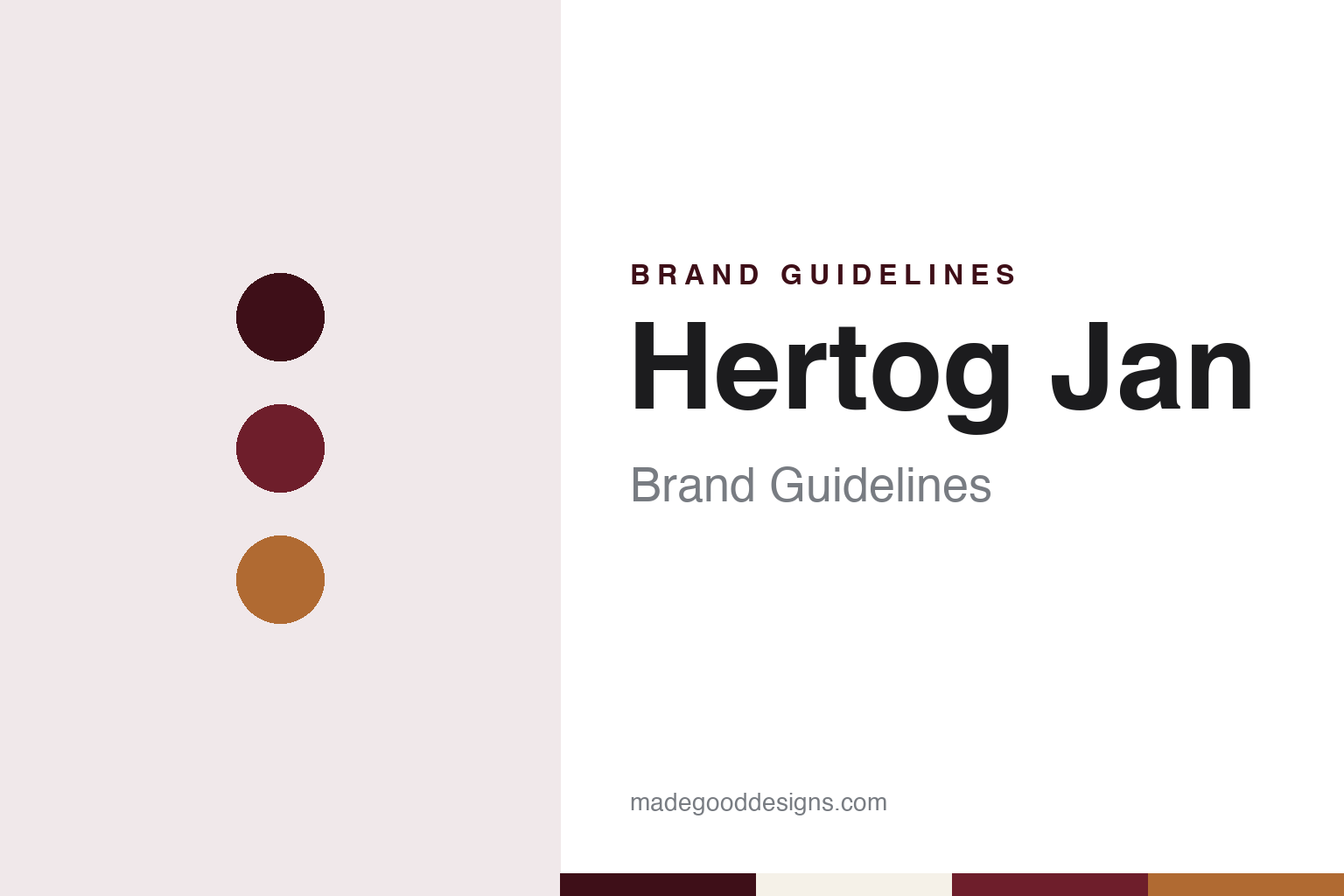
Two constants: a ducal burgundy, kettle copper and Arcen white palette and a classical ducal serif register. Abstract homage — not a Hertog Jan product or mark; no bottle, label, duke or logo is reproduced.
A steam brewery in Arcen
Four brewers, a closure and a wholesaler’s house brand.
Hertog Jan is a Dutch beer brand owned by AB InBev, with its own brewery in Arcen, a village on the Maas in the province of Limburg. The brewery is older than the brand. Dutch Wikipedia says that on 2 March 1915 four brewers — Leopold Haffmans, Gerard van Dijk, August Schraven and Gerard van Soest — founded the Stoombierbrouwerij de Vriendenkring in Arcen. It was equipped with a steam engine and, unusually for the time, brewed only bottom-fermented beer, sold as VK bier in swing-top bottles and wooden casks. The company tells the same story: four small brewers who were friends built a modern steam brewery just outside Arcen.
The decades that followed brought a string of owners. Dutch Wikipedia says the brewery suffered badly in the Second World War and was rebuilt from 1945, but sales stayed weak and money ran short, and in 1949 all its shares were sold to the Breda brewer De Drie Hoefijzers, which kept the brewery and the VK brand and modernised the plant in 1956. In 1968 De Drie Hoefijzers was itself taken over by the British group Allied Breweries, and in October 1980 the group decided to close the Arcen brewery and its bottling line in Helmond.
That closure is where Hertog Jan begins. Toon van de Reek, who worked in Helmond, and two partners decided to run the Arcen brewery themselves as the Arcense Stoombierbrouwerij, brewing only top-fermented beers from 1981 with financial backing from the drinks wholesaler De Kikvorsch, Dutch Wikipedia says, citing the Limburgsch Dagblad (1983) and NRC Handelsblad (1986). Hertog Jan was De Kikvorsch’s house brand, introduced in 1981: its top-fermented beers came from Arcen, while its pilsener and oud bruin were brewed by Dommelsch. English Wikipedia says the Arcen brewery played a major role in the revival of Dutch beer culture in the early 1980s.
Colour
A duke, a pilsener and a crown jewel.
The name honours John I, Duke of Brabant, who ruled Brabant from 1267 to 1294 and won the Battle of Worringen in 1288. Dutch Wikipedia says the duke reputedly loved feasts where the beer flowed freely, and English Wikipedia says the brand’s logo has always included an illustration of him. The latest version of the logo and visual identity was designed by the British branding agency Osborne Pike, both Wikipedias note.
Osborne Pike says its work for AB InBev began in 2015, with a task to unite two parts of the brand that had stood apart: the mainstream Hertog Jan Pilsener, which the agency puts at 85% of sales, and a large range of regional, seasonal and speciality beers. The agency says the design system was built to stretch to new beers, from a 0.0% beer to a Grand Pilsener in 2023, and that Hertog Jan grew from the fourth-placed brand in its market to the Netherlands’ best-selling beer with virtually no conventional advertising; those are the agency’s own figures. The brand’s long-standing slogan is “Uit liefde voor bier” — “for the love of beer.”
Its top beer is Grand Prestige, which the company calls its crown jewel and says can be laid down to mature, with the flavour at its best, in its view, after six years. Since March 2017 Hertog Jan has released barrel-aged editions of it under the name Vatgerijpt: the first rested in cognac, bourbon and port barrels and included one made with the American brewer Goose Island, and in 2019 the brewery worked with three Dutch jenever distillers, Hooghoudt, Rutte and Zuidam, the company says. Osborne Pike also credits the brand with limited editions such as Ongekend in autumn 2015 and Proeftuin, a subscription launched in 2021 that sends members a new experimental beer each quarter.
Typography
Design and documentation.
The seven brands in this group are all beer brands from the Netherlands, France and Italy: Amstel, Grolsch, Bavaria, Hertog Jan, Kronenbourg, Birra Moretti and Menabrea. Dutch, French and Italian beer brands in general sit at many different points in the trade, from family firms that still carry a founder’s name to names that now belong to much larger brewing groups, and a single brand can be sold everywhere from a corner bar to a supermarket shelf.
A beer brand’s identity is usually carried less by a single product than by a label, a name and the drink it promises, because the company behind the name may have changed hands, moved its brewing or grown far beyond the town where it started. That makes the questions behind each name worth asking plainly: who started it, who owns it now, and where its beer is actually brewed and packed.
Each guide separates what independent sources record from what the company says about itself — its founding story, its owners over time, where its beer is brewed and how its labels have changed — and marks plainly what rests only on the company’s own word.
Aa
A classical serif for a beer named after a medieval duke. (Specimen set in Libre Caslon Text, a serif STAND-IN; NOT the Hertog Jan logo.)
AB InBev
Interbrew, a new name and two breweries.
Hertog Jan came under the group that owns it today in stages. De Kikvorsch was taken over in 1986 by Dommelsch, by then part of the Belgian brewer Artois. On 29 October 1992 the Arcen brewery was absorbed into Allied Breweries’ Dutch business, renamed Oranjeboom Bierbrouwerij in April 1993, and in 1995 that business was bought by Interbrew Nederland, which also owned Dommelsch, Dutch Wikipedia says. Interbrew later became InBev and then Anheuser-Busch InBev. In 1998 the Arcense Stoombierbrouwerij was renamed the Hertog Jan Brouwerij, so that brand and brewery finally shared one name.
Where the beer is made depends on the beer. The company says its brewers make its beers together in Arcen, and the white brewery there, with copper brewing kettles and a cellar of Grand Prestige vintages, is open for guided tours. The pilsener is not brewed in Arcen, Dutch Wikipedia says: it comes from AB InBev’s Dommelsch brewery in Dommelen and from the Stella Artois brewery in Leuven, Belgium, and bottles from the two can be told apart by the neck label, rounded from Dommelen and pointed from Leuven. The company’s FAQ says a recent label change replaced the descriptor “natuurzuiver bier” with “Pilsener” and now names hop extracts among the ingredients, and that the recipe is unchanged.
The brewers themselves are part of the brand. The company says the men visitors recognise from its television advertising are its real brewers, whom it uses as ambassadors, and its site lists a master brewer in post since 2021, succeeding one who held the role from 1995. One naming trap: Hertog Jan is also the name of a restaurant in Belgium, unrelated to the beer.
For a design guide, Hertog Jan shows how a duke on the label and a single slogan can hold a mass-market pilsener and small-batch barrel-aged beers in one family. Compare Jupiler, another AB InBev lager from the Low Countries, and Bavaria, a fellow Dutch lager. For this guide we use a ducal burgundy, a kettle copper and an Arcen white with a classical serif, an unofficial interpretation; no product or logo is reproduced.
Explore & save
Keep Hertog Jan’s identity on hand — save it to a board in the Made Good inspiration library.
Hertog Jan identity set
Pin the Hertog Jan ducal burgundy, kettle copper and Arcen white palette and the classical ducal serif register to your own board.