Kronenbourg Brand Guidelines
The Strasbourg brewery of 1664 and its red-and-white check.
Aa
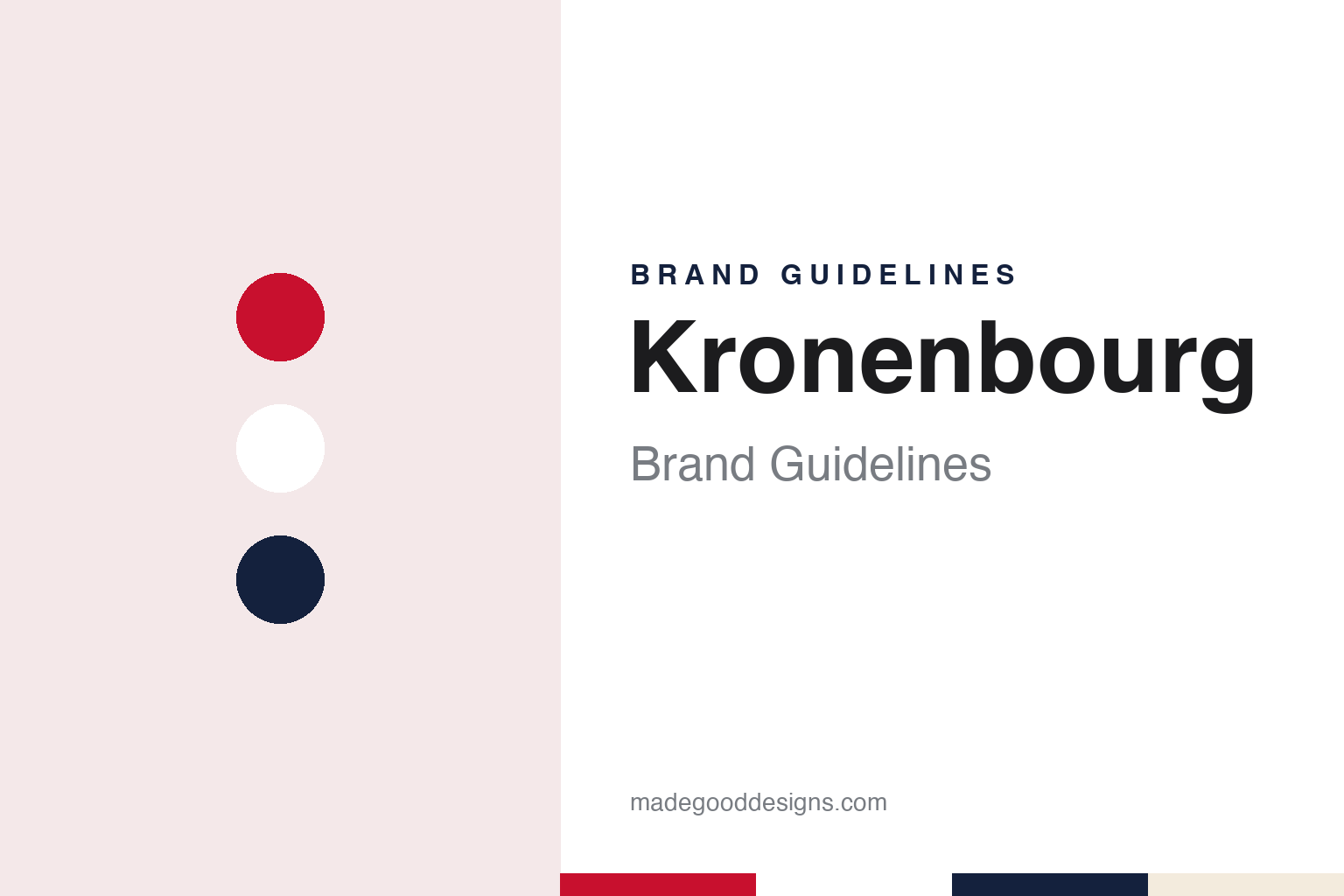
Two constants: an Alsace red, white and navy palette and a classic bookish serif register. Abstract homage — not a Kronenbourg product or mark; no label, logo or bottle is reproduced.
The Canon brewery
A master brewer, a cannon and a move uphill.
Kronenbourg dates itself to 1664 and to Jérôme Hatt, a Strasbourg brewer whose name appears in English sources in its Latin form, Geronimus. French Wikipedia, citing L’Express in 2014, says Hatt, the son of a dyer, gained his mastership as a brewer in June 1664 and on 9 June rented the brasserie du Canon — the “Cannon” brewery, a brewery since 1647 — on the place du Corbeau in Strasbourg, then a free imperial city of the Holy Roman Empire. English Wikipedia dates his master brewer’s certificate to 1649. French Wikipedia says he bought the business outright in 1669, and that it stayed with his descendants for eight generations.
By 1857, French Wikipedia says, the brewery was sending its casks to Paris by train. The family then moved production uphill, to the Cronenbourg district on the heights west of Strasbourg, away from the frequent floods of the river Ill; its deep cellars also suited bottom-fermented lager, which must be kept cool. French Wikipedia, citing a Strasbourg planning report, dates the move to 1862 and credits Frédéric Guillaume Hatt; English Wikipedia gives 1850. Cronenbourg became the company’s head office for the next century and a half.
In 1922 Maurice-Georges Hatt bought the Grand Tigre brewery and restaurant in Strasbourg and named the family’s beer Tigre Bock. The name that stuck came after the Second World War. On 15 September 1947, French Wikipedia says, Tigre Bock was registered under the brand Kronenbourg, spelled with a K, the German spelling of the district used while Alsace was part of the German Empire from 1871 to 1919. The company took the same name. French Wikipedia credits the expansion to another Jérôme Hatt, the sixth of the name, who had joined the firm in 1935; he sold the new beer in capped 33cl and then 25cl bottles.
Colour
A check, a date and a six-pack.
The best-known piece of Kronenbourg’s design is its red-and-white checked label. French Wikipedia says the check takes up the traditional colours of Alsace and of the city of Strasbourg, and that the Kronenbourg beer brand has kept those colours through its logo changes; it shows brand logos introduced in 2015 and in 2019.
The second asset is a date. In 1952 the brewery launched a premium lager named Kronenbourg 1664, after the founding year; English Wikipedia, citing Carlsberg and the Oxford Companion to Beer, says it was created to celebrate the founder, and French Wikipedia says the launch was timed to the coronation of Queen Elizabeth II, citing a 2010 book by Jean-Paul Hébert and Dany Griffon. The beer was renamed simply 1664 in 1988, French Wikipedia says, citing Les Échos. English Wikipedia says it uses the Strisselspalt hop, an aroma hop grown in Alsace. In Britain, Campaign reported in 2009 that Tony Kaye had directed a spot built on the line “Smaller Bubbles, Smoother Taste,” and in 2010 a “Slow the Pace” campaign featured Motörhead playing a slow acoustic “Ace of Spades.”
Packaging carried the brand as well. French Wikipedia, citing the trade journal Revue des marques in 2010, says Kronenbourg launched its first beer in a metal can in the early 1950s and in 1963 sold the first six-pack of non-returnable glass bottles, aimed at the new hypermarkets; packs of ten 25cl bottles followed in 1973 and of 26 in 1988.
The corporate identity has changed more often. On 2 April 2015 Brasseries Kronenbourg launched a new corporate identity designed by the agency Carré Noir, which the company said had been its design agency for several years; its press release said the logo reaffirmed Kronenbourg as a French brewer with 350 years of history. French Wikipedia says a new blue-and-white company logo has been used since 2023, while the beer brand keeps its Alsace red and white.
Typography
Design and documentation.
The seven brands in this group are all beer brands from the Netherlands, France and Italy: Amstel, Grolsch, Bavaria, Hertog Jan, Kronenbourg, Birra Moretti and Menabrea. Dutch, French and Italian beer brands in general sit at many different points in the trade, from family firms that still carry a founder’s name to names that now belong to much larger brewing groups, and a single brand can be sold everywhere from a corner bar to a supermarket shelf.
A beer brand’s identity is usually carried less by a single product than by a label, a name and the drink it promises, because the company behind the name may have changed hands, moved its brewing or grown far beyond the town where it started. That makes the questions behind each name worth asking plainly: who started it, who owns it now, and where its beer is actually brewed and packed.
Each guide separates what independent sources record from what the company says about itself — its founding story, its owners over time, where its beer is brewed and how its labels have changed — and marks plainly what rests only on the company’s own word.
Aa
A classic bookish serif for a brewery that wears its founding year. (Specimen set in Libre Baskerville, a serif STAND-IN; NOT the Kronenbourg logo.)
Kronenbourg
From the Hatt family to Danone and Carlsberg.
Kronenbourg left family hands in 1970, when it joined the glass group Boussois-Souchon-Neuvesel (BSN), which later became Groupe Danone, according to English and French Wikipedia. In 1986 it merged with the Société européenne de brasserie, owner of the Kanterbräu brand and the Champigneulles brewery near Nancy, and took the name Brasseries Kronenbourg, French Wikipedia says, citing a French competition authority decision. In 2000 Danone sold the business to the British brewer Scottish & Newcastle, The Independent reported in March 2000. In January 2008 a consortium of Carlsberg and Heineken agreed to buy Scottish & Newcastle and divide it, The Times reported; Kronenbourg went to Carlsberg, and French Wikipedia dates its integration into the Danish group to 29 April 2008.
The beer is brewed at Obernai, about 20 kilometres from Strasbourg. The company built a second brewery there, known as K2, between 1966 and 1968 and brought it into service in March 1969; L’Usine nouvelle called it the largest brewery in France when it marked its fiftieth anniversary in 2019. French Wikipedia says brewing at the original Cronenbourg site, by then called K1, stopped in 2000 and moved to Obernai, and that the head office and research centre followed in 2013 and early 2014. A Carlsberg research centre opened at Obernai on 10 June 2014, BFM Business reported, and Les Échos said that year that Carlsberg was concentrating its global brewing research there. Outside France, English Wikipedia says 1664 has also been brewed under licence, including in Britain by Heineken at its Manchester brewery after 2008.
Alongside its own brands, Brasseries Kronenbourg sells Grimbergen, which it launched in France in 1989, Kanterbräu and Carlsberg in France, French Wikipedia says. Part of the old Cronenbourg site has become housing; the Hatt family villa of 1897 and an old copper brewhouse were kept, and the Kronenbourg sign that once crowned the site’s water tower was saved to be reinstalled, the Dernières Nouvelles d’Alsace reported in 2016.
For a design guide, Kronenbourg shows how a regional colour scheme and a founding date can carry one brewery from a Strasbourg brewery of 1664 to a national brand. Compare Tuborg, Carlsberg’s Danish sister brand, and Saku, the Estonian brewery. For type notes, see what font Kronenbourg uses. For this guide we use Alsace red, white and a deep navy with a classic serif, an unofficial interpretation; no product or logo is reproduced.
Explore & save
Keep Kronenbourg’s identity on hand — save it to a board in the Made Good inspiration library.
Kronenbourg identity set
Pin the Kronenbourg Alsace red, white and navy palette and the classic bookish serif register to your own board.