Menabrea Brand Guidelines
The Biella brewery of 1846, with two rampant lions on its crest.
Aa
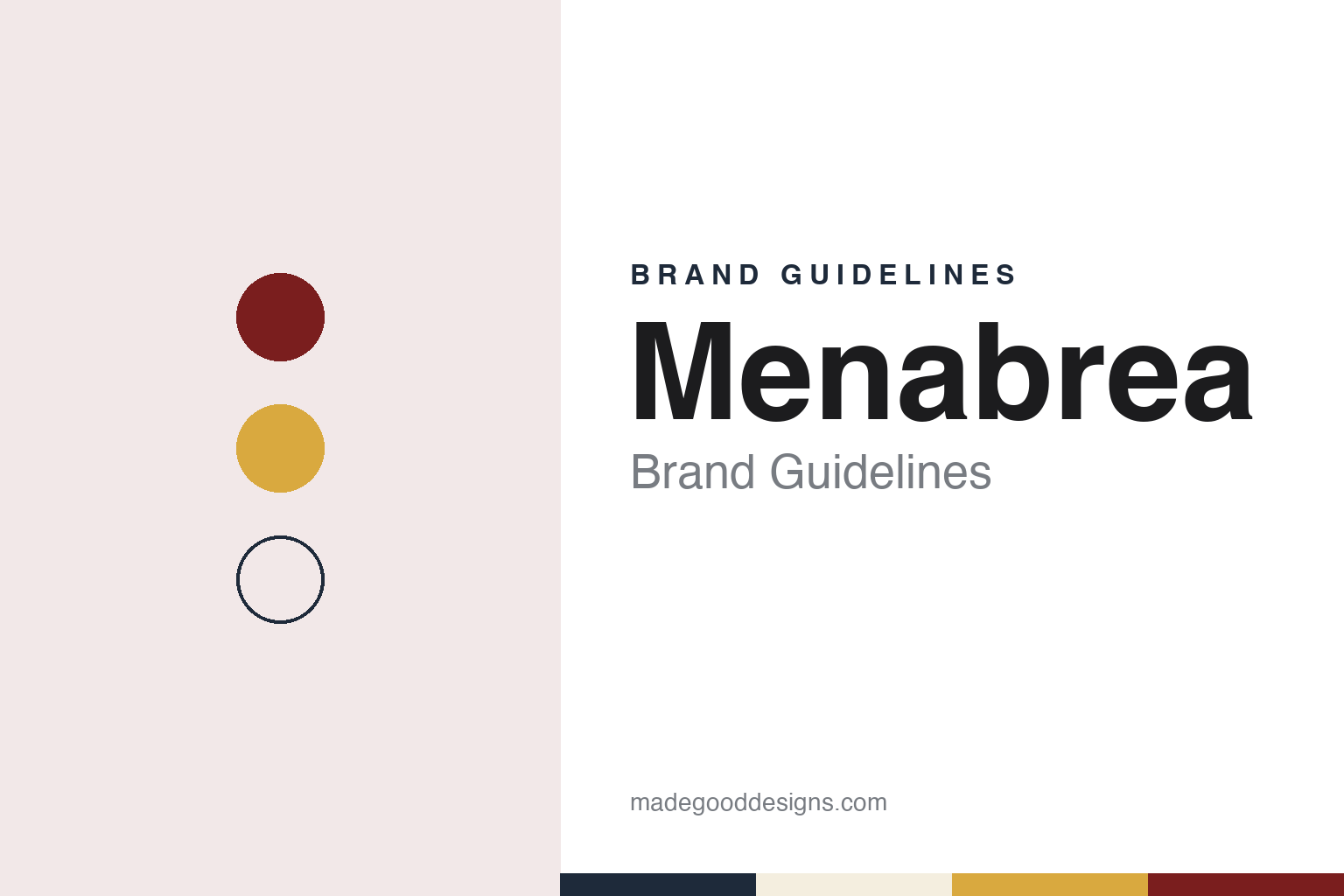
Two constants: a Menabrea crest red, Alpine navy and lager gold palette and a heritage serif register. Abstract homage — not a Menabrea product or mark; no bottle, label, crest or logo is reproduced.
From Caraccio to Menabrea
A brewery founded in 1846, renamed after its second owners.
Menabrea is a beer brewed in Biella, a town in the north of Piedmont at the foot of the Alps. The brewery dates itself to 1846, but it was not founded by the family whose name it carries. Its own history page says it was founded by a Mr Welf of Gressoney and the brothers Antonio and Gian Battista Caraccio; Italian Wikipedia, citing the same company history, adds that the Welf family were Walser people from Gressoney-La-Trinité, in the Aosta Valley, and that the Caraccio brothers came from Bioglio and kept a café in Biella.
In 1854 the brewery was leased to Giuseppe Menabrea and Antonio Zimmermann, who bought it in 1864, the company says. Italian Wikipedia describes the two buyers as men from Aosta and notes that Menabrea was born Jean Joseph and used the Italian form Giuseppe after the unification of Italy. When Zimmermann left the business, Giuseppe Menabrea formed G. Menabrea e Figli, “G. Menabrea and Sons,” on 6 July 1872, according to the company. Two years later, in 1874, he had a circular cellar built for storing the casks while the beer matured; the company calls it the “Rotonda.”
The company says that bottling was done by hand at first, one bottle at a time, with cork and sealing wax or a swing stopper, and that the beer was racked into wooden casks made in the brewery’s own joinery shop until the 1960s; its first metal keg dates from 1971. It also says the brewery used bottom fermentation, which it describes as uncommon at the time, from early on, and the spring water of the Biella area. Italian Wikipedia records that Menabrea beer won four grand prizes in 1924 alone, at exhibitions in Milan, Rome, Brussels and Paris.
Colour
The Thedy family, and a South Tyrolean partner.
The brewery has been led by the Thedy family for more than a century. Carlo Menabrea, Giuseppe’s son, ran it until 1896, when it passed to Emilio Thedy and Augusto Antoniotti, the husbands of the Menabrea sisters, the company says; Italian Wikipedia gives the handover as taking place between 1896 and 1899 and names the sisters as Eugenia and Albertina. From that point, the company says, the Thedy family has run the business, and its museum, Casa Menabrea, presents the brewery as the work of the Menabrea and Thedy families together.
Italian Wikipedia says that until the 1980s the brewery’s output was about 36,000 to 40,000 hectolitres a year, and that an expansion of the Biella plant under the Thedy heirs in that decade took it beyond what had been a largely provincial scale.
In 1991 Menabrea became part of the Forst group, the brewery of Algund (Lagundo), near Merano in South Tyrol, in an agreement signed by Paolo Thedy, the company says, adding that Menabrea kept its identity and independence. Italian Wikipedia’s article on Forst names Birra Menabrea as a subsidiary and says Forst owns the Menabrea brand; the English Wikipedia article describes Forst as Menabrea’s distributor since the early 1990s and the Thedy family as owners. The company’s own legal footer describes Birra Menabrea S.p.A. as a company with a single shareholder. Franco Thedy, whom the company calls the fifth generation of the family, has directed the brewery since 2005 and is named on its website as chief executive.
The company says the brewery and its head office have always stood on the site of the founding, in the historic centre of Biella, and that an enlarged brewhouse, begun in 2017, was opened in March 2019. Not all Menabrea is brewed there: Italian Wikipedia, citing a retailer listing, says that Menabrea Original, the version sold in supermarkets, is produced at the Forst plant in Lagundo. In Britain the brand’s website is run by Magners GB Limited of Bristol, and its footer carries the line “Brewed in the UK.”
Typography
Design and documentation.
The seven brands in this group are all beer brands from the Netherlands, France and Italy: Amstel, Grolsch, Bavaria, Hertog Jan, Kronenbourg, Birra Moretti and Menabrea. Dutch, French and Italian beer brands in general sit at many different points in the trade, from family firms that still carry a founder’s name to names that now belong to much larger brewing groups, and a single brand can be sold everywhere from a corner bar to a supermarket shelf.
A beer brand’s identity is usually carried less by a single product than by a label, a name and the drink it promises, because the company behind the name may have changed hands, moved its brewing or grown far beyond the town where it started. That makes the questions behind each name worth asking plainly: who started it, who owns it now, and where its beer is actually brewed and packed.
Each guide separates what independent sources record from what the company says about itself — its founding story, its owners over time, where its beer is brewed and how its labels have changed — and marks plainly what rests only on the company’s own word.
Aa
A high-contrast heritage serif for a brewery that has drawn its own name since 1872. (Specimen set in Playfair Display, a serif STAND-IN; NOT the Menabrea logo.)
The crest
Lions, brewing tools and a name simplified in 2015.
Menabrea publishes a detailed history of its own mark. The company says that until 1871 the brewery had no logo as such: the name Menabrea, moulded in relief on its glass bottles, was all that identified it. From 1872 the heading “G. Menabrea e Figli,” with the words “Fabbricanti di Birra e Gazeuse,” makers of beer and soda water, and the name Biella, appeared on its official documents. The company notes that the lettering changed with the fashions of the time, and that it was set within a drawing of the brewery and decorated with hop cones, hop leaves and ears of wheat, standing for the beer’s ingredients.
In 1900 the elements of a crest first appeared together on the letterhead, and the new managers, Antoniotti and Thedy, filed it as a trademark in 1905, the company says. It shows two bearded, rampant lions and a tub holding the tools of the brewer’s trade: a tasting ladle, a mashing paddle and a sieve shovel. The company offers its own explanation for the lions: the Menabrea family held titles for military and administrative service, and the lion is the emblem of the Aosta Valley and of Gressoney, where the founding families came from. In 1924 the “G. Menabrea e Figli” lettering took its final form, and in 1930 lettering and crest together became the company’s registered mark.
In 2015 the mark was redrawn. The company says the name was shortened from “G. Menabrea e Figli” to simply Menabrea, which it presents as a return to the name on its first bottles, that the lettering was simplified and modernised, and that the crest’s symbols were made lighter while keeping their main elements. The range has grown alongside it: for its 150th anniversary in 1996 the brewery made a lager it called the 150° Bionda, and Italian Wikipedia says the 150° series later added an Ambrata, a Strong, a Rossa and a Weiss. The company says its beers have won gold and silver medals at the World Beer Championships in Chicago since 1997, and it has since added cans and a five-litre mini keg, which it says were new formats for Menabrea in Italy.
For a design guide, Menabrea shows how a brewery can carry a heraldic crest and a family surname through more than a century of redrawing without losing either. Compare Birra Moretti, another Italian beer brand, and Stiegl, the Salzburg brewery. For this guide we use crest red, Alpine navy and lager gold with a heritage serif, an unofficial interpretation; no product or logo is reproduced.
Explore & save
Keep Menabrea’s identity on hand — save it to a board in the Made Good inspiration library.
Menabrea identity set
Pin the Menabrea crest red, Alpine navy and lager gold palette and the heritage serif register to your own board.