Grolsch Brand Guidelines
The swing-top beer from Groenlo.
Aa
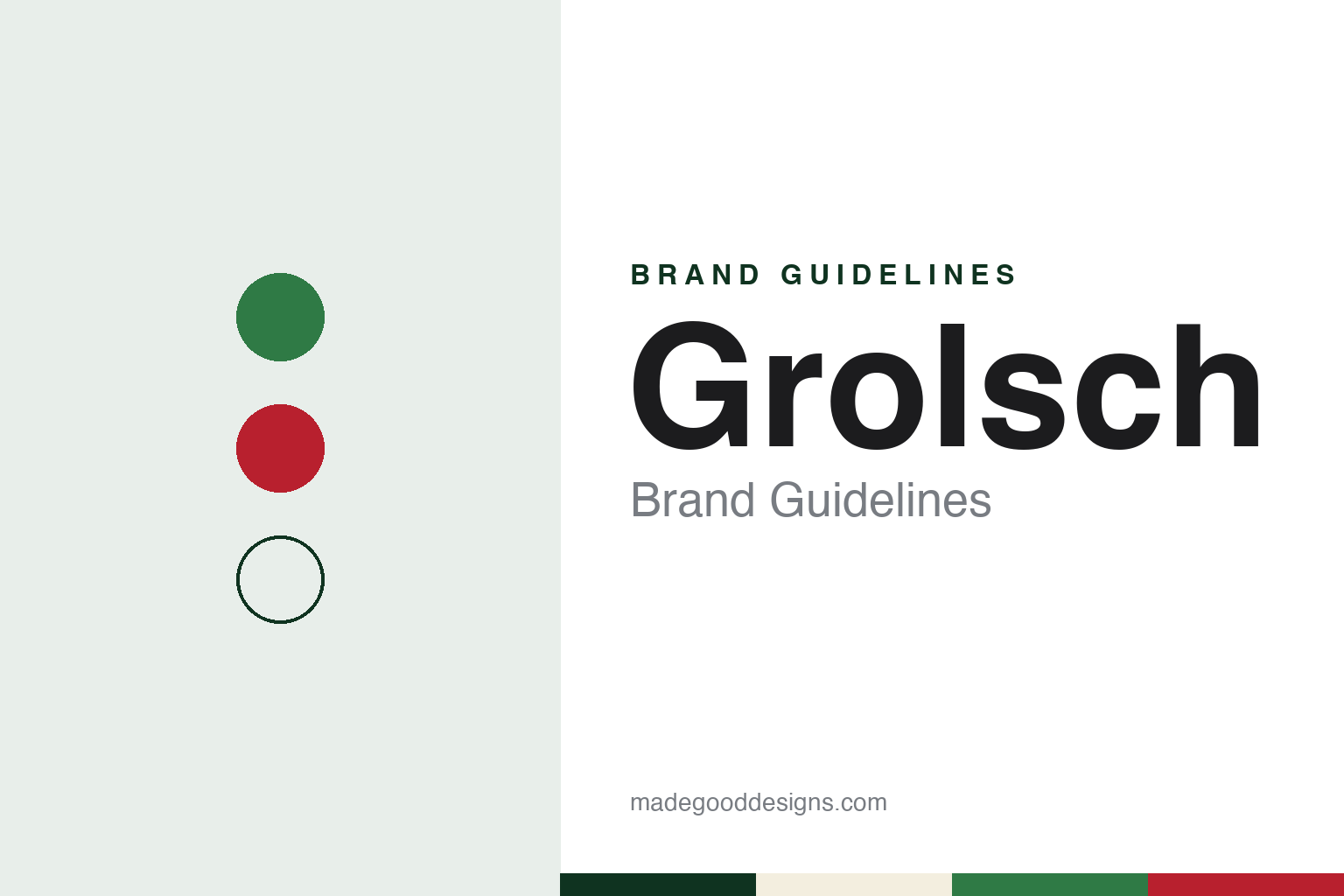
Two constants: a bottle green, ring red and porcelain palette and an old-style brewery serif register. Abstract homage — not a Grolsch product or mark; no bottle, label or logo is reproduced.
Of Grolle
A brewery in Grol, a guild master and a family called De Groen.
Grolsch dates itself to 1615 and to the small fortified town of Groenlo, in the east of the Netherlands, whose old name was Grolle or Grol; “Grolsch” simply means “of Grolle,” English Wikipedia says. The company says its story begins on 11 May 1615, when Willem Neerfeldt bought a building in Grol to start a brewery. One of his brewers, Peter Kuijper, married Neerfeldt’s daughter Jenneken and carried the business on; the company tells a family legend that she turned him down three times until he brewed a beer with two kinds of hops. Dutch Wikipedia, which spells the name Cuyper, says he was made master of Grol’s brewers’ guild in 1676.
The brewery stayed in the family line. The company says it passed from son to son until, in 1806, a Kuijper daughter married into the Harperink family, and that the business became known as De Klok, the Bell. It was brewed inside Groenlo’s walls until 1876, when a second De Klok brewery was built just outside them.
The family that made Grolsch national arrived in 1897. That year, the company and Dutch Wikipedia say, the brewer Theo de Groen, from a brewing family, bought De Klok from the Harperinks, and his sons Theo, Cobus and Andries later ran it. On 3 May 1922 De Klok merged with a brewery in the textile city of Enschede, founded by local manufacturers, traders and bankers in 1895, to form N.V. Bierbrouwerij De Klok Enschede-Groenlo. The company later became the Grolsche Bierbrouwerij, and the beer took the name Grolsch.
Colour
A swing-top bottle and a slogan about craftsmanship.
The thing most people know about Grolsch is its bottle. In 1897 Theo de Groen introduced the half-litre swing-top, the beugelfles, with a porcelain head, a rubber ring and a metal clasp, the company says; its early advertisements praised it because the beer stayed fresh, needed no opener and did not have to be finished in one go. As the crown cap took over the beer market after the Second World War, Grolsch kept the swing-top, Dutch Wikipedia says. The bottle was streamlined in the early 1960s, and the company says the relief decoration of hop cones and an ear of grain is still on it today. In 1997 the brewery marked the bottle’s centenary with six special beers on swing-top; drinkers voted for Het Kanon, which stayed in the range.
Grolsch has kept reworking its packs. On 5 February 2007 it replaced the brown standard returnable bottle at home with its own transparent green one, with flattened sides, a vertical Grolsch relief and a two-hop symbol on the shoulder, the company says; it introduced it with the slogan “Bier mag weer gezien worden,” beer may be seen again. In 2008 a new green swing-top replaced the brown one in the Netherlands, ending 111 years of the brown bottle, the regional broadcaster RTV Oost reported. In 2014 the pilsner bottle changed again, to a 30 cl design.
Its advertising has rested on one line for more than six decades. In 1949 Theo de Groen hired the advertising man Gerard Brummer, who later became the first director from outside the family. After “Bierkenners vragen Grolsch” (beer connoisseurs ask for Grolsch), Brummer coined “Vakmanschap is Meesterschap”, craftsmanship is mastery, in the late 1950s, and around 1960 he brought in the photographer Paul Huf to shoot working craftsmen, the company says.
Typography
Design and documentation.
The seven brands in this group are all beer brands from the Netherlands, France and Italy: Amstel, Grolsch, Bavaria, Hertog Jan, Kronenbourg, Birra Moretti and Menabrea. Dutch, French and Italian beer brands in general sit at many different points in the trade, from family firms that still carry a founder’s name to names that now belong to much larger brewing groups, and a single brand can be sold everywhere from a corner bar to a supermarket shelf.
A beer brand’s identity is usually carried less by a single product than by a label, a name and the drink it promises, because the company behind the name may have changed hands, moved its brewing or grown far beyond the town where it started. That makes the questions behind each name worth asking plainly: who started it, who owns it now, and where its beer is actually brewed and packed.
Each guide separates what independent sources record from what the company says about itself — its founding story, its owners over time, where its beer is brewed and how its labels have changed — and marks plainly what rests only on the company’s own word.
Aa
An old-style serif for a brewery that dates itself to 1615. (Specimen set in Cormorant Garamond, a serif STAND-IN; NOT the Grolsch logo.)
Grolsch
A listed company, a new brewery and two foreign owners.
Under the De Groen family Grolsch grew from a regional brewer into an international one. It was listed on the stock exchange from 1984 to 2008, with the family holding a large share, Dutch Wikipedia says, and although it had exported since 1946, the company says it made a serious push abroad from 1972, when its green export swing-top stood out on foreign shelves. In 1995 it received the Koninklijk (Royal) title and became Koninklijke Grolsch. In April 2007 the European Commission fined Grolsch, with Heineken and Bavaria, for a price-fixing cartel in the Dutch beer market, The Guardian reported.
Where Grolsch is made changed after 13 May 2000, when a fireworks warehouse exploded about 200 metres from the Enschede brewery, the company says; BBC News reported the disaster, and it took half a year to get the brewery back to full production. Dutch Wikipedia says Hertog Jan took over part of the production in the meantime. A new brewery, decided on in 1998, opened in 2004 at Usselo, in the municipality of Enschede, on the border with Boekelo; it replaced both old sites, and since 2005 all production has been there, Dutch Wikipedia says. From the 2008–09 season FC Twente’s stadium in Enschede took the name De Grolsch Veste.
Ownership then moved twice. In November 2007 the board accepted a takeover offer from SABMiller, BBC News reported, and Grolsch became a SABMiller subsidiary in February 2008. When Anheuser-Busch InBev bought SABMiller, it agreed in April 2016 to sell Grolsch, Peroni and Meantime to Japan’s Asahi, de Volkskrant reported, and the company says it has been part of Asahi Group Holdings since October 2016. Grolsch says its Premium Pilsner is brewed with two hop varieties and that it has worked that idea into its logo. A separate guide covers the font Grolsch uses.
For a design guide, Grolsch shows how one bottle and one slogan can carry a brewery through four centuries of claimed history and three owners. Compare Kozel, the Czech beer that also passed from SABMiller to Asahi, and Hertog Jan, another Dutch brewery. For this guide we use a bottle green, a ring red and a porcelain white with an old-style serif, an unofficial interpretation; no product or logo is reproduced.
Explore & save
Keep Grolsch’s identity on hand — save it to a board in the Made Good inspiration library.
Grolsch identity set
Pin the Grolsch bottle green, ring red and porcelain palette and the old-style brewery serif register to your own board.