Martini Brand Guidelines
The Turin vermouth of the ball and bar and the racing stripes.
Aa
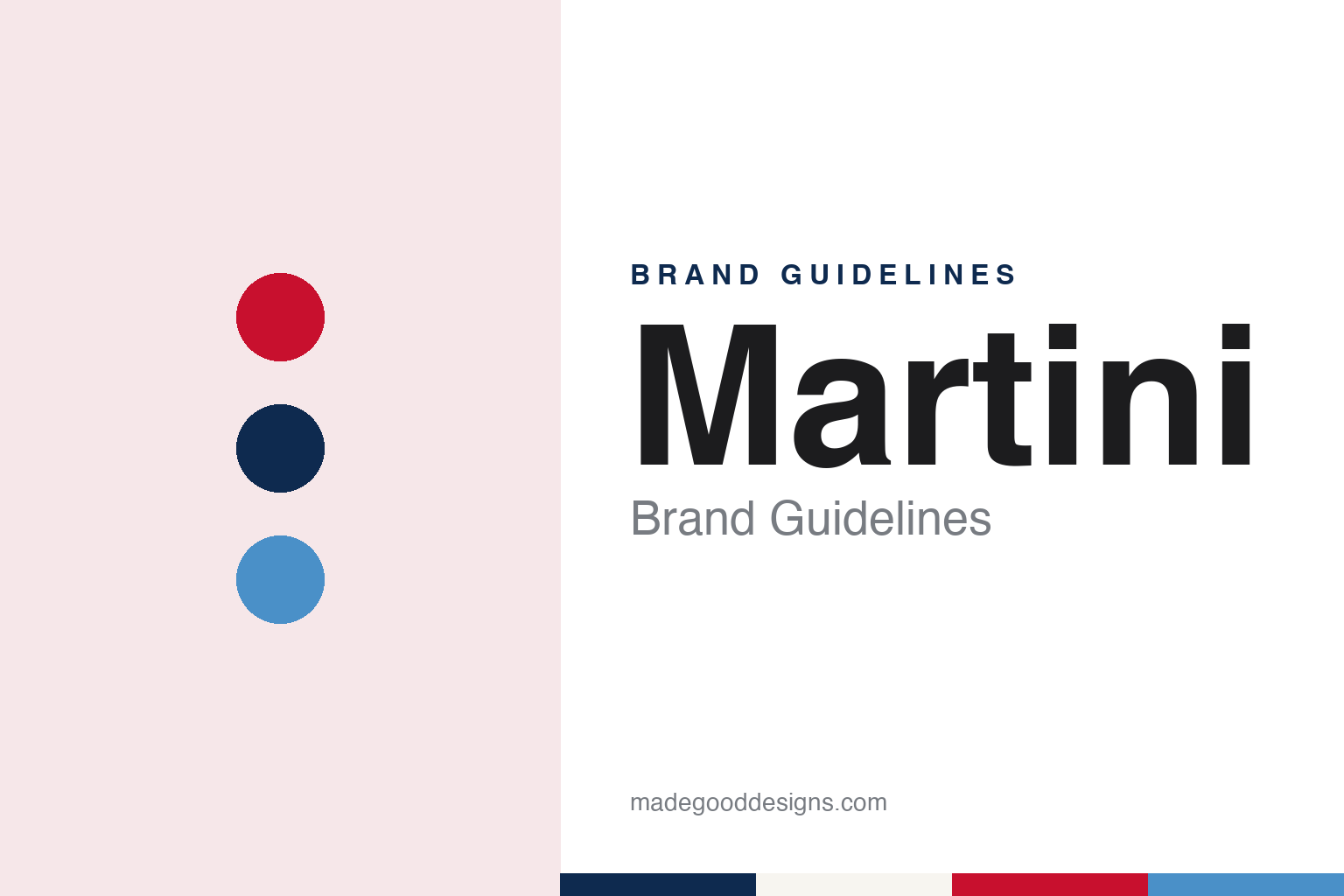
Two constants: a red, navy and sky-blue palette and a high-contrast serif register. Abstract homage — not a Martini product or mark; no bottle, logo or livery is reproduced.
A merchant and a herbalist
A Turin distillery, three partners and a move to Pessione.
Martini is a brand of Italian vermouth and sparkling wine, not the cocktail that shares its name. Its maker, Martini & Rossi, traces itself to a Turin firm founded on 1 July 1847 as a national wine-spirit distillery, Michel Re Agnelli e Baudino, Italian Wikipedia says. Two of its employees, the salesman Alessandro Martini, originally from Florence, and the accountant Teofilo Sola, took a share of its profits from 1851.
In 1863 the business was reorganised in Turin as Martini, Sola e C.ia, with a third partner, Luigi Rossi, a herbalist and liqueur maker whose Turin shop was known for vermouth. The brand dates its Martini Rosso to that year, and the company calls the recipe Rossi’s original formula. In 1864 production moved to Pessione, a village in the commune of Chieri on the railway between Turin and Genoa, where the partners bought a country house with cellars, Italian Wikipedia says. In 1879, when the Sola family left the business, the firm took the name Martini & Rossi, English Wikipedia says.
Exports came early. English Wikipedia says the first cases reached New York in 1867; Italian Wikipedia says the first foreign branch opened in Buenos Aires in 1883, followed by Geneva, Barcelona, London, Paris and Brussels. Exhibition medals fed the label: after a diploma at Dublin in 1865 an image of Victory was added, later replaced by the winged figure of Fame from a Paris gold medal of 1878, Italian Wikipedia says. Martini Extra Dry followed on New Year’s Day 1900 and Martini Bianco in 1910, English Wikipedia says.
Colour
Ball and bar, posters and stripes.
The brand’s mark is the ball and bar: a red disc crossed by a horizontal bar carrying the name. Both English and Italian Wikipedia say it was first registered in 1929, and Bacardi says the logo “was born” that year. Advertising was commissioned from leading illustrators: Italian Wikipedia credits Marcello Dudovich with a 1920 poster known as “la Dama Bianca,” Giorgio Muggiani with a lithographic poster in 1921, and Armando Testa with later work, and says Andy Warhol drew an American campaign in the late 1950s, keyed to red for sweet vermouth and green for dry. The brand entered the Italian television showcase Carosello on 3 February 1957, and Italian Wikipedia says the company’s sponsored radio concerts, launched in 1936, ran until 1964 with a wartime break.
The company also built places. The first Terrazza Martini, a rooftop hospitality room, was planned in Paris in 1948, and the Milan terrace opened in 1958, designed by the architect Tomaso Buzzi, Il Foglio reported in 2018; others followed in Barcelona, Brussels, São Paulo, London and Genoa. A museum of wine history opened at Pessione in 1961.
The best-known design is the Martini Racing livery, which grew out of the Martini International Club sponsorship programme set up in 1958: stripes of dark blue, light blue and red, usually on white or silver cars, English Wikipedia says. It records Martini stickers on a Porsche 910 in April 1968 and an “International Martini Racing Team” in 1970; the company says the stripes were introduced in 1971, the year a Martini-entered Porsche 917 won at Le Mans, Italian Wikipedia says. The stripes later ran on Brabham Formula One cars from 1975, on Lancia rally cars that took six consecutive world titles from 1987 to 1992, and on Williams Formula One cars from 2014 to 2018.
Typography
Design and documentation.
The seven brands in this group are all liqueur and aperitif brands: Baileys, Kahlúa, Disaronno, Martini, Cinzano, Molinari and Becherovka. Liqueur and aperitif brands in general sit at many different points in the trade, from family firms that still carry a founder’s name to names that now belong to much larger drinks groups, and a single brand can be sold everywhere from a corner shop to a hotel bar.
A liqueur or aperitif brand’s identity is usually carried less by a single recipe than by a bottle, a label, a name and the drink or occasion it promises, because the company behind the name may have changed hands, moved its production or grown far beyond the place where it started. That makes the questions behind each name worth asking plainly: who started it, who owns it now, and where its drinks are actually made and bottled.
Each guide separates what independent sources record from what the company says about itself — its founding story, its owners over time, where its drinks are made and how its bottles and labels have changed — and marks plainly what rests only on the company’s own word.
Aa
A high-contrast serif for a nineteenth-century Turin label. (Specimen set in Playfair Display, a serif STAND-IN; NOT the Martini logo.)
Martini & Rossi
The Rossi family, a holding company and Bacardi.
The Rossi family ran the company for most of its first 130 years. Luigi Rossi’s sons, among them Teofilo and Cesare, took over around the turn of the century, and in 1911 the family received the title of Counts of Montelera, Italian Wikipedia says. From the 1960s the group bought other drinks brands, including Noilly Prat, Saint Raphael and William Lawson’s, and in 1977 it set up the holding company General Beverage Corporation in Luxembourg.
In 1987 Martini & Rossi handed its United States distribution to Bacardi Imports of Miami, and the two groups’ coming together was reported by La Repubblica in September 1992. Bacardi dates the deal to 1993, when it says it acquired General Beverage, owner of the Martini & Rossi group, doubling its size. Martini has been a Bacardi brand since. Bacardi says the blending is in the hands of a master blender and a master herbalist who alone know the recipes, and its Casa Martini visitor centre at Pessione di Chieri offers tours of the production plant. Italian Wikipedia adds a second plant at Santo Stefano Belbo, in the Langhe, which replaced an older site at Montechiaro d’Asti in 1959. The company says its historical archive at Pessione, set up in 1999, keeps documents, bottles and labels, and Italian Wikipedia notes an advertising collection covering 1938 to 1982.
For a design guide, Martini shows how a simple geometric mark and three stripe colours can travel from a label to a race car without losing recognition. Compare Cinzano, its Turin vermouth rival, and Bacardi, its owner since 1993; for the lettering, see our note on the Martini & Rossi font. For this guide we use ball red, stripe navy and stripe sky with a high-contrast serif, an unofficial interpretation; no product or logo is reproduced.
Explore & save
Keep Martini’s identity on hand — save it to a board in the Made Good inspiration library.
Martini identity set
Pin the Martini ball red, stripe navy and stripe sky palette and the high-contrast serif register to your own board.