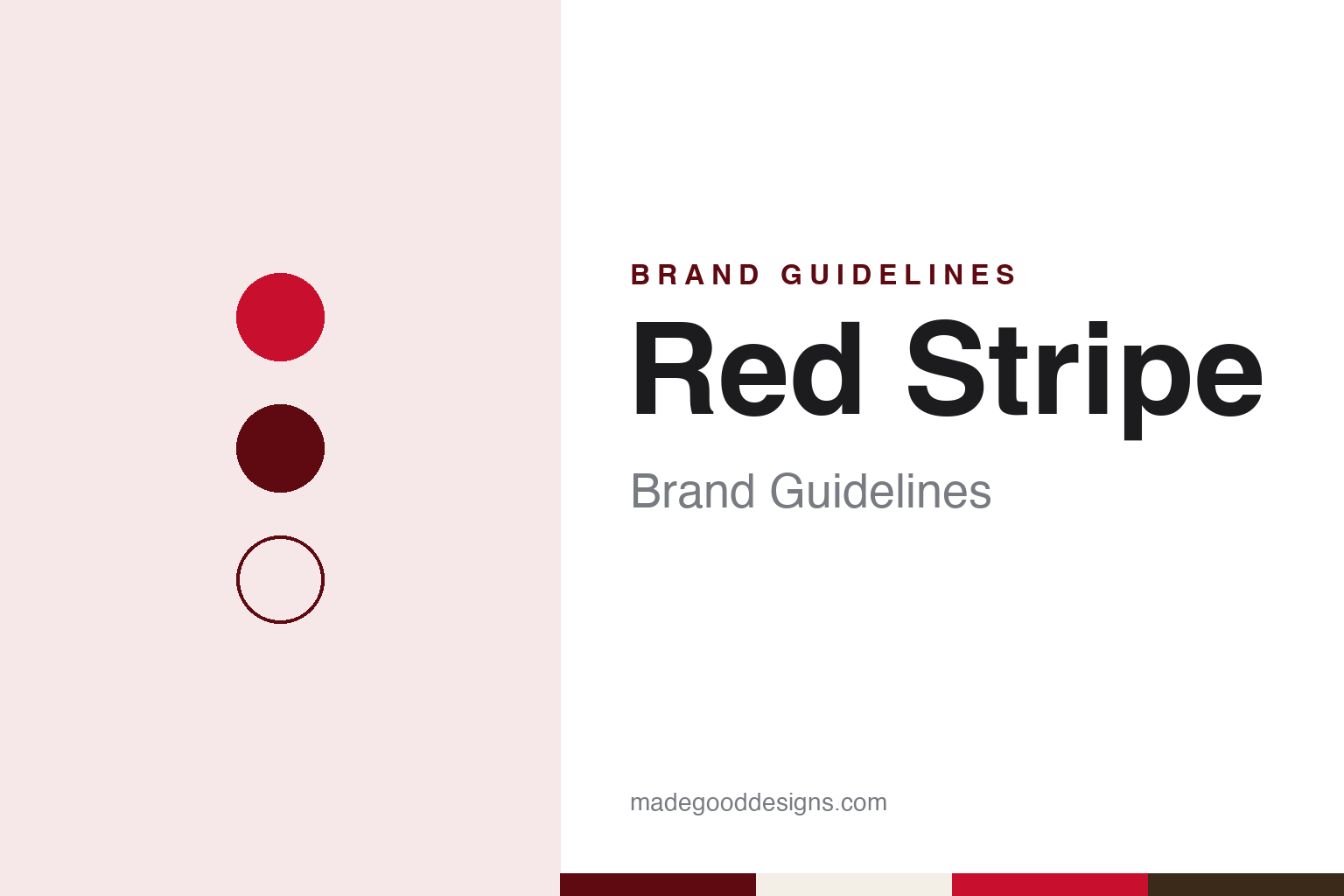
Red Stripe Brand Guidelines
The Jamaican lager in the stubby bottle.
Aa
Two constants: a stripe red, label cream and bottle brown palette and a condensed label sans register. Abstract homage — not a Red Stripe product or mark; no bottle, label or logo is reproduced.
Two shops in Kingston
A drinks merchant, a brewery and a lager in 1938.
Red Stripe is the beer of Desnoes & Geddes, the Kingston company formed in 1918 by Eugene Peter Desnoes and Thomas Hargreaves Geddes, who, according to The Oxford Companion to Beer as cited by English Wikipedia, combined their two shops into one business. At first the firm made soft drinks and distributed imported alcohol; Northern Public Radio’s This Week in Illinois History reported in 2021 that it also branched into wine, liquor, lotions and perfumes before turning to beer.
The company says the first Red Stripe branded beer was brewed in 1928. That year, the 2021 report says, Desnoes & Geddes opened a brewery and brought a master brewer from England, and advertising of the time shows that early Red Stripe beers included ales and stouts as well as lagers. The beer known today came a decade later. In 1938, Northern Public Radio reported, the founder’s son Paul Geddes took over the brewery and reworked the recipe to create the Red Stripe lager; Dutch Wikipedia likewise says the first Red Stripe was an ale, replaced in 1938 by the current lager. The company’s own timeline marks 1938 as the year Peter Desnoes and Paul Geddes took over the family business.
The company tells a story about the name: it says Paul Geddes, asked what to call the beer, was stopped by a policeman on a routine check on his way to work and named it after the red stripe down the side of the local police uniform. A beer called Red Stripe had earlier been brewed in Galena, Illinois, from the 1880s until 1936; the same 2021 report noted similarities between the Galena labels of the 1930s and Desnoes & Geddes labels of the 1940s but called any connection unknown and “most likely a coincidence.”
Colour
Guinness, Diageo, Heineken and a licence in Bedford.
Desnoes & Geddes became a publicly traded company in 1970, the company says. In 1993, English Wikipedia says, Guinness Brewing Worldwide, now Diageo, bought a controlling interest, a deal it credits with widening the international distribution of Red Stripe and its sister beer Dragon Stout. In 1999, citing The Oxford Companion to Beer, it says the company sold its soft-drink business, including Ting, to PepsiCo, and its spirits and wine division to J. Wray & Nephew, leaving it a brewer.
Ownership changed again in 2015. Reuters reported on 7 October 2015 that Diageo had sold its 57.87 percent stake in Desnoes & Geddes to Heineken, and The Drinks Business reported that December that Heineken, which already held 15.5 percent, now owned 73.3 percent and would take over Red Stripe in the UK from 1 January 2016. The company’s timeline puts it simply: in 2015 “Red Stripe becomes part of the Heineken family.”
Where the beer is made has varied by market. English Wikipedia, citing a Charles Wells annual review, says the Bedford brewer Charles Wells brewed Red Stripe under licence for the UK from 1976 to 2014. For the United States, BusinessWeek reported in 2011 that Diageo was moving production for the American market from Jamaica to a contract brewer in Pennsylvania; by 2023 the brand’s US website said bottles for the US were brewed and packed by Desnoes & Geddes in Kingston, while cans and draught were brewed under licence in Amsterdam.
Red Stripe was first imported to the United States in 1985, English Wikipedia says, and its brand building there and in Jamaica has run through music and sport. Brandweek reported in 2001 on a North American television campaign built around the line “Hooray, beer!”; USA Today reported in 2004 on the brand’s on-and-off sponsorship of the Jamaica bobsled team, and HuffPost reported in 2018 that Red Stripe paid for a new sled for the women’s team before the Pyeongchang Olympics.
Typography
Design and documentation.
The seven brands in this group all make beer or rum, and all of them come from the Caribbean: Presidente, Brugal, Barceló, Red Stripe, Appleton Estate, Mount Gay and Carib. Caribbean drink brands in general sit at many different points in the trade, from family firms that still carry a founder’s surname to names that now belong to much larger drinks groups, and a single brand can be sold everywhere from a rum shop to an airport duty-free shelf.
A drink brand’s identity is usually carried less by a single product than by a bottle, a label and the place it promises, because the company behind the name may have changed hands, moved its brewing or bottling or grown far beyond the island where it started. That makes the questions behind each name worth asking plainly: who started it, who owns it now, and where its beer or rum is actually made and bottled.
Each guide separates what independent sources record from what the company says about itself — its founding story, its owners over time, where its drinks are made and how its labels have changed — and marks plainly what rests only on the company’s own word.
Aa
A condensed label sans for a beer sold in a short brown bottle. (Specimen set in Oswald, a sans STAND-IN; NOT the Red Stripe logo.)
Red Stripe
A short bottle, a red name and a Jamaican address.
Red Stripe’s bottle is part of its story. The brand calls it the stubby, and its own timelines date it differently: the US website in 2023 said the stubby bottle was introduced in 1965, while the Jamaican website in 2026 gives 1971; Northern Public Radio said only that the “snub nose” bottle arrived in the 1960s. English Wikipedia says that when Red Stripe first went to the United States it was shipped in standard green bottles, and that Jamaicans abroad and travellers who knew the beer from the island were reluctant to buy it until the squat brown bottle and its painted label came back.
The company frames the beer as a national emblem. Its timeline says many Red Stripe beers were consumed when Jamaica gained independence in 1962, that by 1970 Red Stripe was “synonymous with all things Jamaican,” and that in 2005 export volume exceeded domestic volume for the first time. It says Red Stripe won a gold medal at the Monde Selection in 2003, with Red Stripe Light taking silver, and gold again in 2022. Le Monde reported in 2005 that an appearance in Sydney Pollack’s film The Firm had helped the beer in the American market.
The range today, the Jamaican website shows, runs from Red Stripe lager and Red Stripe Light to flavoured beers and Rum Stripe premixed drinks, while Dragon Stout, which its own website dates to 1920, remains the company’s other long-standing beer.
For a design guide, Red Stripe shows how a short brown bottle, a red name and a Jamaican address can carry a beer through Guinness, Diageo and Heineken ownership without changing its name; compare it with Appleton Estate, the Jamaican rum, and Carib, the lager from Trinidad and Tobago. For this guide we use stripe red, label cream and bottle brown with a condensed sans, an unofficial interpretation; no product or logo is reproduced.
Explore & save
Keep Red Stripe’s identity on hand — save it to a board in the Made Good inspiration library.
Red Stripe identity set
Pin the Red Stripe stripe red, label cream and bottle brown palette and the condensed label sans register to your own board.