Carib Brand Guidelines
The Trinidad lager born of a 1947 plan to grow local industry.
Aa
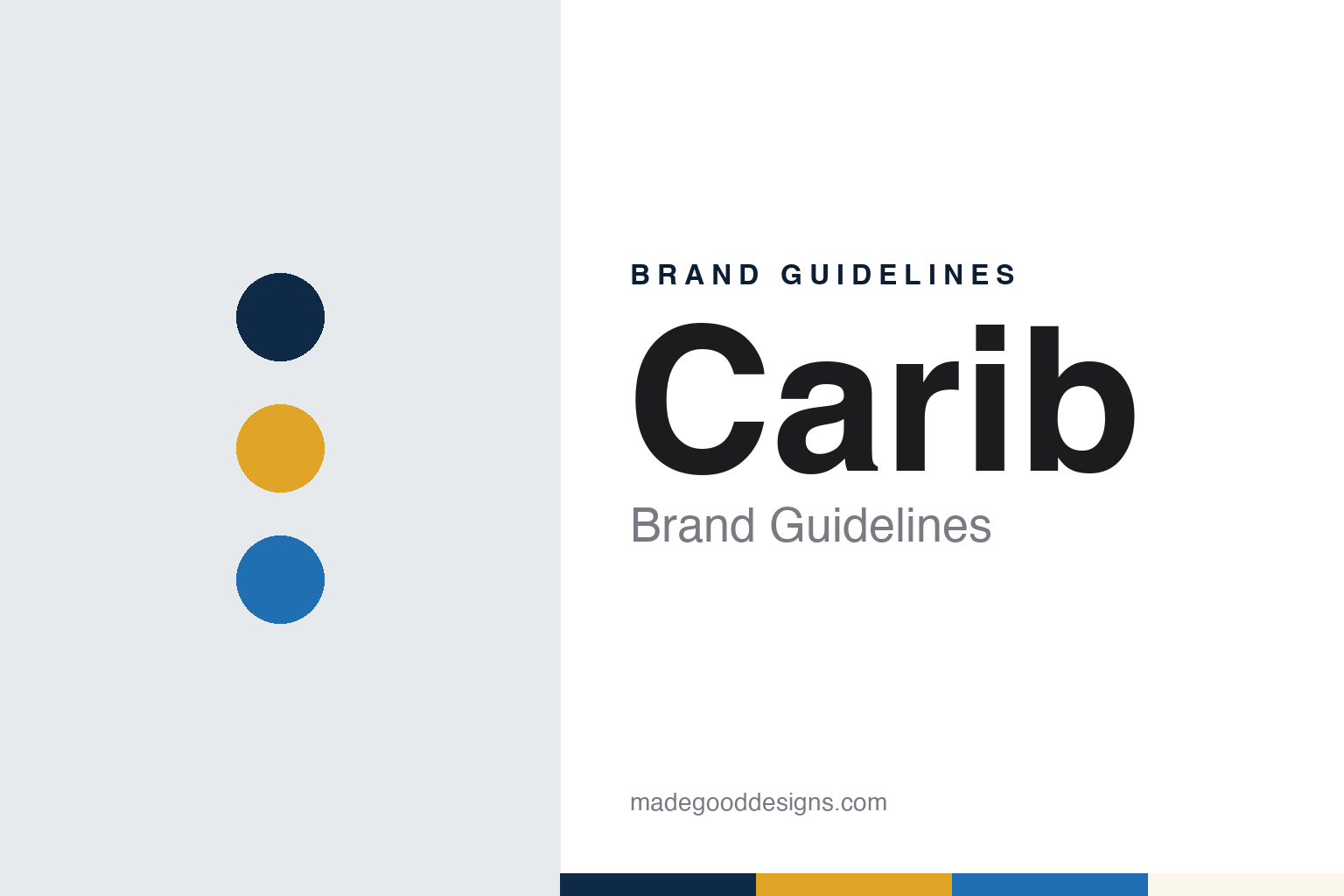
Two constants: a navy, lager gold and Caribbean blue palette and a sturdy grotesque sans register. Abstract homage — not a Carib product or mark; no bottle, label, logo or shield is reproduced.
A brewery and a glassworks
A post-war plan to make more at home.
Carib began as part of a plan to widen Trinidad’s economy. The brewery’s own history says beer brewing in Trinidad and Tobago was inherited from the British, and that the first commercial brewery was started just after the First World War by a Mr Walters, whose Trinidad Brewing Company made Royal Lion Ale, Royal Extra Stout and Black Velvet Stout during the Depression years. After the Second World War, the company says, Sir Gerald Wight, then chairman of the trading house Alstons and Company, saw the need to expand local industry beyond the traditional sugar and oil economy and pushed for a new brewery and a glassworks.
The result was the Caribbean Development Company (CDC), formed in July 1947 with Wight as chairman. The company says the brewery started with a payroll of seven, and that Wight made sure its production process, based on what it calls the European-Continental method of brewing, was mastered before anything went on sale. In September 1950 it launched its own beer, Carib Lager; the company says imported beers had filled the market until then and began to disappear as Carib caught on. English Wikipedia, citing a 2010 company paper for a Master Brewers Association of the Americas convention, says CDC was split in 1955 into Carib Brewery Ltd and Carib Glassworks Ltd.
In 1957, the company says, CDC bought the brewing plant and interests of Walters’ brewery, leaving it the sole brewer and bottler of beer and stout in Trinidad. Royal Extra Stout, one of the old Walters names, still appears in Carib Brewery’s range on its website today.
Colour
A new identity at seventy.
Carib Lager turned seventy in 2020, and the brewery used the anniversary to change how it looks. In an interview with the Trinidad Guardian in August 2020, reproduced on the brewery’s website, Peter Hall, then head of ANSA McAL’s beverage sector, said Carib Brewery had a new identity that was “modern, consistent, and beautiful.” The name stayed the same, he said, but the idea was to set the brewery a little apart from Carib Lager, its flagship beer, and to go back to the origins of the brewery for “inspiring ideas and depictions” to bring up to date. The update covered Trinidad, Grenada, St Kitts and the international business, and would show most on the brewery building, its trucks and its uniforms; Hall said it would not affect Carib Lager at all.
The beer’s own label changed separately. In a 2021 interview with the Business Guardian, also reproduced by the company, Antron Forte, Carib Brewery’s category manager for beer, stout and cider, described a re-branding of the Carib logo developed over the previous eighteen months. People always picture the Caribbean with a palm or coconut tree, he said, so the brewery wanted a symbol that would make Carib and the Caribbean one. The new label carries what the company calls its “Caribbean icon”: a shield bearing birds, the ocean, the rays of the sun and the north star. In Forte’s telling the birds tell fishermen that land is near, the sea both joins and separates the islands, the sun gives life, and the north star is the first star seen in the evening sky.
Forte said the icon would not be used across the whole portfolio but only on Carib Lager, Carib Pilsner, a new blue-bottled variant called Carib Blue, and Carib Malta, the malt drink formerly sold as Malta Carib. The new packaging was launched in late 2021 with a music video, “Can You Feel It,” featuring the Trinidadian soca singer Kerwin Du Bois and the Jamaican dancehall artist Shenseea, with a cameo by DJ Khaled; Forte said it was shot in the Bahamas and showed the flags of other islands. His summary of the brand’s pitch: “The word Caribbean does not exist without Carib in front of it.”
Typography
Caribbean beer and rum, side by side.
The seven brands in this group all make beer or rum, and all of them come from the Caribbean: Presidente, Brugal, Barceló, Red Stripe, Appleton Estate, Mount Gay and Carib. Caribbean drink brands in general sit at many different points in the trade, from family firms that still carry a founder’s surname to names that now belong to much larger drinks groups, and a single brand can be sold everywhere from a rum shop to an airport duty-free shelf.
A drink brand’s identity is usually carried less by a single product than by a bottle, a label and the place it promises, because the company behind the name may have changed hands, moved its brewing or bottling or grown far beyond the island where it started. That makes the questions behind each name worth asking plainly: who started it, who owns it now, and where its beer or rum is actually made and bottled.
Each guide separates what independent sources record from what the company says about itself — its founding story, its owners over time, where its drinks are made and how its labels have changed — and marks plainly what rests only on the company’s own word.
Aa
A sturdy grotesque sans for a lager named after the region it sells to. (Specimen set in Archivo, a sans STAND-IN; NOT the Carib logo.)
Carib Brewery
Four breweries and a group behind them.
Carib Brewery is owned by ANSA McAL, one of Trinidad and Tobago’s largest conglomerates, English Wikipedia says. The group traces its history to 1881, when George R. Alston set up a cocoa trading business in Trinidad, and the company’s website today speaks of a 145-year legacy. The brewery’s own history describes its founding chairman, Sir Gerald Wight, as the then chairman of Alstons and Company, the business it says later became McEnearney Alstons. The main brewery stands at Champs Fleurs in north Trinidad.
The range grew around the lager. The company says the brewery bought more land and brewhouse equipment in 1972, taking capacity above 250,000 hectolitres a year, and launched Malta Carib, its first non-alcoholic drink, in 1973. Shandy Carib followed in 1985, which the company describes as an effort to capitalise on the local custom of mixing beer with other flavoured drinks; Stag lager and Smalta came later. Over the years Carib also took on licences from international companies, naming Guinness, Interbrew, Carlsberg and Diageo among its partners, and it says brands such as Guinness and Mackeson stout are produced under licence for local and export markets.
Carib is no longer brewed only in Trinidad. English Wikipedia says Carib Brewery has operated in St Kitts and Nevis since 1997 and in Grenada since 2002. In 2016 ANSA McAL bought the Florida Beer Company in Cape Canaveral, Florida; in 2021 it was renamed Carib Brewery USA, Florida Today reported that September, quoting the brewery’s marketing director, Asa Sealy, who said the company wanted to unify its brand. Forte said in 2021 that Carib was distributed in more than 33 countries from four breweries, and that Carib products would be brewed in Florida for drinkers in North America and the Caribbean diaspora. English Wikipedia, citing Newsday, adds that in late 2024 the company formed a joint venture with the Indian distiller Globus Spirits to brew beer for the Indian market.
For a design guide, Carib shows how a beer first sold to replace imports can turn its own name into a regional banner, and how a brewery can renew its corporate look while giving its flagship label a separate emblem. Compare Red Stripe, Jamaica’s lager, and Presidente, the Dominican Republic’s. For this guide we use a harbour navy, a lager gold and a Caribbean blue with a sturdy grotesque sans, an unofficial interpretation; no product or logo is reproduced.
Explore & save
Keep Carib’s identity on hand — save it to a board in the Made Good inspiration library.
Carib identity set
Pin the Carib harbour navy, lager gold and Caribbean blue palette and the sturdy grotesque sans register to your own board.