Zacapa Brand Guidelines
The Guatemalan centenary rum wrapped in a woven petate band.
Aa
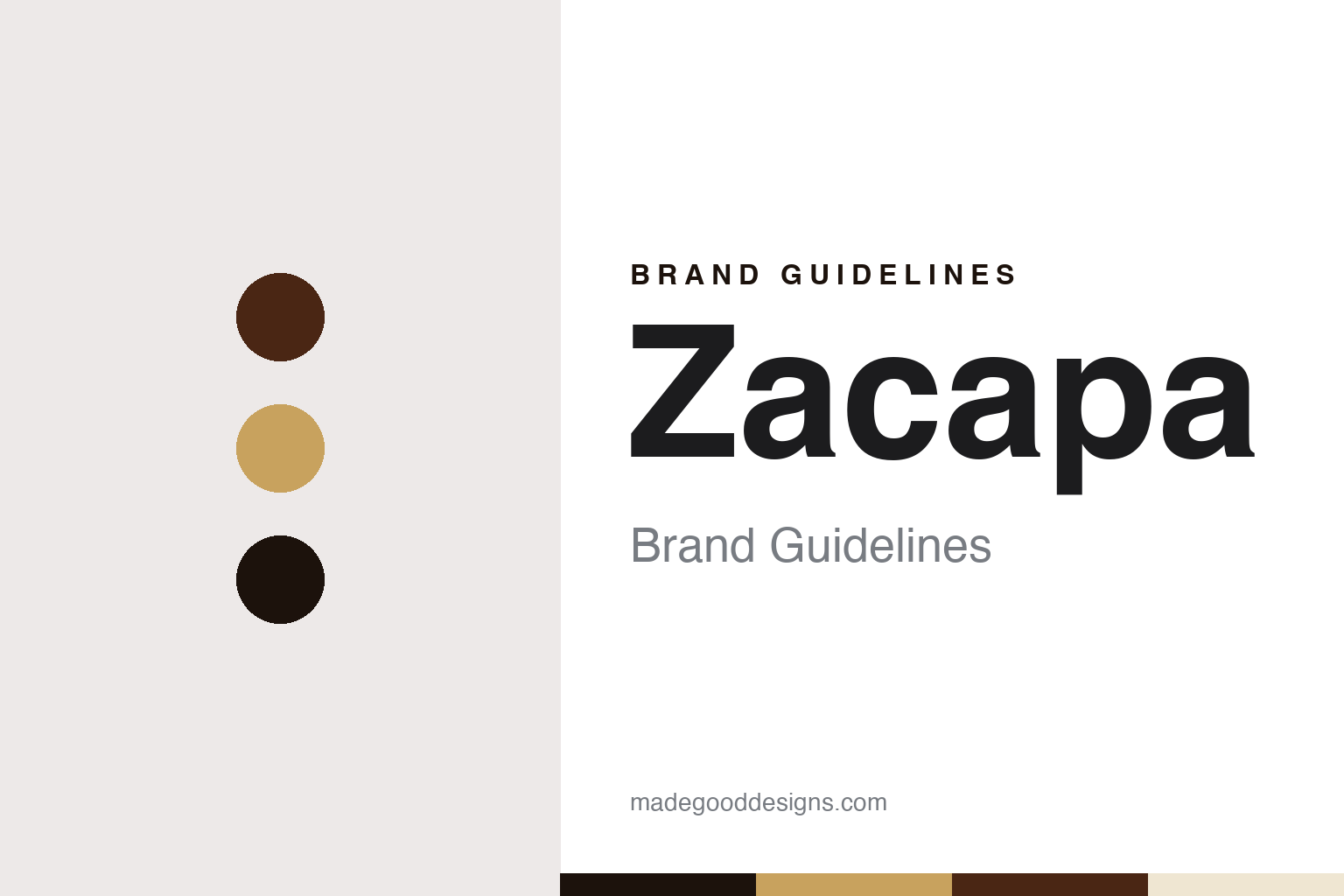
Two constants: a Zacapa mahogany, black and petate straw palette and a classical display serif register. Abstract homage — not a Zacapa product or mark; no bottle, band or logo is reproduced.
Centenario
A town’s hundredth birthday and a family of distillers.
Zacapa was created in 1976 to mark the hundredth anniversary of the town of Zacapa, in eastern Guatemala, founded in 1876 — hence the word Centenario that long sat beside the name. The company says the name Zacapa means “on the river of grass” in Nahuatl. The company tells the same story on its own site. The rum is made by Industrias Licoreras de Guatemala (ILG), which English Wikipedia describes as the biggest of Guatemala’s three distilling companies, and English Wikipedia credits the early blending and maturing work to a chemist, Alejandro Burgaleta.
ILG is older than the rum. English Wikipedia says it was formed in the 1940s — sources give 1940, 1942 or 1944 — from a merger of four family distilleries. One was Industria Licorera Quezalteca, founded in 1939 by five Botrán brothers from Burgos, in Spain, who had settled in Quetzaltenango in the 1930s. The Spirits Business, in a 2016 history of the Botran rum brand, describes the Botrán family joining four other distilling families to form ILG. Production moved to Mixco, near Guatemala City, in 1968, and the four original companies still operate as subsidiaries of the group; a separate company, La Nacional, was formed in 1959 to handle marketing, distribution and sales.
Zacapa’s reputation abroad was built in the 1990s and 2000s. English Wikipedia says it won the premium category of the International Rum Festival four years running, from 1998 to 2001, and became the first rum entered in the festival’s Hall of Fame. Roberto García Botrán, president and chief executive from 2002 to 2015, worked bars and liquor stores in Miami in the early 2000s to spread the rum by word of mouth, the business magazine E&N reported in 2014.
Colour
Aged above the clouds.
Zacapa’s production story starts on the Pacific lowlands and ends in the highlands. The company says its cane is grown and its rum fermented and distilled in the Retalhuleu region, and English Wikipedia names the Tululá sugar mill as the source. Instead of molasses, the first-press cane juice is reduced to a syrup, miel de caña or sugarcane honey, fermented for about 120 hours with a yeast originally taken from pineapples, and distilled in multi-column stills. English Wikipedia, citing a 2009 interview with the master blender, says distilling runs for only about two months a year, timed to the cane harvest.
Ageing is the part the brand puts first. The spirit matures by a Sistema Solera, in which younger rum is blended into older stocks through a sequence of casks — ex-bourbon, re-charred bourbon, sherry and Pedro Ximénez barrels, according to English Wikipedia — at a warehouse about 2,300 metres above sea level near Quetzaltenango. The company calls this ageing “above the clouds,” and says the cool mountain air slows maturation. The master blender is Lorena Vásquez, whom the company describes as one of the few women in the world in that role, with more than 35 years of experience.
The method is now written into law. Guatemala established a geographical indication for its rum in 2010, which the European Union recognised in 2014, and a 2012 designation, Ron de Guatemala, requires cane from Retalhuleu and Suchitepéquez and solera ageing at 2,300 metres or more in Quetzaltenango. English Wikipedia adds that the distillery earned ISCC PLUS certification in 2017, burns waste methane for energy and returns distillation residue to the cane fields as fertiliser.
The number on the bottle has drawn criticism. The drinks writer Matt Pietrek argued in Cocktail Wonk in 2016 that a large “23” invites readers to assume an age, and Bloomberg Law reported in September 2021 on a US lawsuit making that allegation against Diageo’s marketing of Zacapa 23.
Typography
Design and documentation.
The seven brands in this group all make food or drink, and all of them come from Central America, Peru or Jamaica: Flor de Caña, Zacapa, Toña, Dos Pinos, Big Cola, Grace and Walkerswood. Food and drink brands from this part of the world sit at many different points in the trade, from family firms and cooperatives that still carry a founder’s or a place’s name to names that now belong to much larger groups, and a single brand can be sold everywhere from a village shop to a supermarket shelf abroad.
A food or drink brand’s identity is usually carried less by a single product than by a label, a name and the meal or occasion it promises, because the company behind the name may have changed hands, moved its production or grown far beyond the town where it started. That makes the questions behind each name worth asking plainly: who started it, who owns it now, and where its products are actually made, bottled and packed.
Each guide separates what independent sources record from what the company says about itself — its founding story, its owners over time, where its products are made and how its labels have changed — and marks plainly what rests only on the company’s own word.
Aa
A classical display serif — the register of a rum named for a town’s centenary. (Specimen set in Cormorant Garamond, a serif STAND-IN; NOT the Zacapa logo or label lettering.)
Zacapa
A band of woven palm.
The most recognisable thing about a Zacapa bottle is the petate, a hand-woven palm mat. English Wikipedia says early bottles were wrapped in a full petate sleeve and that a 2011 redesign reduced it to a band around the middle of the bottle; the same redesign shortened the flagship’s name from “23 Años” to simply “23,” and Zacapa 15 carried a straw-coloured band. The company says more than 700 women weavers in Jocotán make the bands that dress Zacapa No. 23.
The partnership with Diageo came in two steps. English Wikipedia says Diageo took exclusive distribution rights on 1 April 2008, and in July 2011 bought a 50% stake, forming Rum Creation & Products, the ILG subsidiary that now makes the rum; The Spirits Business confirmed the 2011 stake in its 2016 history. ILG kept its other rums, including Botran, independent. The range today runs from Zacapa 23 to the XO, finished in French-oak cognac casks, and Edición Negra, finished in double-charred oak.
For a design guide, Zacapa shows how one piece of local craft — a woven band — can carry a brand across export markets. Compare Flor de Caña, the Nicaraguan rum that puts its volcano on the label, and Dos Pinos, another Central American name. For this guide we use solera mahogany, highland black and petate straw with a serif, an unofficial interpretation; no product or logo is reproduced.
Explore & save
Keep Zacapa’s identity on hand — save it to a board in the Made Good inspiration library.
Zacapa identity set
Pin the Zacapa mahogany, black and petate straw palette and the classical display serif register to your own board.