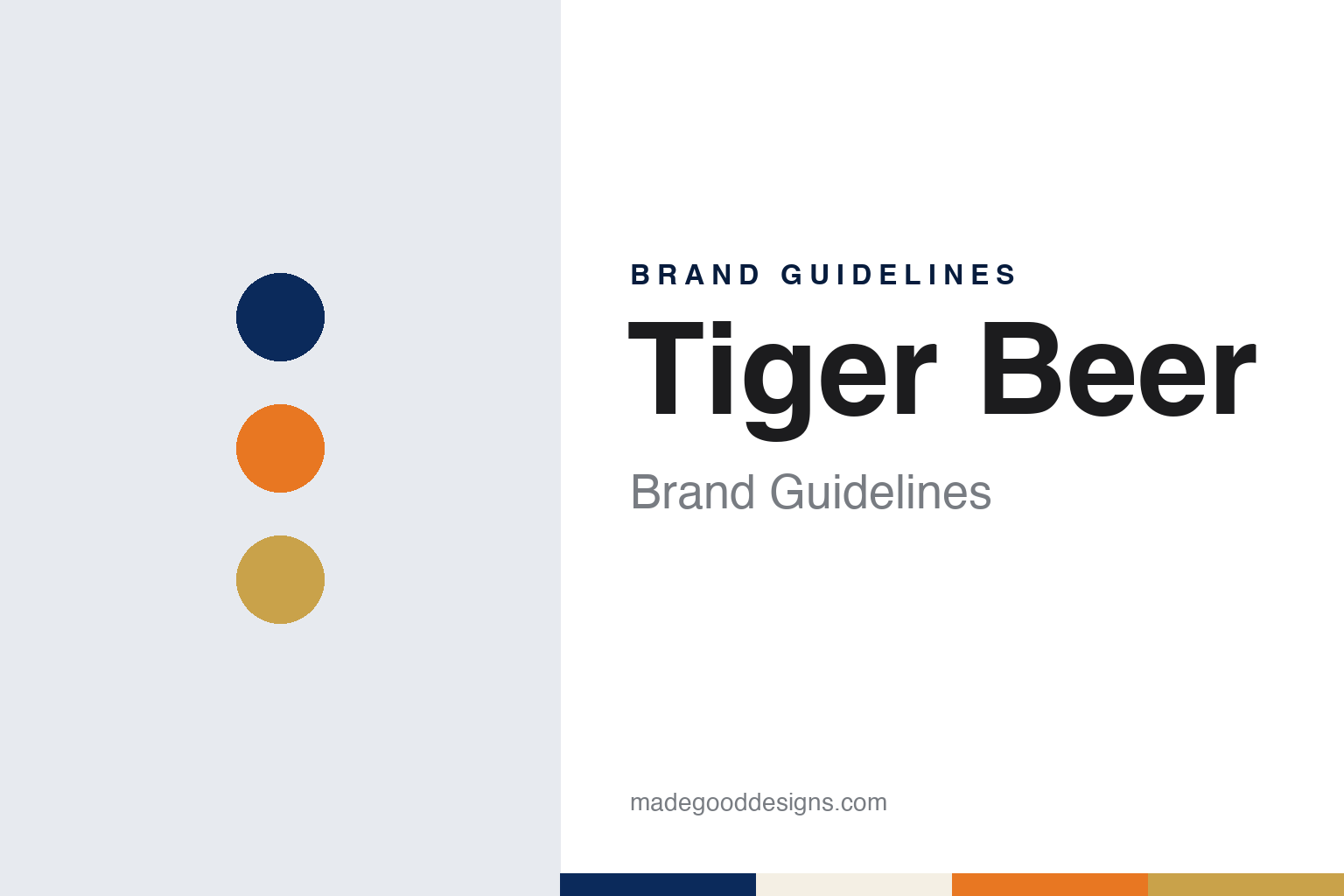
Tiger Beer Brand Guidelines
The 1932 Singapore lager of Malayan Breweries.
Aa
Two constants: a Tiger blue, orange and gold palette and a condensed label sans register. Abstract homage — not a Tiger Beer product or mark; no bottle, label or logo is reproduced.
Malayan Breweries
A soft-drinks firm, a Dutch brewer and a brewery behind the brickworks.
Tiger Beer was created by Malayan Breweries Limited, a company formed in Singapore in 1931 by the soft-drinks maker Fraser & Neave and the Dutch brewer Heineken. Asia Pacific Breweries, the company’s present name in Singapore, tells the origin as a late-night exchange over drinks at the Raffles Hotel between executives of the two firms. BiblioAsia, the National Library Board’s magazine, said in a 2024 history of Singapore brewing that the company was founded with a capital of a million dollars and built the first modern brewery in Singapore, behind the Alexandra Brickworks; the same article put Heineken’s stake in the venture at 40 per cent.
The beer followed in 1932. The brewer dates the launch to 1 October 1932 and calls Tiger “the world’s first ever tropical lager,” a description that is its own. BiblioAsia records a launch tasting for more than 200 guests and the slogan “Time for a Tiger,” and says that within about two years the beer accounted for more than two-thirds of the beer drunk in British Malaya. The brewery was enlarged in 1937 and again in 1939, the magazine says, and exports, including to Hong Kong, were growing by 1935.
War interrupted the original recipe. According to BiblioAsia, a lighter wartime beer called Tiger Cub was brewed from 1939, and the original Tiger returned in 1947, announced in advertisements that January. The magazine names Dr Leonard Bels as the brewery’s brewmaster from 1949 to 1974.
Colour
A palm, a tiger and a slogan.
Tiger’s early imagery reached well beyond the bar. Asia Pacific Breweries says that in 1937 the servicemen of the Royal Air Force’s No. 230 Squadron, then in Malaya, liked the Tiger Beer and “Traveller’s Palm logo” on their bottles so much that they adopted it as their insignia. The squadron’s heraldry supports the outline of that story: English Wikipedia, citing a 2004 history of the squadron, describes its badge as a tiger in front of a palm tree, approved by King George VI in February 1937, and says the tiger is said to have been inspired by the labels on the local Singapore beer, while the travellers palm refers to the squadron’s long flights.
The slogan travelled too. The novelist Anthony Burgess, who worked in Malaya in the 1950s, took Time for a Tiger as the title of his first novel, published in 1956 as the first part of his Malayan trilogy. English Wikipedia relates that Burgess wrote in his autobiography that he asked the brewery, then part of Fraser & Neave, for a complimentary clock bearing the slogan and was refused, and that in 1970 the company offered him free beer while in Singapore; by then, he wrote, he had become “wholly a gin man.”
The brewer’s own timeline marks the brand’s steps into new media and packs. It says Tiger won its first international award, a silver medal at the Commonwealth Beer Competition, in 1939; that the first canned Tiger went on sale in 1964; that its first television commercial ran in Singapore in 1973; and that exports reached the United Kingdom and Germany in 1981. BiblioAsia lists earlier export markets in 1968, including the United States, Australia and New Zealand.
The range has widened since. Tiger Crystal, a lighter lager, was first released in Malaysia as a limited edition for the Year of the Tiger in 2010, The Star reported, and returned in 2019, the year Asia Pacific Breweries gives for its Singapore launch. The company also sells Tiger Radler and, since 2023, a Tiger Soju Infused Lager. Its Singapore product page describes the original Tiger as a 5 per cent lager “born in Singapore in 1932.”
Typography
Design and documentation.
The seven brands in this group are all beer names from Asia: Tiger, Anchor, Beerlao, Bintang, Cobra, Kingfisher and Taiwan Beer. Asian beer brands in general sit at many different points in the trade, from names first brewed by a single local company to names that now belong to much larger brewing groups, and a single brand can be sold everywhere from a street stall to a supermarket shelf.
A beer brand’s identity is usually carried less by a single brew than by a label, a name and the occasion it promises, because the company behind the name may have changed hands, moved its brewing or grown far beyond the place where it started. That makes the questions behind each name worth asking plainly: who started it, who owns it now, and where its beer is actually brewed and packed.
Each guide separates what independent sources record from what the company says about itself — its founding story, its owners over time, where its beer is brewed and how its packaging has changed — and marks plainly what rests only on the company’s own word.
Aa
A condensed label sans — “Time for a Tiger.” (Specimen set in Barlow Condensed, a sans STAND-IN; NOT the Tiger Beer logo.)
Tiger Beer
From joint venture to Heineken.
The company changed its name before its owners changed. BiblioAsia says Malayan Breweries became Asia Pacific Breweries in 1990 and adopted a new logo; the company says the same year it moved its brewing from its birthplace on Alexandra Road to a new brewery at Tuas, in western Singapore. In August 2012 Fraser & Neave accepted Heineken’s offer for its stake in Asia Pacific Breweries, Channel NewsAsia reported, and F&N shareholders approved the sale on 28 September 2012. The company describes itself as part of a joint venture from 1931 to 2012 and fully owned since 2012; BiblioAsia dates Heineken’s full ownership to 2013, the year English Wikipedia says the business was merged into Heineken’s regional company and renamed Heineken Asia Pacific. The Singapore brewing company still trades as Asia Pacific Breweries Singapore, “part of the HEINEKEN Company.”
Tiger remains its flagship. The company says the Tuas brewery’s capacity reached 2 million hectolitres in 2014 and that 8,038 solar panels were installed on its roof in 2015; in 2017 it unveiled a new company logo to mark Tiger’s 85th birthday. The Tiger Brewery Tour at Tuas is open to visitors, the Philippine website Spot.ph reported in 2018. Tiger is not brewed only in Singapore: BiblioAsia said in 2024 that it was brewed in 11 countries and sold in more than 75, while the company’s Singapore product page says it is enjoyed in more than 50. In Malaysia it is marketed by Heineken Malaysia, and in Cambodia Heineken brews it near Phnom Penh, according to English Wikipedia.
For a design guide, Tiger Beer shows how a label animal and a slogan can outlast the company that created them: the tiger and the travellers palm passed into a squadron badge, and the slogan into a novel title. Compare Anchor Beer, the Singapore lager Malayan Breweries acquired in 1941, and Fraser & Neave, Tiger’s co-founder. For this guide we use a deep blue, an orange and a gold with a condensed sans, an unofficial interpretation; no product or logo is reproduced.
Explore & save
Keep Tiger Beer’s identity on hand — save it to a board in the Made Good inspiration library.
Tiger Beer identity set
Pin the Tiger blue, orange and gold palette and the condensed label sans register to your own board.