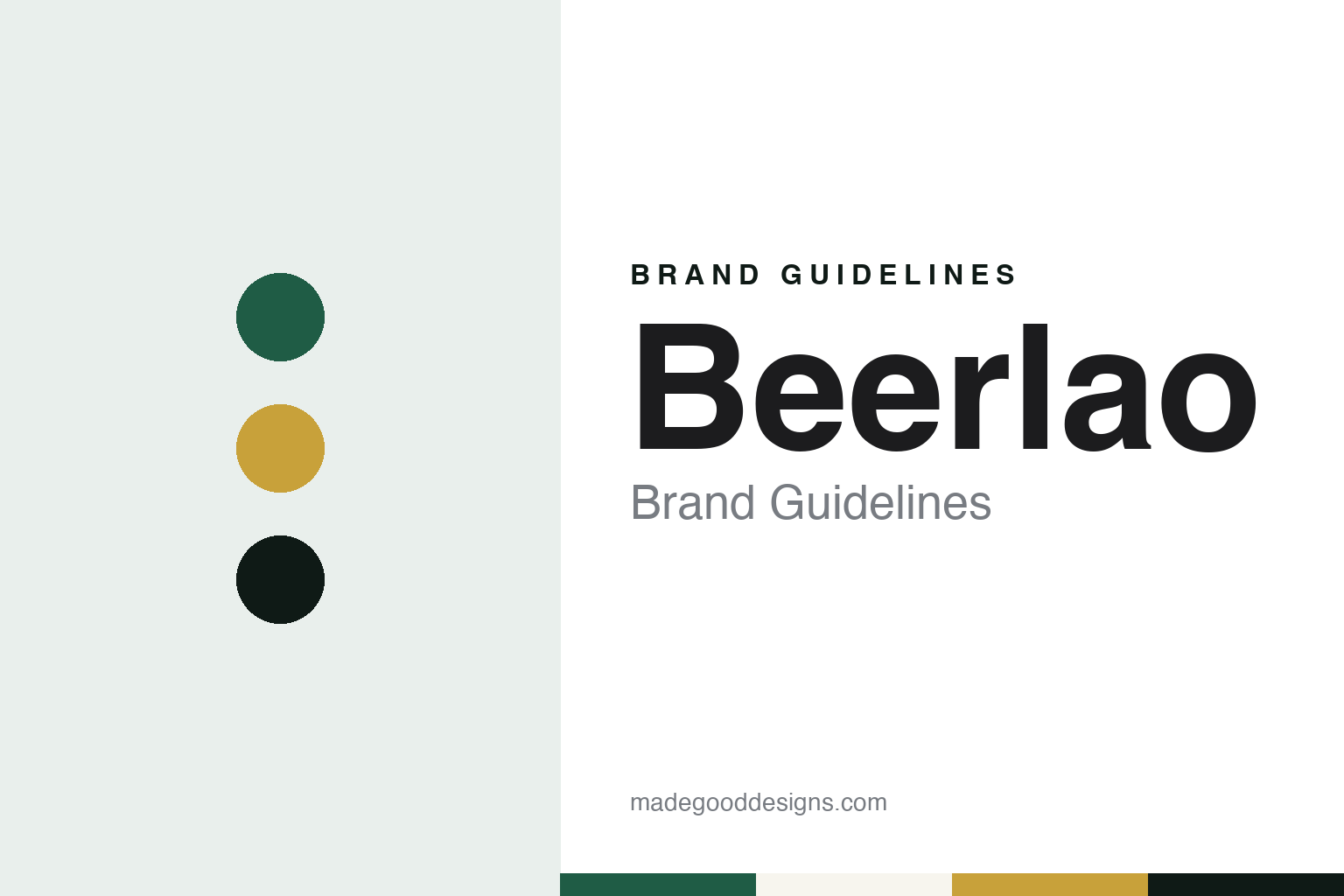
Beerlao Brand Guidelines
The Vientiane rice lager owned by Laos and Carlsberg.
Aa
Two constants: a river green, rice gold and ink palette and a sturdy grotesque register. Abstract homage — not a Beerlao product or mark; no bottle, label or logo is reproduced.
Brasseries et Glacières du Laos
A French–Lao brewery in Vientiane.
Beerlao is the beer of the Lao Brewery Company (LBC) of Vientiane, the capital of Laos. The company says it was established as a brewery in 1973. The World Intellectual Property Organization (WIPO), in a case study last updated in April 2010, describes it as a joint venture formed that year between French investors and Lao businessmen, with a capacity of three million litres of beer a year. English Wikipedia dates the founding of the venture to 1971, with brewing from 1973, and gives the company’s first name as Brasseries et Glacières du Laos. In those years, Wikipedia says, it sold Bière Larue at home and “33” Export to the rest of Indochina.
After the Lao People’s Democratic Republic was founded in December 1975, the company was nationalised and became a state-owned enterprise, WIPO says. According to Wikipedia, its beer was then sold as Bière Lao and, from early 1995, as Beerlao; the “33” label was dropped in 1990 and Larue in 1995. WIPO adds that LBC has held registered trademarks in Laos since 1994.
The flagship is still the lager. The company’s product page dates Beerlao Lager to 1973, gives Laos as its origin and lists its ingredients as water, malted barley, rice and hops. English Wikipedia, citing the company, says the rice is grown in Laos, the malt comes from France and Belgium, and the hops and yeast from Germany; it also says the brewery’s machinery is imported from Europe.
Colour
From state brewery to a Carlsberg joint venture.
The ownership has changed several times since the state took over. In 1993, WIPO says, LBC became a joint venture between the Lao government and foreign investors, Loxley Public Company and Italian-Thai Public Company; English Wikipedia, citing an ASEAN business case study of 2001, puts the split at 49 per cent for the government and 51 per cent for the foreign partners. In 2002 the foreign partners changed to Carlsberg Asia and TCC International, and in 2005 the shareholding became an even split: 50 per cent for the Lao government and 50 per cent for Carlsberg Breweries of Denmark, WIPO says. Wikipedia, citing a Carlsberg press release, adds that Carlsberg took 70 per cent of Lao Soft Drink Company in 2007.
Today LBC calls itself “a proud member of the Carlsberg Group” and a joint venture between the Lao government and Carlsberg. Its business has grown well beyond beer. The company says it now works in five categories — beer, drinking water, carbonated soft drinks as the bottler for PepsiCo in Laos, snacks and wine — and its bottled water is sold as Tigerhead. On its production page it says renewable biomass now supplies more than 80 per cent of the steam used at its Vientiane brewery; that is the company’s own figure.
The range has widened around the lager. On the company’s own dates, Beerlao Dark arrived in 2005, the LaneXang lager in 2008, Beerlao Gold in 2010, a white lager in 2018, an IPA in 2019, Luang Prabang Beer in 2021 and Beerlao Green in 2023. English Wikipedia says LaneXang takes its name from the historic Lao kingdom of Lan Xang, the kingdom of the “Million Elephants,” and that LBC began brewing Carlsberg locally in 2005. For Beerlao Gold, the company has said it uses a local rice called khao kai noy.
Typography
Design and documentation.
The seven brands in this group are all beer names from Asia: Tiger, Anchor, Beerlao, Bintang, Cobra, Kingfisher and Taiwan Beer. Asian beer brands in general sit at many different points in the trade, from names first brewed by a single local company to names that now belong to much larger brewing groups, and a single brand can be sold everywhere from a street stall to a supermarket shelf.
A beer brand’s identity is usually carried less by a single brew than by a label, a name and the occasion it promises, because the company behind the name may have changed hands, moved its brewing or grown far beyond the place where it started. That makes the questions behind each name worth asking plainly: who started it, who owns it now, and where its beer is actually brewed and packed.
Each guide separates what independent sources record from what the company says about itself — its founding story, its owners over time, where its beer is brewed and how its packaging has changed — and marks plainly what rests only on the company’s own word.
Aa
A sturdy grotesque for a national lager. (Specimen set in Archivo, a sans STAND-IN; NOT the Beerlao logo or label lettering.)
Beerlao
A national lager that travels.
WIPO calls Beerlao one of the most successful export products of Laos. It says exports began in 1997, to eight countries including Australia, France, Japan, the United Kingdom and the United States, and that by 2010 the beer was sold through distributors in more than ten countries, among them China, Germany and Thailand. By then, WIPO says, LBC could brew 210 million litres of beer a year, seventy times its capacity at the start. The Vientiane Times reported in 2024 that LBC had exported more than ten million litres of Beerlao. In July 2026 The Economist ran an article headlined “Beerlao: probably the most important lager in the world.”
The company has long said it holds close to 99 per cent of the Lao beer market, a figure WIPO repeated in 2010 as the company’s own. WIPO quotes the line LBC used to tie the beer to the country — “drink Beerlao, absorb Lao culture” — and notes that the company sponsors national sports events. Beerlao was an official sponsor of the 2009 Southeast Asian Games, held in Vientiane, English Wikipedia says.
WIPO lists awards for Beerlao at contests in New Zealand in 2002, Belgium in 2003 and 2005, France in 2004, and Russia and the United States in 2005, and says Time magazine named it Asia’s best beer of 2004. English Wikipedia, citing the company’s news pages, adds gold quality awards from Monde Selection in 2006 and 2010.
For a design guide, Beerlao shows how a single national lager, owned jointly by a state and an international brewer, can carry a country’s name on every bottle. Compare Tuborg, another Carlsberg Group beer, and Singha, from neighbouring Thailand. For this guide we use river green, rice gold and ink with a sans, an unofficial interpretation; no product or logo is reproduced.
Explore & save
Keep Beerlao’s identity on hand — save it to a board in the Made Good inspiration library.
Beerlao identity set
Pin the Beerlao river green, rice gold and ink palette and the sturdy grotesque register to your own board.