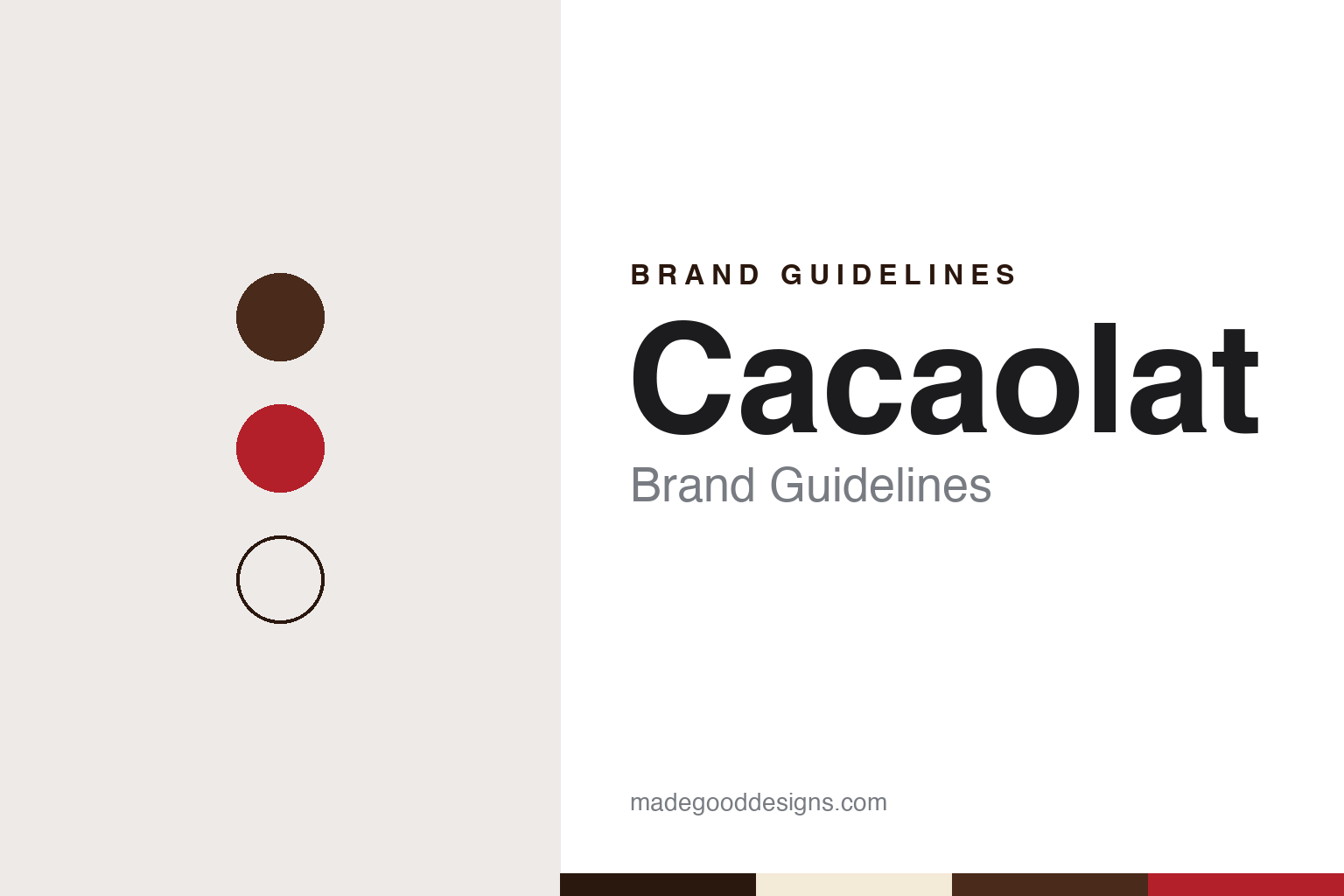
Cacaolat Brand Guidelines
The Barcelona cocoa milkshake bottled since 1933.
Aa
Two constants: a Cacaolat cocoa brown, red and cream palette and a rounded friendly sans register. Abstract homage — not a Cacaolat product or mark; no bottle, label or logo is reproduced.
Letona
A drink tasted in Budapest.
Cacaolat is a bottled milk-and-cocoa drink from Barcelona, and it was born in a dairy business. The Viader family were stock-breeders and milk merchants in the Vallès Oriental, north-east of the city. Marc Viader Bas imported Dutch dairy cows, commissioned a farm at Cardedeu from the modernista architect Manuel J. Raspall and ran a chain of dairies in Barcelona, of which the Granja Viader in carrer Xuclà survives, Eix, the magazine of the Catalan museum of science and technology, reported in 2019. In 1925, with other dairymen, he founded Letona, which became Catalonia’s largest milk producer, Eix says.
The idea came from Hungary. On a trip there Marc Viader and his son Joan Viader Roger tasted a handmade drink of milk and cocoa — at a wedding in Budapest, according to the company and the Catalan news site Vilaweb. On 4 December 1931 Joan Viader applied to register the Cacaolat name for a refreshing drink, covering both the process and the mark, Eix reports. The drink used skimmed milk, known in Catalan as “xerigot,” then a by-product with little commercial value, mixed with cocoa and sugar.
The first bottles went on sale in 1933, and the drink was shown to the public at the Fira de Mostres, Barcelona’s trade fair — in 1934, according to Eix. Vilaweb reported in 2023 that sales tripled in the first three years and described Cacaolat as the first industrially made cocoa milkshake in the world, a claim the company also makes. The Civil War and a shortage of cocoa stopped production from 1936 until 1950.
Colour
Pepi and the bottle.
Cacaolat’s identity rests on its bottle and on a mascot. The company’s own timeline says that after the 15-year pause, when cocoa imports returned to normal, it created Pepi, an athletic boy with a satchel and an enormous Cacaolat bottle, who has accompanied the brand ever since; in the 1950s its advertising carried the line “El alimento número 1.” Pepi later appeared for the first time as a real person, and was then redrawn when the labels were redesigned, the company says.
The same timeline records the brand’s design milestones. Cacaolat says it received the seventh Trofeo Tanit for the best brand image; that the designers Ibon Zugasti and Iñigo Beldarrain made a poster recalling the paintings of Andy Warhol; that it marked its 65th anniversary with a lithograph by the artist Josep Maria Subirachs; and that for its 80th anniversary it launched packaging in homage to the first bottle of 1933. Its current packaging, it says, recovers the iconic image its founders created for the bottle, under the line “Desde 1933, como en 1933.” It has taken part in the Fira de Barcelona’s Christmas children’s fair since 1982, and it adopted the gorilla Copito de Nieve, the company says.
The drink was first sold in returnable 200 ml glass bottles; Catalan Wikipedia lists later plastic bottles and cartons, and flavours including vanilla and strawberry. A milk-free Cacaolat Veggie followed in 2017, Economía Digital reported. Under its later owners the name has also been licensed for products made by others, including pastries, ice creams and coffee capsules, Vilaweb reported in 2023, when the brand announced a cocoa powder.
Typography
Milk, cocoa and fruit in a bottle.
The seven brands in this group are all milk, chocolate and fruit drink names: Milo, Nido, La Lechera, Cacaolat, Granini, Ting and Bigga. Milk, chocolate and fruit drink brands in general sit at many different points in the trade, from family firms that still carry a founder’s name to names that now belong to much larger food and drink groups, and a single brand can be sold everywhere from a corner shop to a supermarket shelf.
A drink brand’s identity is usually carried less by a single product than by a pack, a name and the taste or moment it promises, because the company behind the name may have changed hands, moved its production or grown far beyond the place where it started. That makes the questions behind each name worth asking plainly: who started it, who owns it now, and where its drinks are actually made and packed.
Each guide separates what independent sources record from what the company says about itself — its founding story, its owners over time, where its products are made and how its packaging has changed — and marks plainly what rests only on the company’s own word.
Aa
A rounded friendly sans for a drink with a cartoon mascot. (Specimen set in Nunito, a sans STAND-IN; NOT the Cacaolat logo.)
Cacaolat
From Letona to Damm.
Cacaolat has changed hands often. In the 1970s the dairy group Clesa bought Letona and with it Cacaolat — in 1971, according to Spanish Wikipedia — and concentrated its promotion on Catalonia, Valencia and Murcia, Vilaweb reported. The drink was made at a factory in Barcelona’s Poblenou district, Vilaweb says; the company says its plant at number 5 carrer Pujades became too small and was replaced by a new one at number 25 of the same street. The Italian group Parmalat took over Clesa — in 1998 according to Spanish Wikipedia, in 2001 according to Vilaweb. In 2007 Clesa passed to Nueva Rumasa, which separated Cacaolat as a business of its own — in 2009 according to Vilaweb, 2010 according to Spanish Wikipedia — with a view to a stock-market listing that never took place.
When Nueva Rumasa ran into debt in 2011, customers campaigned under the slogan “Salvem el Cacaolat,” El Mundo reported. On 8 November 2011 a Barcelona commercial court awarded the company to a joint bid by the brewer Damm and Cobega, the Coca-Cola bottler, at 50 per cent each, El Mundo reported; other bidders included Vichy Catalán and Central Lechera Asturiana, according to Vilaweb. Production moved to Damm’s former brewery at Santa Coloma de Gramenet, next to Barcelona, in 2013, Eix says, and the Zaragoza plant closed. In June 2021 Damm bought Cobega’s half to become sole owner, Cinco Días and La Vanguardia reported, and in June 2024 Idilia Foods, owner of Cola Cao, agreed to buy half of the company, Cinco Días reported.
For a design guide, Cacaolat shows how a local drink can keep returning to its first bottle and its mascot through half a dozen owners. Compare Cola Cao, the Barcelona cocoa drink whose owner bought into Cacaolat, and Estrella Damm, the lager of its other owner. For this guide we use cocoa brown, red and cream with a rounded sans, an unofficial interpretation; no product or logo is reproduced.
Explore & save
Keep Cacaolat’s identity on hand — save it to a board in the Made Good inspiration library.
Cacaolat identity set
Pin the Cacaolat cocoa brown, red and cream palette and the rounded friendly sans register to your own board.