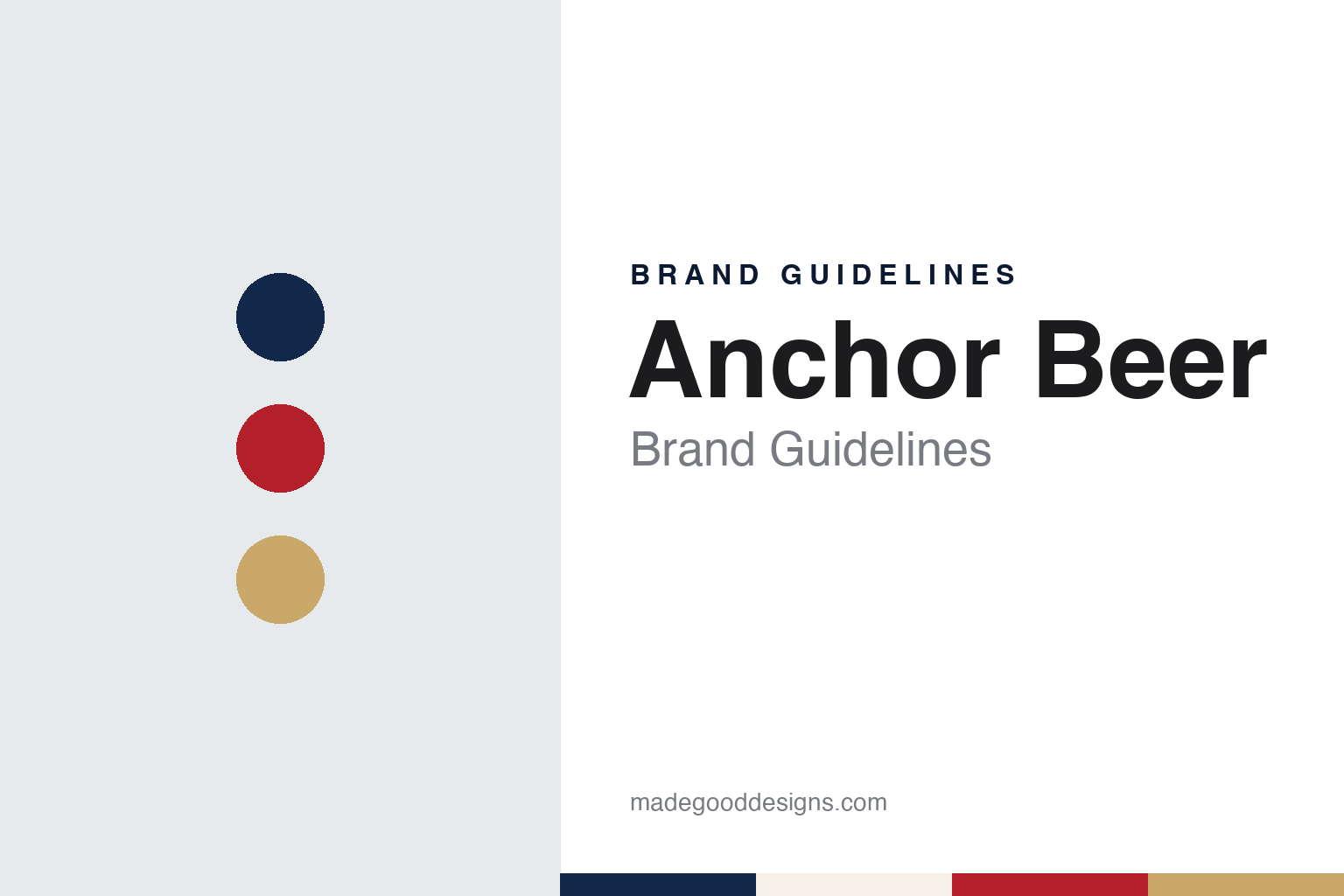
Anchor Beer Brand Guidelines
The 1933 Archipelago Brewery lager of Singapore.
Aa
Two constants: an Anchor navy, red and brass palette and an art-deco serif register. Abstract homage — not an Anchor Beer product or mark; no bottle, label or logo is reproduced.
Archipelago Brewery
A Batavia trading house, a Bremen brewer and Singapore’s second brewery.
Anchor Beer began as the lager of the Archipelago Brewery Company, a business with Dutch colonial and German roots. English Wikipedia, citing a study of capital and entrepreneurship in South-East Asia, says the company, N.V. Archipel Brouwerij Compagnie, was formed in Batavia, now Jakarta, in August 1931, with a board formed by the trading firm Geo. Wehry & Co. BiblioAsia, the National Library Board of Singapore’s magazine, said in a 2024 history of Singapore brewing that the venture was backed by Wehry of Batavia and by Beck’s of Germany, whose beers had been imported into Singapore since 1893.
Its Singapore brewery opened on Alexandra Road on 4 November 1933, according to English Wikipedia, citing the Urban Redevelopment Authority and a Rough Guide. It was Singapore’s second brewery, after the Malayan Breweries plant that made Tiger Beer, and its buildings were designed in an art-deco style by the architect Heinrich Rudolf Arbenz. BiblioAsia says the company claimed a capacity of 450,000 gallons a year.
The beer was a light pilsener made with English hops and Australian malt, the magazine says, and the earliest Anchor advertisement it cites appeared in The Straits Times on 30 July 1934. That year the brewery also arranged retail distribution with the Phoenix Aerated Water Works, a soft-drinks firm, according to a report in the Sunday Tribune of 21 January 1934.
Colour
War, seizure and a new owner.
The brewery’s German links decided its fate. According to BiblioAsia, its German managers left Singapore in 1939 as war began in Europe, the colonial government put the company up for sale in 1940, and in 1941 it was acquired by Malayan Breweries, the joint venture of Fraser & Neave and Heineken that brewed Tiger. The Urban Redevelopment Authority, cited by English Wikipedia, says the British treated the brewery as enemy property because of its German ties and seized it in 1941. Asia Pacific Breweries, Malayan Breweries’ successor, describes the 1941 purchase as the acquisition of the company that created Anchor Beer and ABC Stout.
Within months the city was occupied. During the Japanese Occupation, BiblioAsia says, the brewery was seized, renamed Kirin Beer Kaisha and reopened in 1942. With the 1941 purchase, Anchor and Tiger, the two Singapore lagers of the 1930s, had come under one owner.
The name also travelled north. In 1989 Guinness Malaysia Berhad merged with Malayan Breweries (Malaya) Sdn Bhd to form a joint venture called Guinness Anchor Berhad, according to English Wikipedia. After Heineken bought Diageo’s remaining shares in the holding company in October 2015, the Malaysian company announced that it would be renamed Heineken Malaysia Berhad from 21 April 2016. English Wikipedia, citing Heineken Malaysia’s 2018 annual report, says the company describes Anchor Smooth as the first lager brewed locally in Malaysia, in 1933, and lists it at 4 per cent.
The Archipelago name had a second life of its own. English Wikipedia says the old company was re-commissioned on 24 July 2006 as the craft-brewing arm of Asia Pacific Breweries, under the brewmaster Fal Allen, and that in May 2024 Heineken Asia Pacific announced the brewery would close at the end of that June; Channel NewsAsia reported the closure as “an end of an era” on 6 June 2024.
Typography
Design and documentation.
The seven brands in this group are all beer names from Asia: Tiger, Anchor, Beerlao, Bintang, Cobra, Kingfisher and Taiwan Beer. Asian beer brands in general sit at many different points in the trade, from names first brewed by a single local company to names that now belong to much larger brewing groups, and a single brand can be sold everywhere from a street stall to a supermarket shelf.
A beer brand’s identity is usually carried less by a single brew than by a label, a name and the occasion it promises, because the company behind the name may have changed hands, moved its brewing or grown far beyond the place where it started. That makes the questions behind each name worth asking plainly: who started it, who owns it now, and where its beer is actually brewed and packed.
Each guide separates what independent sources record from what the company says about itself — its founding story, its owners over time, where its beer is brewed and how its packaging has changed — and marks plainly what rests only on the company’s own word.
Aa
An art-deco serif — a nod to the 1933 Alexandra Road brewery. (Specimen set in DM Serif Display, a serif STAND-IN; NOT the Anchor Beer logo.)
Anchor Beer
Smooth, Strong and Heineken.
Today Anchor belongs to Heineken through Asia Pacific Breweries Singapore, which lists Anchor Smooth and Anchor Strong among its beers, alongside ABC Extra Stout. The company describes Anchor Smooth as a 3.8 per cent lager “brewed according to the Pilsen tradition and using an authentic European recipe”; that description is the company’s. Ownership followed Tiger’s: Malayan Breweries was renamed Asia Pacific Breweries in 1990, and Fraser & Neave’s shareholders approved the sale of its stake to Heineken on 28 September 2012, Channel NewsAsia reported.
Where Anchor is brewed depends on the market. Asia Pacific Breweries says it moved its Singapore brewing from Alexandra Road to Tuas in 1990. In Malaysia Anchor Smooth is part of Heineken Malaysia’s portfolio. In Cambodia, English Wikipedia says, Heineken brews Anchor and Tiger at Prek Aeng, on the edge of Phnom Penh; Cambodia Breweries Limited had operated there since 1994 before being absorbed into HEINEKEN Cambodia in 2020. Anchor Beer is a different brand from Anchor Brewing of San Francisco and from the New Zealand dairy brand Anchor.
The 1933 buildings still stand. English Wikipedia cites the Urban Redevelopment Authority’s conservation portal, which records the Alexandra Road site as the former Anchor Brewery, and illustrates the former Archipelago Brewery Company building with a 2025 photograph.
For a design guide, Anchor Beer shows how a brand can outlive its founding brewery and its rivalry, passing from a German-backed company to the owner of its competitor and carrying a nautical name into new markets. Compare Tiger Beer, the lager whose brewer bought Anchor in 1941, and Bintang Beer, the Indonesian lager that Asia Pacific Breweries acquired in 2010. For this guide we use a navy, a red and a brass with a serif, an unofficial interpretation; no product or logo is reproduced.
Explore & save
Keep Anchor Beer’s identity on hand — save it to a board in the Made Good inspiration library.
Anchor Beer identity set
Pin the Anchor navy, red and brass palette and the art-deco serif register to your own board.