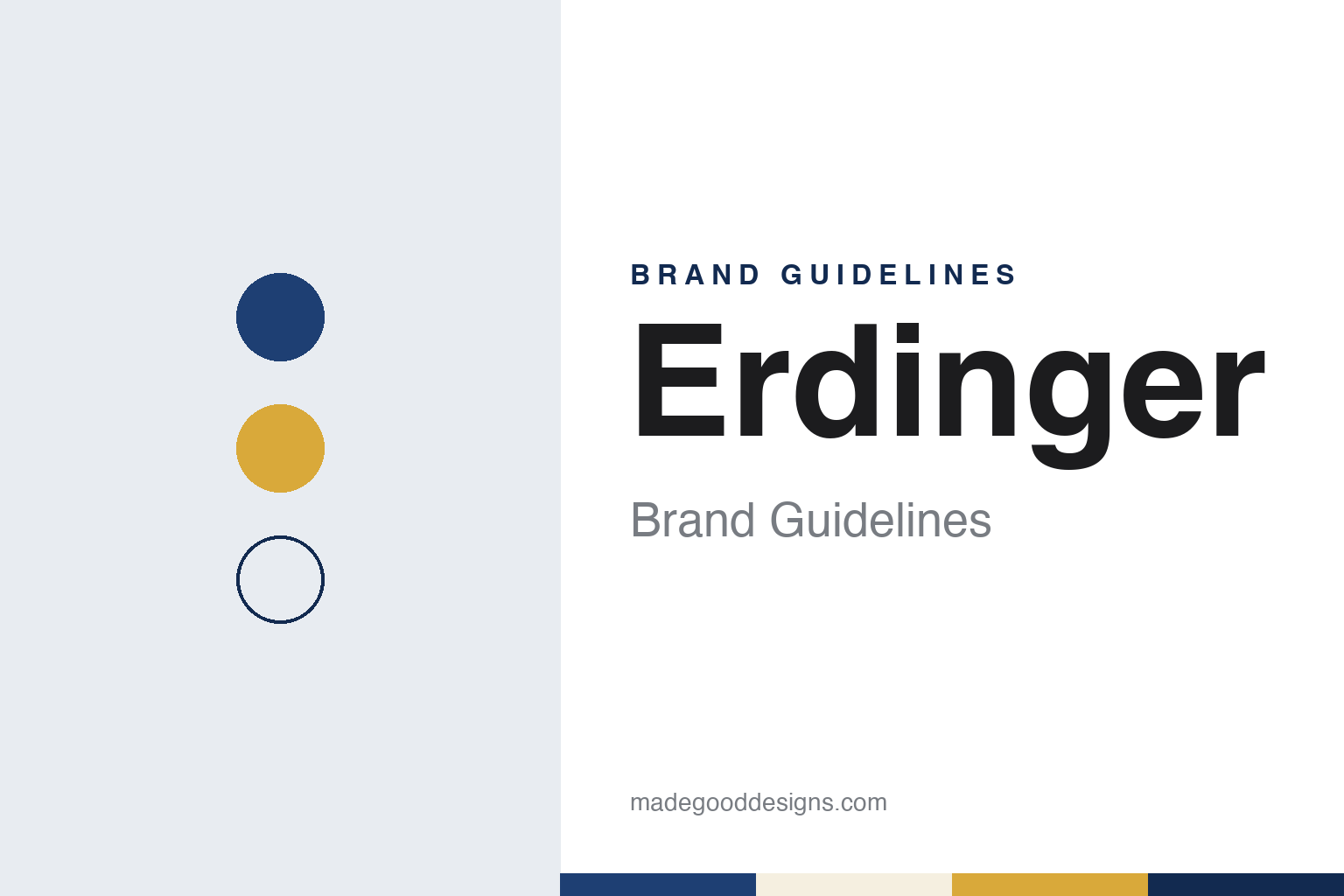
Erdinger Brand Guidelines
The Erding wheat-beer brewery built by the Brombachs.
Aa
Two constants: a Bavarian blue, wheat gold and foam cream palette and a warm book serif register. Abstract homage — not an Erdinger product or mark; no bottle, glass, label or logo is reproduced.
The white brewhouse
A town brewery, a maltster and a managing director who bought it.
Erdinger began as the Weisse Bräuhaus, the wheat-beer brewery, in Erding, north-east of Munich, in 1886, the company says. German Wikipedia, citing the Münchner Merkur, says it was owned until 1890 by Johann Kienle of Erding, then by the Stadlmaier family from Munich, and from 1930 by the maltings company F. W. Otto of Hildesheim.
The family that made the brand arrived in 1935, when the brewery’s managing director, Franz Brombach, was given the chance to buy it. The company says it was then brewing about 3,500 hectolitres of wheat beer a year. On 27 December 1949, German Wikipedia says, he gave it the name Erdinger Weißbräu. His son Werner Brombach joined in 1965, when the company says output was around 40,000 hectolitres, and set himself the goal of building a national wheat-beer brand.
At the time wheat beer was a Bavarian speciality. The company says Werner Brombach was the first brewer to sell his wheat beer beyond Bavaria in the 1960s, first in Baden-Württemberg, then in North Rhine-Westphalia and further north, and that Austria became its first export market in the 1970s. He took sole charge in 1975, and two years later, the company says, output had reached about 225,000 hectolitres and Erdinger led its market. In 1983 the brewing moved from the cramped site in the old town to a new brewhouse on the edge of Erding, and in 1990 Erdinger became the first wheat-beer brewery to pass one million hectolitres a year.
Colour
One brewery, one town, a hundred countries.
Erdinger is brewed in one place. German Wikipedia, citing the company, says Erding is its only site and that it grants no brewing licences, and the company says every beer is brewed in its Erding brewery, with water from two of its own wells about 160 metres deep and a yeast it cultivates itself. Its wheat beers are bottle-fermented, the company says. It describes itself as the largest wheat-beer brewery in the world and gives its total sales as 1.5 million hectolitres in 2020; it says it exports to 106 countries. In 2017 new bottling lines went into service that, the company says, fill up to 165,000 bottles an hour.
The range is built around the classic Erdinger Weißbier, with a darker Dunkel, the filtered Kristall, the strong dark wheat bock Pikantus, seasonal beers such as Schneeweiße and the Festweiße brewed for Erding’s autumn fair, and Erdinger Alkoholfrei. In 1991 the town’s other surviving brewery, Fischer’s Stiftungsbräu, became part of the company, German Wikipedia says, and in 2022 its brand was replaced by Erdinger Brauhaus, which the company says brought the first bottom-fermented beers, a Helles and a radler, under the Erdinger name; an alcohol-free Helles followed in 2025.
Werner Brombach later handed over the running of the brewery while remaining its sole shareholder, the Münchner Merkur reported in 2023; Stefan Kreisz chairs the management board. In 2025 he transferred his shares to the Werner Brombach family foundation, which the company’s legal notice names as shareholder. He died in August 2026 at the age of 86, the Münchner Merkur reported, adding that the foundation is committed to continuing the company as he ran it.
Typography
Design and documentation.
The seven brands in this group are all German beer brands: Beck’s, Krombacher, Warsteiner, Bitburger, Paulaner, Erdinger and Radeberger. German beer brands in general sit at many different points in the trade, from family firms that still carry a founder’s name to names that now belong to much larger brewing and drinks groups, and a single brand can be sold everywhere from a corner shop to a supermarket shelf.
A beer brand’s identity is usually carried less by a single product than by a bottle, a label, a name and the town it comes from, because the company behind the name may have changed hands, moved its production or grown far beyond the place where it started. That makes the questions behind each name worth asking plainly: who started it, who owns it now, and where its beer is actually brewed and bottled.
Each guide separates what independent sources record from what the company says about itself — its founding story, its owners over time, where its beer is brewed and how its packaging has changed — and marks plainly what rests only on the company’s own word.
Aa
A warm book serif for a brewery that sells Bavarian tradition abroad. (Specimen set in Alegreya, a serif STAND-IN; NOT the Erdinger logo.)
Erdinger
A jingle, a fan club and famous faces.
Erdinger’s advertising has kept one sound for half a century. The company says its brand campaign began in 1971, built on the ideas of an old-Bavarian speciality and high quality, and that its jingle, “Des Erdinger Weißbier, des is hoid a Pracht…”, became a classic; German Wikipedia says the tune, taken from the folk song “Mein Vatern sei Häusl,” has been used unchanged since the early 1970s. Its current slogan, German Wikipedia says, is “Erdinger Weißbier – gebraut mit Leib und Seele” (brewed with body and soul). The company writes its name in capitals, ERDINGER, throughout its own copy.
Famous faces have carried the brand. German Wikipedia, citing the Münchner Merkur, names Franz Beckenbauer as an ambassador from 2003, with the biathlete Magdalena Neuner; the company says the football coach Jürgen Klopp joined in 2019 and the footballer Thomas Müller in 2026. Erdinger founded an official fan club in 1995, which the company says has members in around 66 countries, and from 2001 it marketed Erdinger Alkoholfrei to athletes; its Team Erdinger Alkoholfrei community of triathletes and biathletes is part of that marketing. Its pack copy has also changed: German Wikipedia says that after a warning from a Baden-Württemberg consumer body in 2016, labels that had cited the Bavarian purity law “of 1516” were reworded to say only that the beer is brewed to the Bavarian purity law.
For a design guide, Erdinger shows how a single-site family brewery can turn a regional style into an export brand with one name, one jingle and a steady cast of sports stars. Compare the Paulaner brand guidelines, the Munich wheat-beer brewery, and the Ottakringer brand guidelines from Vienna; for lettering, see what font Erdinger uses. For this guide we use Bavarian blue, wheat gold and foam cream with a warm serif, an unofficial interpretation; no product or logo is reproduced.
Explore & save
Keep Erdinger’s identity on hand — save it to a board in the Made Good inspiration library.
Erdinger identity set
Pin the Erdinger Bavarian blue, wheat gold and foam cream palette and the warm book serif register to your own board.