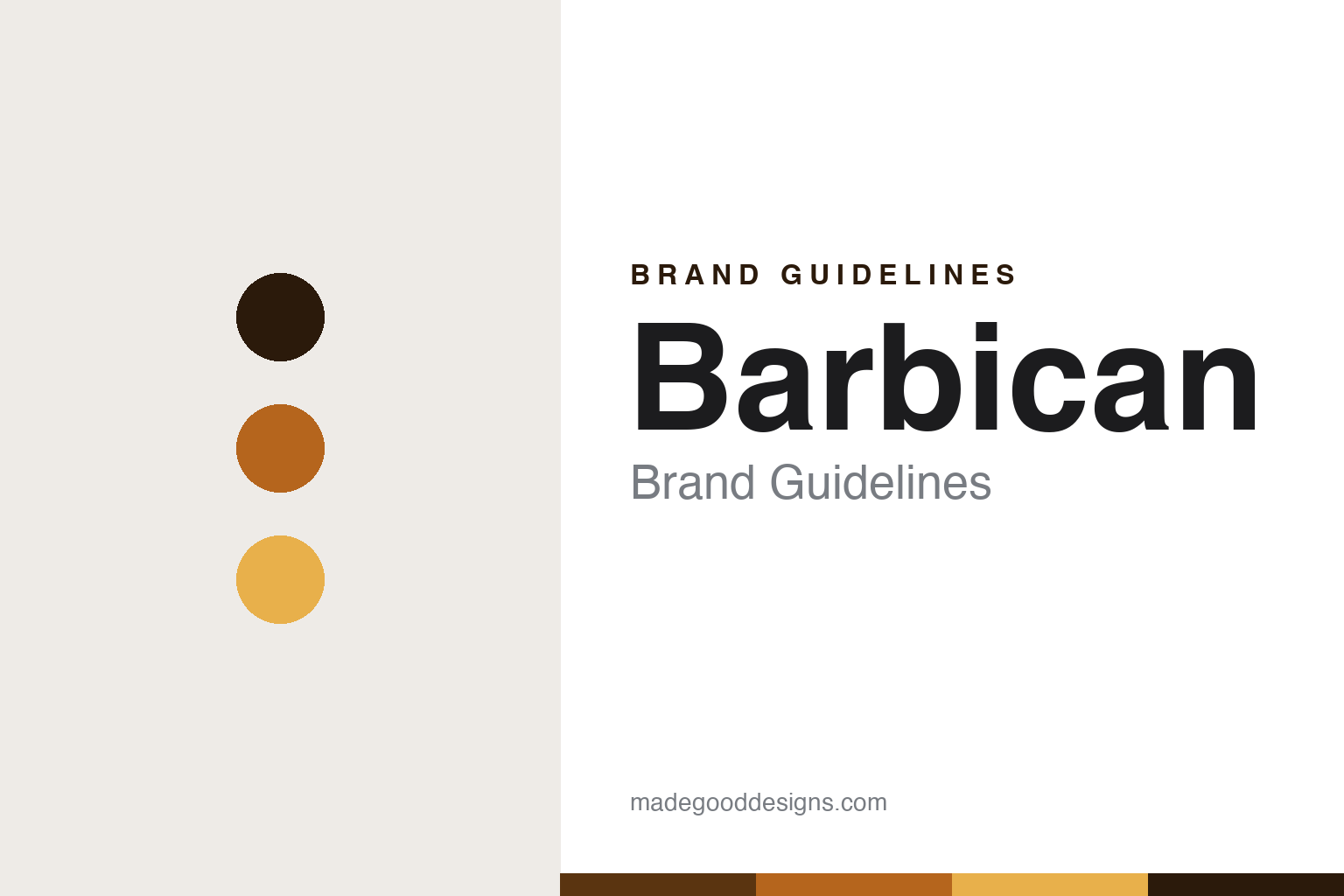
Barbican Brand Guidelines
The Bass malt drink that became a Gulf brand.
Aa
Two constants: a Barbican amber, brown and gold palette and a condensed sans register. Abstract homage — not a Barbican product or mark; no bottle, can, logo or label is reproduced.
A Bass import
A British malt drink that found its market in the Gulf.
Barbican is a non-alcoholic malt drink, and it began as a British product. It was made by Bass, the brewer founded in Burton upon Trent in 1777, and brought to the Middle East as an import by the Aujan family company, according to English Wikipedia, which cites a Bloomberg report of January 2013. It is not to be confused with the Barbican arts centre in London.
Its first maker was one of the best-known names in British brewing. By 1877 Bass had become the largest brewery in the world, and its red triangle became the UK’s first registered trade mark, English Wikipedia says, citing Celia Lury’s 2004 book Brands: The Logos of the Global Economy. In the 1960s it merged with Charrington United Breweries to form Bass Charrington, then the largest brewing company in Britain.
The date of its arrival is given three ways. Wikipedia, citing Bloomberg, says Aujan Industries began importing Barbican from Bass for sale in the Middle East in 1983. The Barbican website says the drink was “first launched by Aujan Industries in 1982” as an imported malt beverage produced by Bass in the UK, while Aujan’s own history timeline dates the launch of Barbican to 1984.
Wikipedia, citing The Power of Belonging, a 2013 marketing book by Said Aghil Baaghil, says Barbican and Moussy, a Swiss-made drink, were the first non-alcoholic malt drinks sold in the region. The same book is cited for the statement that Barbican became so well known in the Gulf states that its name came to be used generically for non-alcoholic malt drinks.
The importer was already a long-established trading house. Aujan traces itself to 1905 in Bahrain, and its timeline records a partnership with Nichols, the British maker of Vimto, in 1927, and its first beverage plant, in Dammam, Saudi Arabia, in 1979. Its first drink of its own, Rani, followed in 1982, the company says.
Colour
From import to owned brand.
Barbican passed from its British maker to Aujan in stages, and the sources date them differently. Wikipedia, citing Bloomberg, says manufacturing changes at Bass disrupted Aujan’s supplies, that Aujan bought the Barbican brand in select markets in 1999, and that it took complete control of the brand in 2010 and began making the drink at its factory in Dubai. Aujan’s timeline says it “later acquired trademark rights in 2000.” The Barbican website gives 2001 for the trademark purchase and says local production in Dubai began in 2005.
Bass itself changed hands in the same period. Its brewing business was sold to the Belgian brewer Interbrew, later part of Anheuser-Busch InBev, in June 2000, according to English Wikipedia; the Barbican website names InBev as the company from which Aujan acquired the trademark.
The next change of ownership came through Coca-Cola. In December 2011 The Coca-Cola Company agreed to buy into Aujan’s drinks business, and the deal was completed in September 2012, Wikipedia says, citing Coca-Cola’s announcements: a half share of Aujan’s brands and 49 per cent of its bottling and distribution company. Two companies were set up in 2012. Rani Refreshments holds the global brand rights to Aujan’s own brands, Rani and Barbican, and supplies concentrate, mirroring the system Coca-Cola uses with its bottlers; Aujan Coca-Cola Beverages Company, known as ACCBC, makes and distributes the drinks. Wikipedia says both are headquartered in Dubai.
Where the drink is made today is stated by the brand itself: the Barbican website says it is “currently being manufactured in Dubai, UAE and Dammam, KSA,” two cities where Aujan’s timeline records beverage plants.
Typography
African and Middle Eastern drink brands.
The seven brands in this group are all drink names from Africa and the Middle East: Tusker, Maltina, Stoney, Almaza, Kassatly, Zamzam and Barbican. African and Middle Eastern drink brands in general sit at many different points in the trade, from family firms that still carry a founder’s name to names that now belong to much larger drinks groups, and a single brand can be sold everywhere from a corner shop to a supermarket shelf.
A drink brand’s identity is usually carried less by a single product than by a bottle, a can, a name and the refreshment it promises, because the company behind the name may have changed hands, moved its production or grown far beyond the place where it started. That makes the questions behind each name worth asking plainly: who started it, who owns it now, and where its drinks are actually made and bottled.
Each guide separates what independent sources record from what the company says about itself — its founding story, its owners over time, where its drinks are made and how its packaging has changed — and marks plainly what rests only on the company’s own word.
Aa
A condensed sans — for a malt drink sold in bottles and cans. (Specimen set in Barlow Condensed, a sans STAND-IN; NOT the Barbican logo.)
Barbican
A malt drink in many flavours.
The range has grown well beyond the original malt. The Barbican website lists a plain malt drink alongside flavoured versions such as pomegranate, apple, peach and raspberry, among others, and a separate Turbo line. It says Barbican comes in glass bottles and aluminium cans, including multipacks; Wikipedia, citing the brand’s archived product page, describes 330 ml bottles and cans. Its fruit-and-malt flavour has also given it a place in the kitchen: Wikipedia, citing The National of Abu Dhabi, says it is sometimes used in desserts, mocktails and other dishes.
Its advertising voice on its own website is social rather than technical: the copy talks about friends, football and gatherings, and the company calls Barbican “a badge brand for the Young Adults” in the region. The website also says the drink has received halal certification. In Malaysia, where Wikipedia says Barbican is imported from Saudi Arabia and distributed by Coca-Cola Refreshments Malaysia, the National Fatwa Council ruled in July 2011 that malt soft drinks were halal for Muslims, the Borneo Post reported. The drink has also been tried further afield: just-drinks reported in August 2019 that Coca-Cola was piloting Barbican in India.
For a design guide, Barbican shows how a drink imported from a British brewer can become a regional brand of its own, owned and made in the Gulf, while keeping the name it arrived with. Compare Rani, the fruit drink held by the same brand company, and Maltina, the Nigerian malt drink. For this guide we use malt amber, dark roast brown and barley gold with a condensed sans, an unofficial interpretation; no product or logo is reproduced.
Explore & save
Keep Barbican’s identity on hand — save it to a board in the Made Good inspiration library.
Barbican identity set
Pin the Barbican amber, brown and gold palette and the condensed sans register to your own board.