Almaza Brand Guidelines
Lebanon’s pilsner, brewed since 1933.
Aa
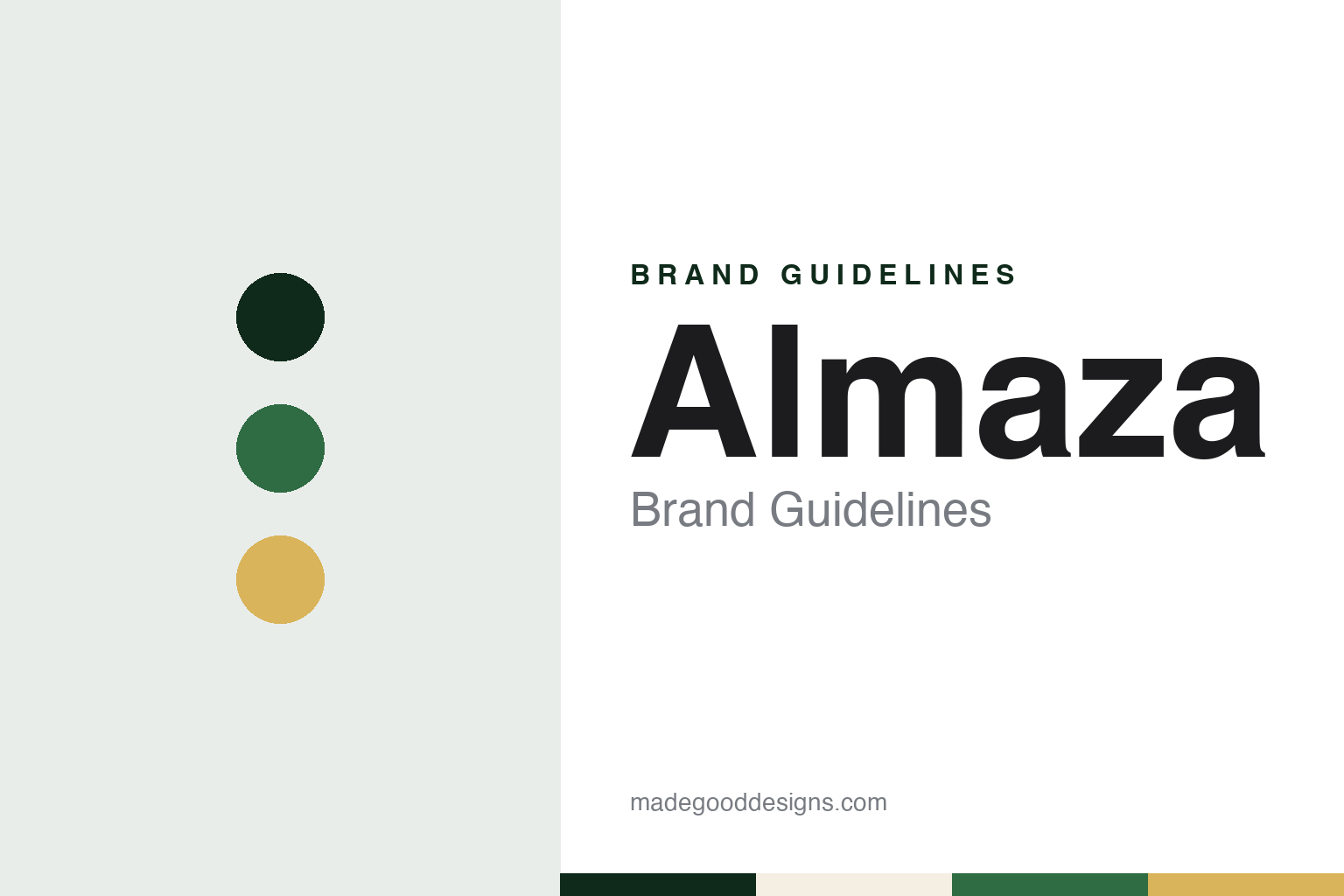
Two constants: a bottle green, pilsner gold and foam palette and a classic high-contrast serif register. Abstract homage — not an Almaza product or mark; no bottle, label or logo is reproduced.
A family brewery from 1933
Three founding families, two names and a pilsner.
Almaza is a Lebanese beer and the name of the company that brews it, Brasserie Almaza S.A.L. The brewery dates from 1933. French Wikipedia says it was founded that year by the Jabre, Comaty and Angelopoulu families, with the Jabre family — Michel, Najib and Assaad Jabre — as the principal shareholder, and that it was first called the Brasserie Franco-Libano-Syrienne. English Wikipedia gives the same original name and the same 1933 date, and says the shareholders were Lebanese, mainly the Jabre family. The two encyclopaedias differ on the place: the French article says Beirut, the English one names Bauchrieh. When the brewery changed hands in 2022, the press release reported by the Lebanese broadcaster MTV described its production site as the historic Dora brewery.
The brewery’s name changed with its owners’ ambitions. English Wikipedia says that in 1950 the company became the Brasserie et Malterie Almaza, a brewery and malt house, and that in 1960 a second generation of shareholders took over its management. It took its present name, Brasserie Almaza, after the Lebanese Civil War. The company keeps its founding year at the front of its marketing: product pages on its website in 2026 described its beers as “Proudly Lebanese since 1933.”
Almaza’s flagship is a pilsner. French Wikipedia describes the company as a Lebanese brewery and pilsner brand, and its range has grown around that core beer into lighter, darker and non-alcoholic versions.
Colour
From Amstel partner to Heineken brewery and back.
Almaza’s link to the Netherlands began decades before any change of control. French Wikipedia says that in 1960 the brewery set up a partnership with Amstel, the Amsterdam brewer, and notes that Heineken bought Amstel in 1968, which brought Almaza into Heineken’s orbit. The same article says that the Jabre owners kept the brewery going through Lebanon’s war years and modernised and restored its installations around 1990.
Majority ownership passed to Heineken in 2003, according to French Wikipedia and to the January 2022 press release carried by MTV, which said the Heineken Group had held a majority stake in the company since that year. Under Heineken, Almaza was counted among the Dutch group’s brands, and English Wikipedia still lists the brewery in its article on Heineken’s brands.
The family came back in December 2021. Philippe Jabre, a third-generation member of the founding family who founded the Geneva-based firm Jabre Capital Partners and was earlier a managing director of the British hedge fund GLG Partners, according to English Wikipedia, acquired majority ownership of Brasserie Almaza, MTV reported on 10 January 2022 and L’Orient-Le Jour reported on 17 January 2022. MTV’s report said the deal returned the company to family control almost 90 years after its founding, and quoted Jabre as saying his priority was “to ensure a sustainable and long-term future for Almaza.” Heineken remained a minority shareholder and would keep providing access to its international brands and technical expertise, the report said, while Almaza kept exclusive rights to sell and distribute Heineken’s brands in Lebanon. Naji Nacouzi was named general manager, and the existing local management and staff stayed in place.
Typography
Design and documentation.
The seven brands in this group are all drink names from Africa and the Middle East: Tusker, Maltina, Stoney, Almaza, Kassatly, Zamzam and Barbican. African and Middle Eastern drink brands in general sit at many different points in the trade, from family firms that still carry a founder’s name to names that now belong to much larger drinks groups, and a single brand can be sold everywhere from a corner shop to a supermarket shelf.
A drink brand’s identity is usually carried less by a single product than by a bottle, a can, a name and the refreshment it promises, because the company behind the name may have changed hands, moved its production or grown far beyond the place where it started. That makes the questions behind each name worth asking plainly: who started it, who owns it now, and where its drinks are actually made and bottled.
Each guide separates what independent sources record from what the company says about itself — its founding story, its owners over time, where its drinks are made and how its packaging has changed — and marks plainly what rests only on the company’s own word.
Aa
A classic high-contrast serif for a brewery that leads with its founding year. (Specimen set in Playfair Display, a serif STAND-IN; NOT the Almaza logo.)
Almaza
One brewery, several beers and a Heineken distribution business.
Brasserie Almaza makes more than one beer. At the time of the 2021 change of ownership the company’s brands were Almaza, Almaza Light, Almaza Special Dark, REX and the non-alcoholic Laziza range, MTV’s report said, and French Wikipedia lists the same names. The company’s website in 2026 grouped its products under four brands — Almaza, Heineken, Laziza and Rex — and added an unfiltered Almaza, sold with the line “Taste on, filter off.” The site describes REX as a range of beers in different intensities and Laziza as a naturally brewed, non-fermented drink offered in several flavours.
Distribution is the other half of the business. Since the 2021 deal Almaza has held the exclusive rights to sell and distribute Heineken’s brands in Lebanon, MTV reported, so the company that brews Almaza also sells Heineken in its home market. Its website sells branded merchandise alongside the beer, including collaborations with Lebanese brands on socks, notebooks and tote bags, and a separate merchandise line for each of its main beers.
French Wikipedia says the beer is exported to Canada, the United States, the United Kingdom, France, Australia and other Middle Eastern countries, and English Wikipedia names the Gulf states among its export markets. The brewery itself remains in Lebanon, and MTV’s 2022 report placed production at the Dora brewery.
For a design guide, Almaza shows how a beer can make its founding date and its country of origin the centre of its identity, holding on to “Proudly Lebanese since 1933” through eighteen years inside a Dutch group and a return to its founding family. Compare Cortas, the Lebanese jam and flower-water maker, and Kassatly, another Lebanese drinks brand. For this guide we use a bottle green, a pilsner gold and a foam white with a high-contrast serif, an unofficial interpretation; no product or logo is reproduced.
Explore & save
Keep Almaza’s identity on hand — save it to a board in the Made Good inspiration library.
Almaza identity set
Pin the Almaza bottle green, pilsner gold and foam palette and the classic high-contrast serif register to your own board.